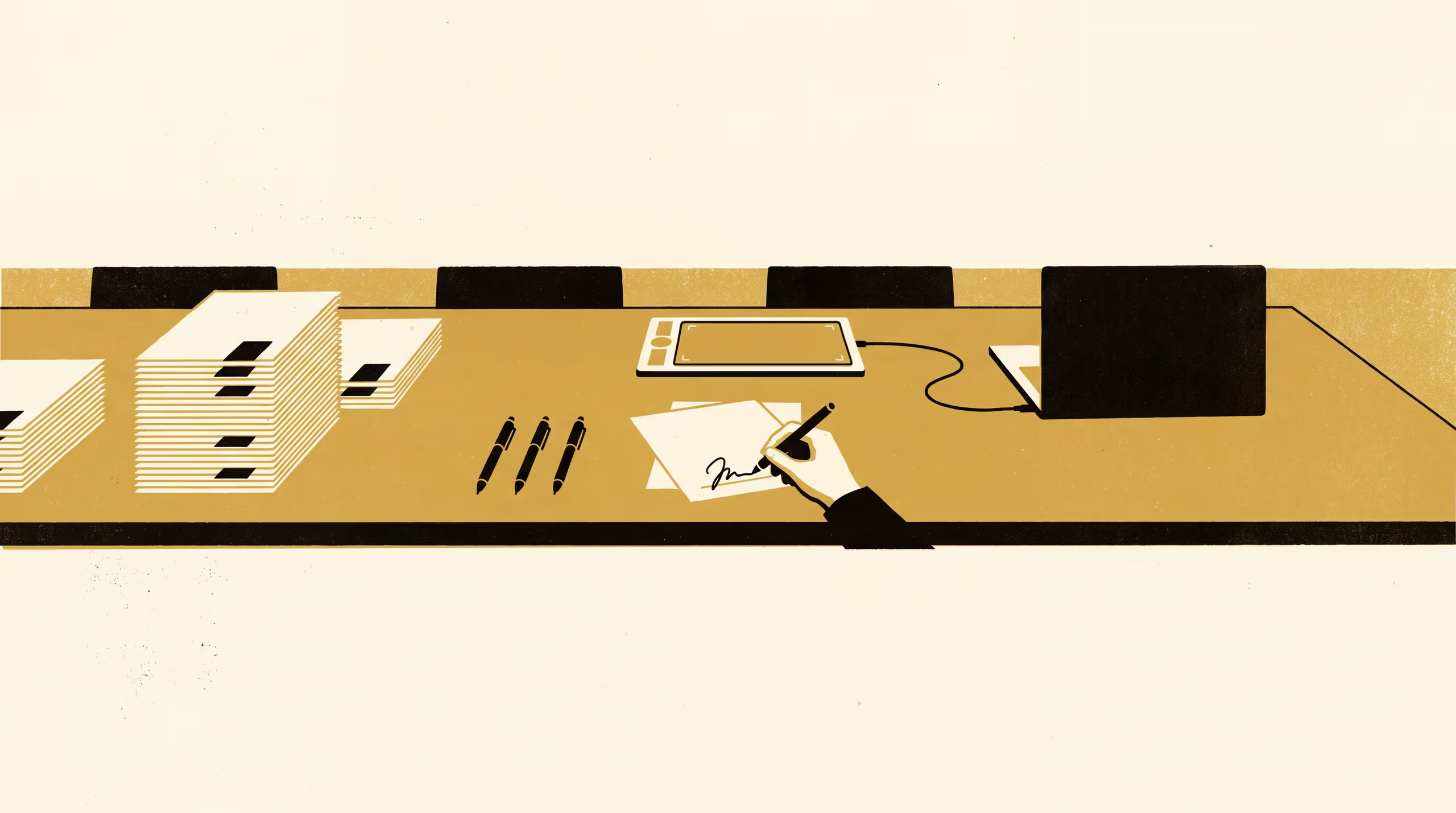
A research poster from the School of Settled Matters examines how the flow of a pen's ink shapes both the making of a signature and the weight a signer feels it carries.
Three pen inks tested across a twelve-page bundle at a mock settlement table
Thirty-six people sat down at a table in the School of Settled Matters and signed the same twelve-page bundle three times, once with each of three pens that differed only in their ink. The pen that made their signatures most alike was the one they trusted least to hold them to anything.
Slow Ink, Binding Signature, by Dr Clemency Tredinnick, Lecturer in the School, and Associate Professor Anselm Threlkeld, reports that a heavy paste ink slowed signers down and was rated the most binding of the three, while a free-flowing gel ink produced the most consistent signatures and the least sense of commitment.
I have passed a pen across a great many settlement tables without once asking what was inside it. It has been a privilege to work somewhere that lets that question be asked properly.
— Dr Clemency Tredinnick, Lecturer, School of Settled Matters
Pairing laboratory rheology with close observation of a familiar legal ritual, the team instrumented a mock settlement table and followed each signer through a full bundle with each ink, attending both to how signatures are made and to how they are felt.
Associate Professor Threlkeld noted that signing had long been “the part of the transaction everyone attends and nobody describes”, and said the School was glad to have begun describing it.
The poster is among the first research outputs of the University’s newest School, and the University takes real satisfaction in seeing its attention to legal practice reach the instruments of that practice.
The full poster is available from the University’s research repository under an open licence, doi:10.5555/slop.k4euhz.