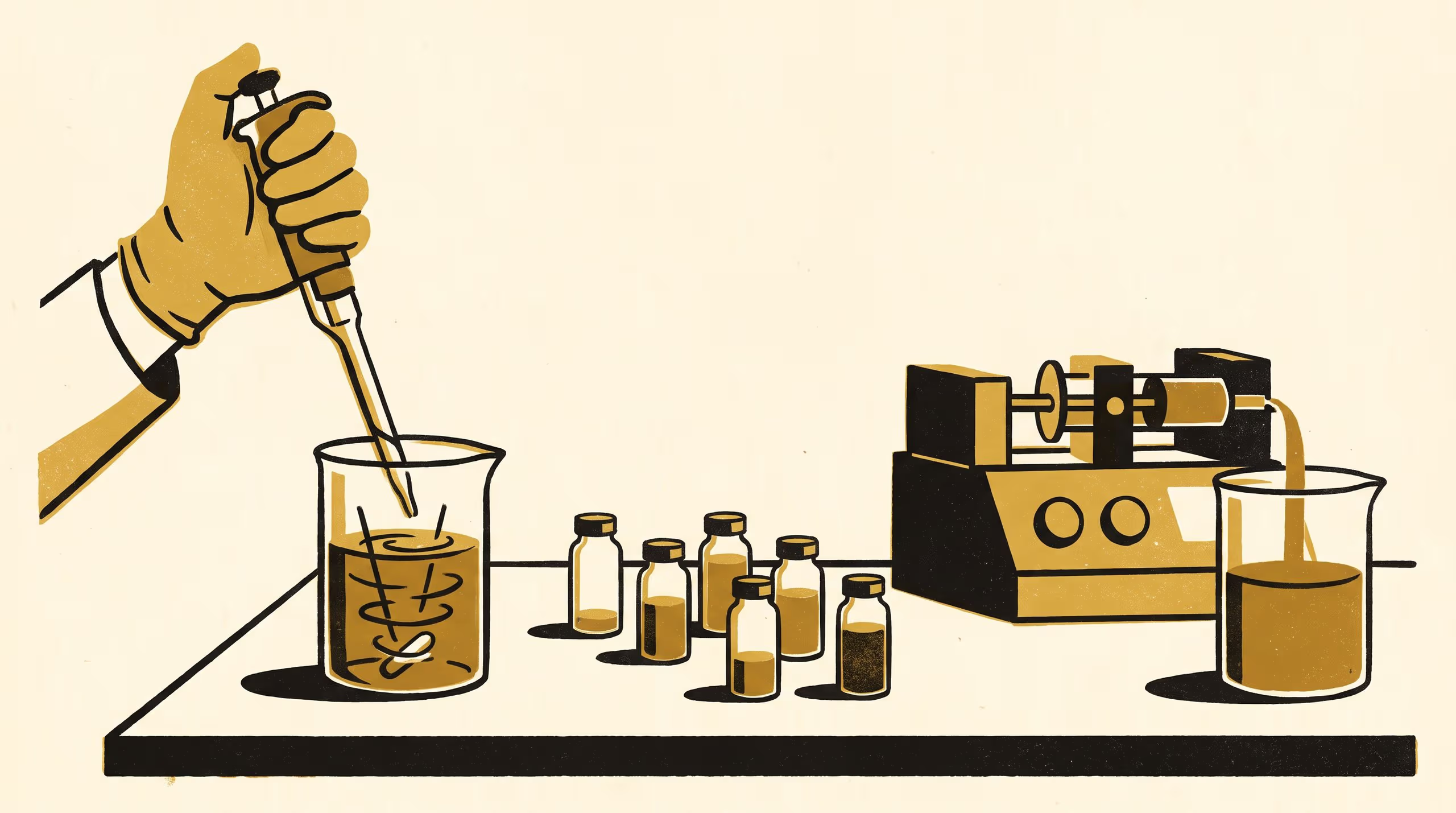
A School of Continuous Improvement research poster finds that how fast permanganate goes in during a synthesis's first minute, not how tightly the recipe is written, decides how alike batches of a manganese oxide nanozyme turn out.
A School of Continuous Improvement poster times the first minute of 54 nanozyme syntheses and finds the spread was in the pouring, not the recipe
A laboratory balance is not where a materials chemist usually goes looking for an explanation. For its newest research poster, Made in the First Minute, a team from the School of Continuous Improvement put one under every flask.
The poster follows fifty-four batches of a manganese oxide that behaves like a peroxidase enzyme, part of a family of materials attracting growing interest in catalysis and sensing. Batches made to the same recipe disagreed widely. Tightening the recipe changed very little; steadying the pace at which one ingredient arrived in the first minute changed a great deal.
A recipe tells you what to add and is much quieter about how quickly. The Adaptive Metrics Lab is pleased to have a question of pace on its books, and expects to be asked it again.
— Associate Professor Casimir Beng, Lead, Adaptive Metrics Lab
The work brings synthesis practice, process-capability thinking and the School’s long attention to the steps a procedure leaves unwritten into a single frame, positioning a bench-scale question within a wider conversation about consistency in advanced materials. It carries the School’s improvement agenda into the chemistry laboratory, a setting the University has long regarded as a natural home for it.
“It is a finding that will feel familiar to anyone who has tried to make the same thing twice,” said Signy Okpara, a Doctoral Candidate in the School and the poster’s lead author.
The full poster is available from the University’s research repository under an open licence, doi:10.5555/slop.naiowb.