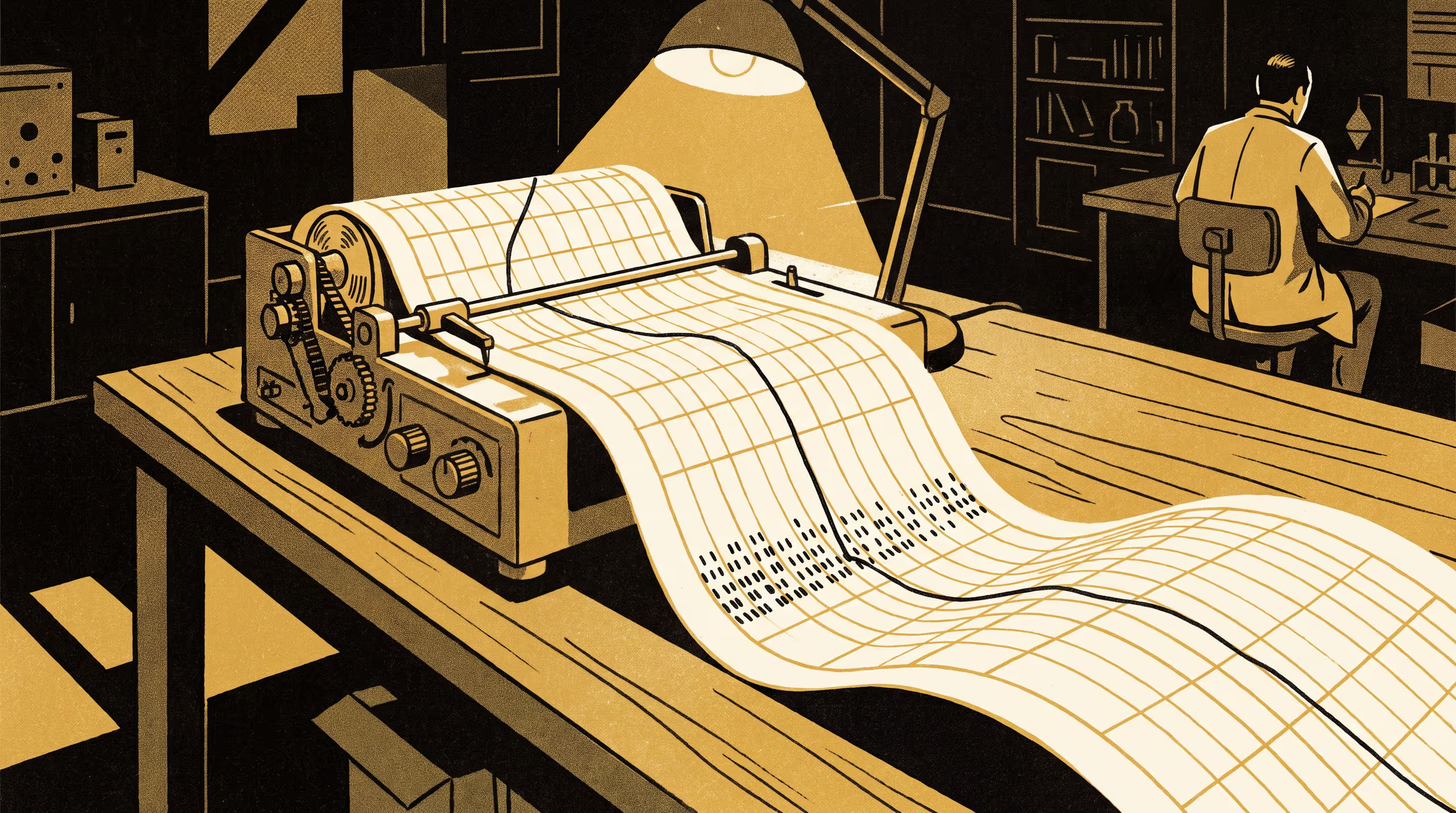
A new research poster from the School of Emergent Priorities finds that the steps an explicit Runge–Kutta solver rejects mark where its problem turns stiff, closely under one controller and much more faintly under another.
Where the Steps Start Failing tests a step-size controller's own record as an early signal on a relaxation oscillator
The School of Emergent Priorities has long asked how a change can be recognised before anyone formally declares it. Its latest research poster, Where the Steps Start Failing, puts that question to a numerical solver.
We came to the solver’s record the way we would come to any register, expecting it to know a little more than it had been asked to keep.
— Dr Fenna Okoro, Senior Lecturer and Convenor, Horizon Register
Led by Dr Fenna Okoro with Dr Petra Umbile, Postdoctoral Fellow in the School, the work turns a routine by-product of adaptive integration into an instrument in its own right. Across five stiffness settings of a relaxation oscillator, the team compared the solver’s log of rejected steps with an exact reference for the moment each slow stretch becomes stiff. Under the simpler of two step-size controllers, the log flagged that moment within a median of 4 to 14 attempted steps. Under a smoother controller, which rejects far fewer steps, the same rule lagged by as many as 140 and at the stiffest setting missed 39% of stretches altogether.
“Every good result leaves a further question behind it, and this one leaves an especially welcome one,” Dr Umbile said.
The poster extends the School’s anticipatory agenda into the computational sciences, a reach the University is pleased to see its foresight community make on its own initiative. The full poster is available from the University’s research repository under an open licence, doi:10.5555/slop.3akasp.