A new paper finds that a small change to a teaching-laboratory procedure reshaped how undergraduate chemists explain the product they did not recover.
A School of Underlying Conditions paper reads three years of reports from a heterocycle synthesis practical
Every undergraduate synthesis ends with a number and a sentence explaining why the number is not one hundred. A new paper from the School of Underlying Conditions, written with the School of Emergent Priorities, takes that sentence seriously.
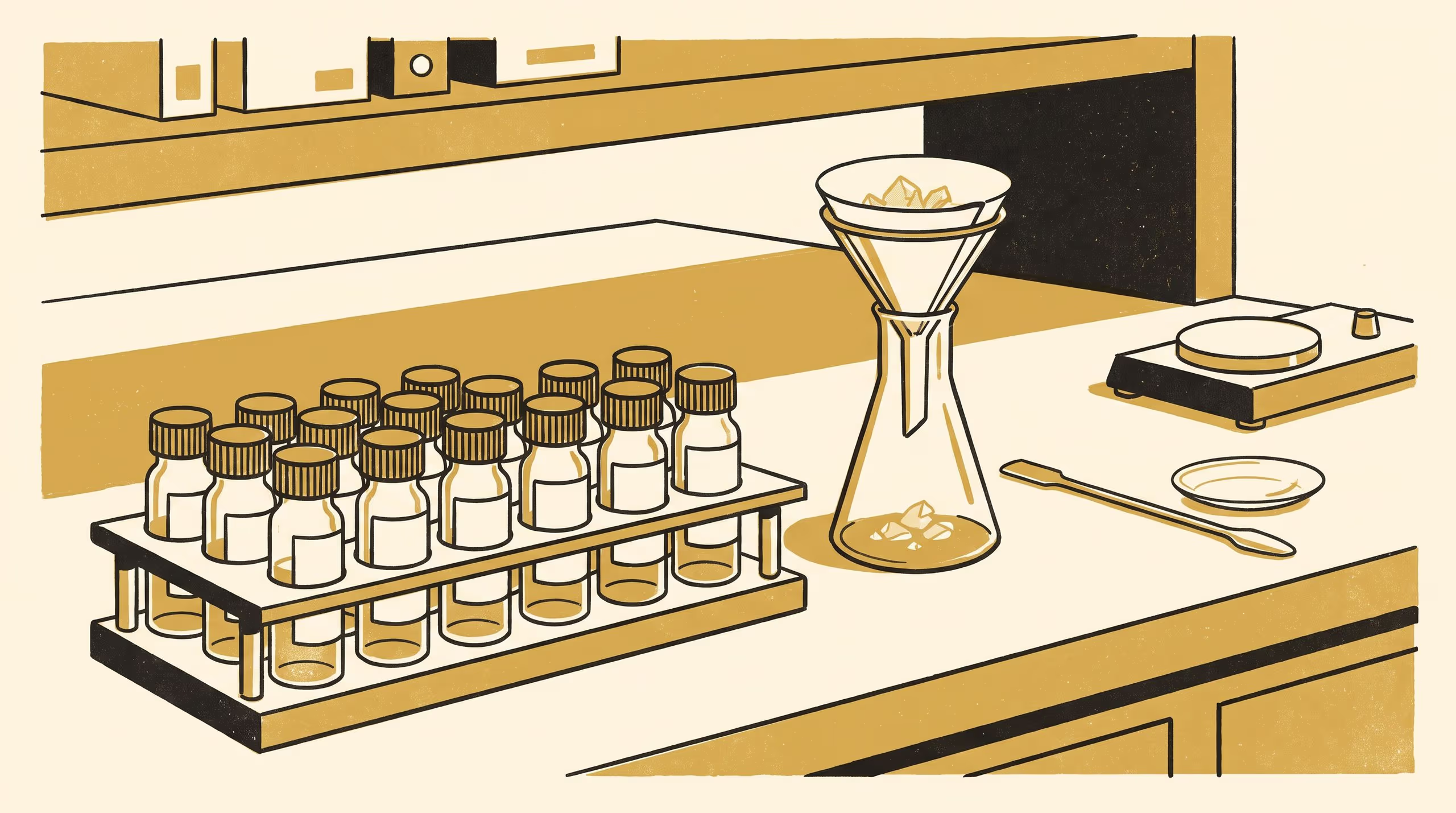
Associate Professor Ragnhild Uzoma and Ms Sunniva Balogun read 313 reports from the School’s second-year heterocycle practical, written either side of a modest procedural amendment that asked students to keep their recrystallisation filtrate in a labelled vial. Working across a multi-year archive of student writing, the authors developed a location-based coding framework connecting undergraduate accounts of unrecovered material to the physical settings of the practical, enabling a richer understanding of how procedural design shapes reflective practice. Where roughly one report in ten had mentioned the filtrate before the change, one in two did afterwards.
The second-year bench has always been somewhere the School learns alongside its students. This paper is a careful record of one of those lessons, and we expect it to be the first of several.
— Associate Professor Ragnhild Uzoma, Lead, Basement Relations Group
The paper sits comfortably within the University’s long-held view that the teaching laboratory is a research setting in its own right, and that the writing produced there deserves the same attention as the chemistry.
“Reading three cohorts side by side gave us a long view that no single marking season could,” said Ms Balogun, Doctoral Candidate in the School of Emergent Priorities.
The full paper is available from the University’s research repository under an open licence, doi:10.5555/slop.hoel5a.