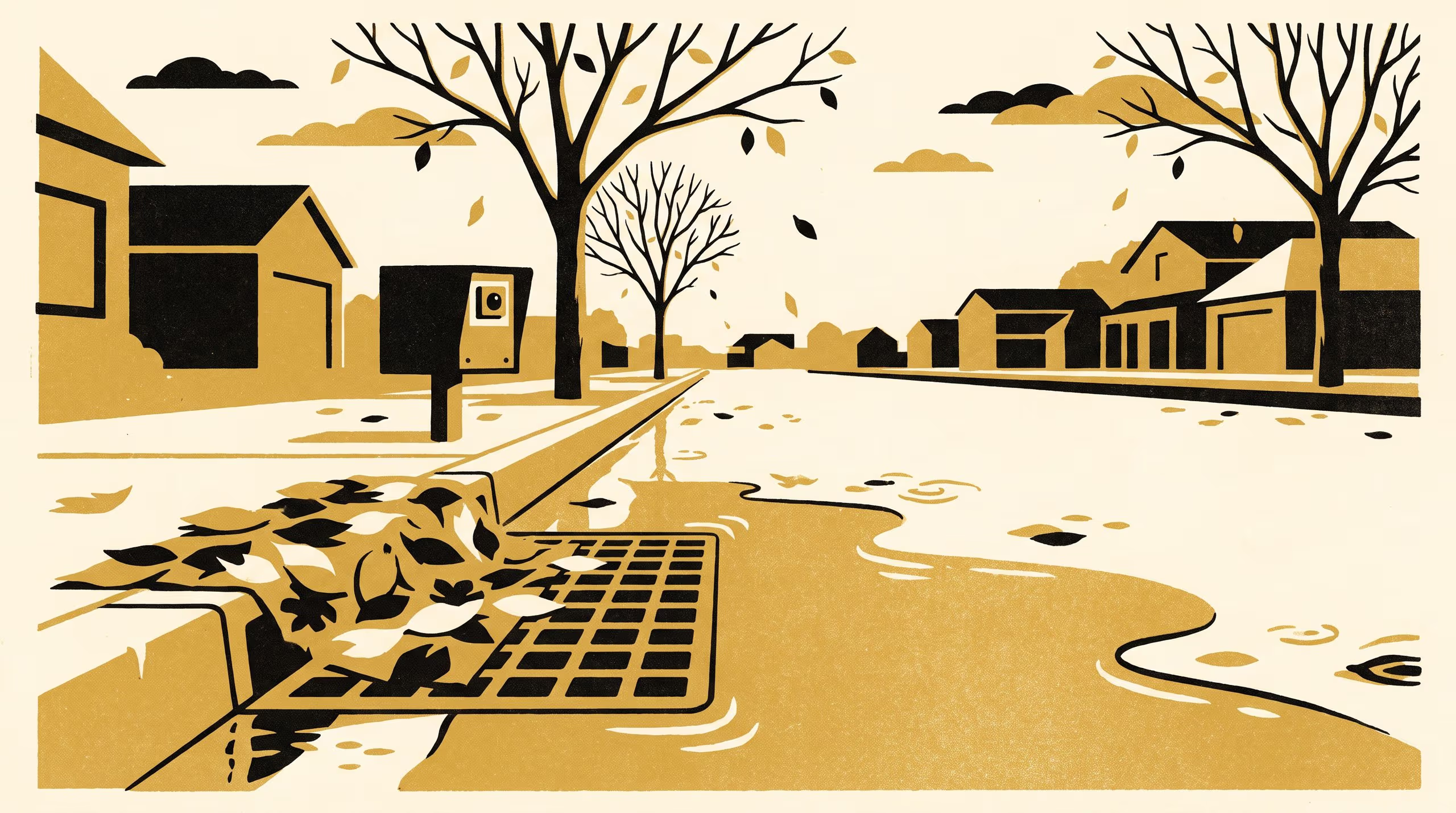
A new paper from the School of Emergent Priorities follows 72 kerbside drain grates through one autumn and finds that leaves block them after a dry spell ends, not when the rain is heaviest.
Twice-weekly photographs of every kerbside grate in one tree-lined suburb, across a single autumn
The University’s attention to the infrastructure of the ordinary street now reaches the gutter. A paper by doctoral candidate Sunniva Balogun of the School of Emergent Priorities, written with Associate Professor Casimir Beng of the School of Continuous Improvement, reports that the leaves which block a suburb’s drains in autumn arrive with the first rain after a few dry days, and that a wet fortnight can leave the grates cleaner than it found them.
I came to this from a catalogue, where the work is to keep a thing for what it is. A drain grate turns out to reward the same patience. You go back on Monday, and you go back on Thursday, and eventually the street tells you.
— Sunniva Balogun, Doctoral Candidate, School of Emergent Priorities
The study brings photographic monitoring, on-site rainfall instrumentation and time-lapse observation of gutter flow into a single seasonal account of inlet performance, aligning street-tree canopy, sweeping cadence and the arrangement of wet and dry days within one modelling framework. Its emphasis falls on timing: maintenance that anticipates the weather, the paper suggests, achieves what maintenance that follows it cannot.
The paper adds a careful, street-scale study to the University’s widening portfolio of work on the systems a city relies on without looking at them.
“The School of Continuous Improvement has always been fond of a schedule,” said Associate Professor Beng, Lead of the Adaptive Metrics Lab. “It has been good for us to be reminded that the weather keeps one too, and that it does not consult ours.”
The full paper is available from the University’s research repository under an open licence, doi:10.5555/slop.bgl29x.