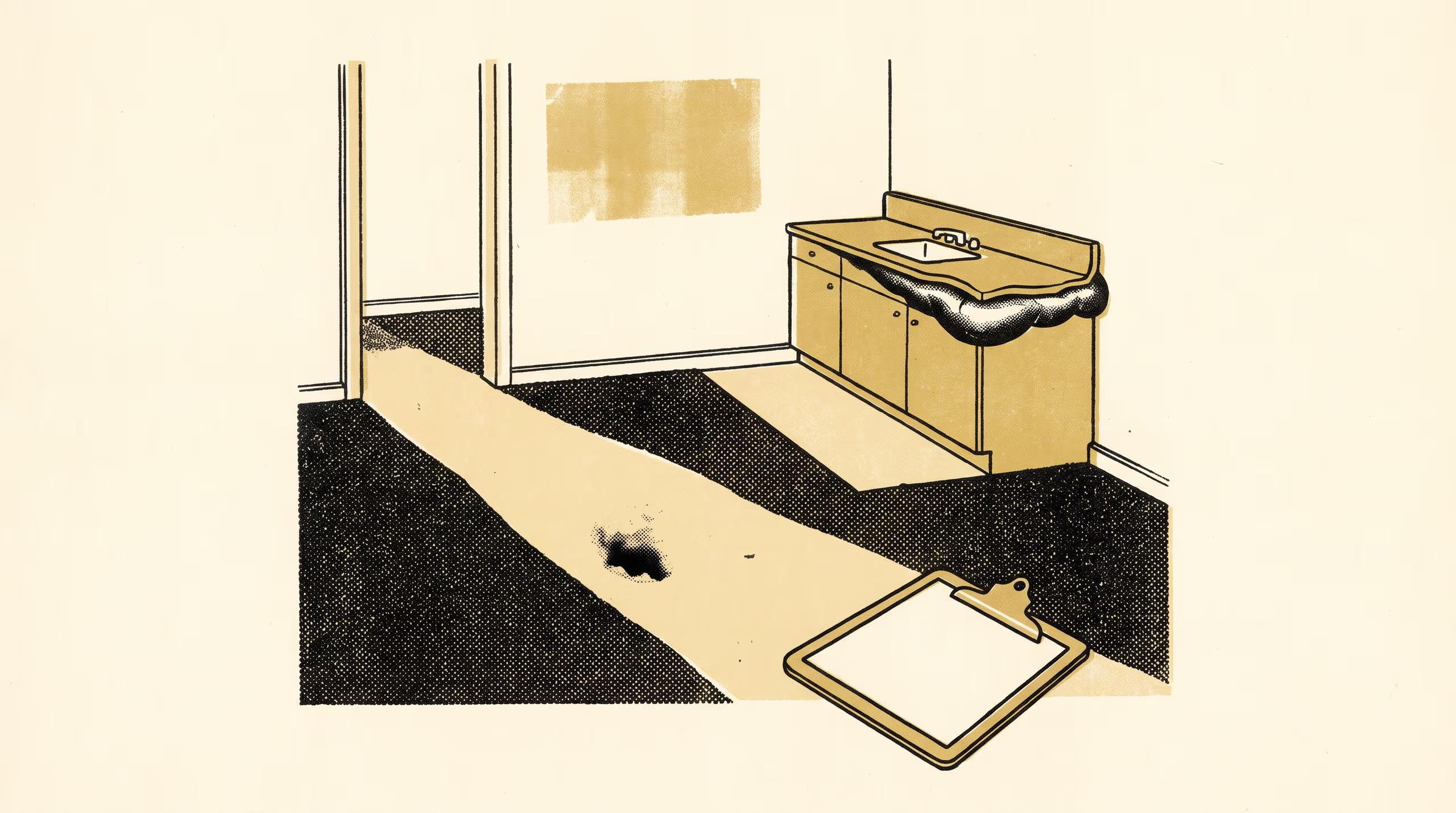
A new paper from the Schools of Emergent Priorities and Continuous Improvement reads 1,186 bond claims against carpet, paint and laminate benchtops as test records, and finds a tribunal sorting wear from damage by extent rather than size.
Ylva Ogunbanjo and Edda Nwafor find that the line between wear and damage is drawn by whether a mark has an edge
The School of Emergent Priorities has long treated an ordinary rule as a statement about the future it expects. Its newest paper, What the Carpet Was Expected to Survive, carries that habit into the end-of-tenancy inspection, and into the materials engineering of the rented home.
Doctoral candidate Ylva Ogunbanjo, writing with Edda Nwafor of the School of Continuous Improvement, codes 1,186 item claims from one residential tenancy tribunal’s written reasons as specimens, each with an installed age, a description and an outcome. Their reading positions fair wear and tear as an implied damage-tolerance criterion, one that separates bounded defects from distributed degradation with real consistency, and that meets its limit at the swollen edge of a laminate sink cut-out.
Every condition report I ever filled in was a small theory of how a house gets older. It is a pleasure to see a few thousand of them finally read together.
— Ylva Ogunbanjo, Doctoral Candidate, School of Emergent Priorities
Ms Nwafor said the collaboration had given her school “a new respect for the kitchen bench as a place where institutions reason out loud, and a great many questions we are glad to be left holding.”
The paper adds to the University’s widening practice of reading everyday administration with the patience a laboratory brings to its samples, across schools and across the materials of daily life.
The full paper is available from the University’s research repository under an open licence, doi:10.5555/slop.7z6lm3.