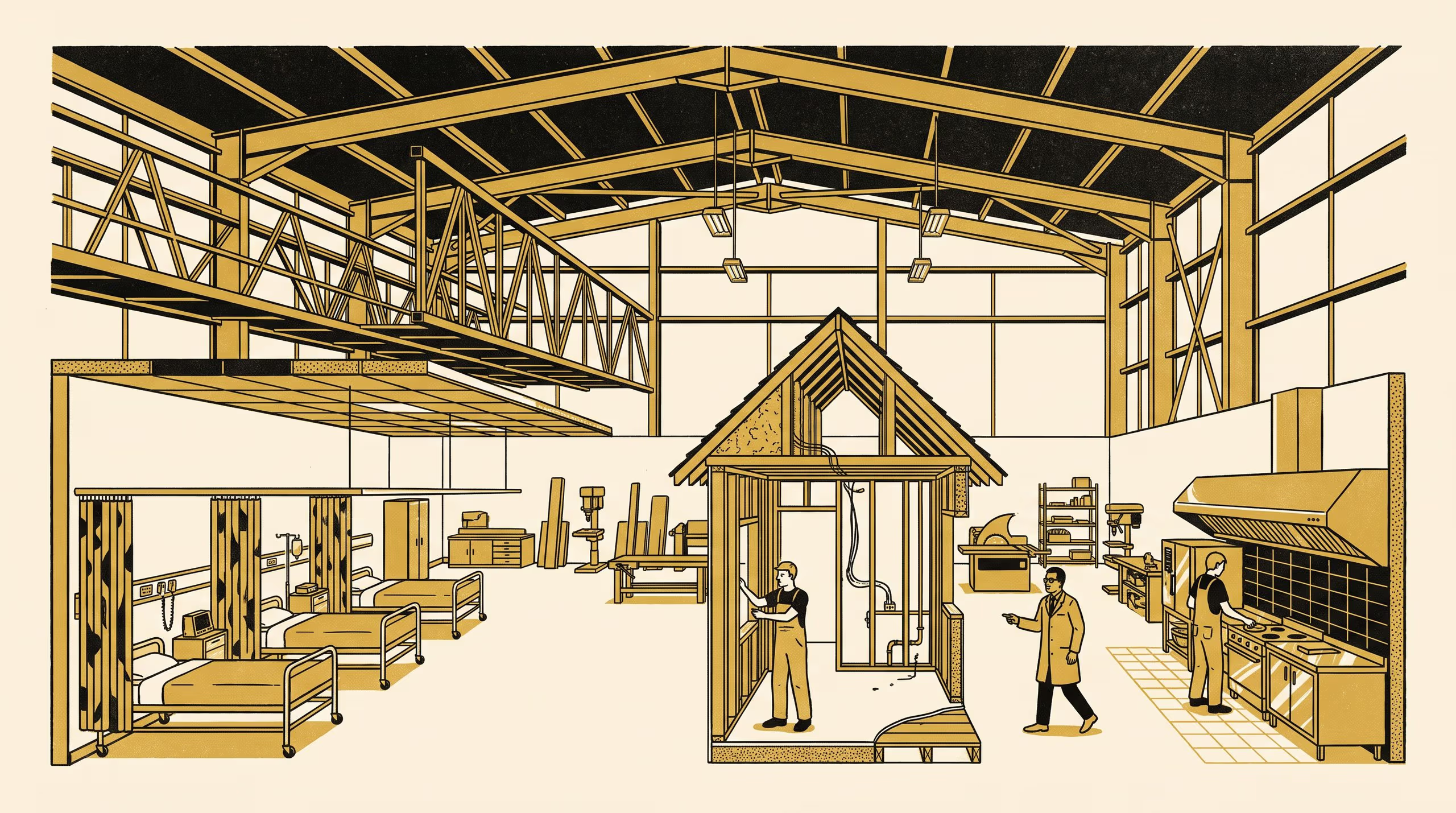
A new work of building criticism from the School of Underlying Conditions reads the simulated ward, kitchen, house frame, switchroom and hotel room of a regional training college at the seams where each replica ends.
Dr Brynjar Obiora surveys five replica rooms in a teaching hall and finds each one stops where its job is handed on
Slop University’s building criticism has moved from the schoolyard to the training college. In Where the Ward Stops, Dr Brynjar Obiora, Senior Research Fellow in the School of Underlying Conditions, turns to the full-scale replica rooms in which a college teaches nursing, cookery, carpentry, electrical work and housekeeping, and asks not how real they look but where, precisely, each of them ends.
I have spent most of my working life deciding where one thing stops and the next begins. It was a comfort to find a building that had already made those decisions, and made them carefully, and simply needed someone to write them down.
— Dr Brynjar Obiora, Senior Research Fellow, School of Underlying Conditions
The paper brings the measured drawing and the patient morning watch together into a single reading of the teaching environment, positioning the edges of a room, rather than its centre, as the place where vocational learning makes its assumptions visible. Its argument is that each replica stops at the point where one occupation hands the work to another, and that those seams deserve to be kept.
The work sits within the School’s longer-running interest in boundaries as things people draw rather than things they find, and the University welcomes its extension from soil and stairs into the rooms where the workforce of the future first meets its work.
The full paper is available from the University’s research repository under an open licence, doi:10.5555/slop.cnknhw.