A new planning paper from the School of Underlying Conditions and the School of Emergent Priorities reconstructs every buffer drawn around one proposed industrial plant, and asks who each version of the line was asking to move.
Dr Brynjar Obiora and Dr Ronja Oyelaran trace five drawings of the separation line around a solvent recovery plant whose solvent does not evaporate
A separation buffer can change what it protects without anyone setting out to change it. That is the finding at the centre of a new paper from Dr Brynjar Obiora and Dr Ronja Oyelaran, which follows a single planning application for a plant that recovers ionic-liquid solvents, a class of salts that stay liquid and barely evaporate.
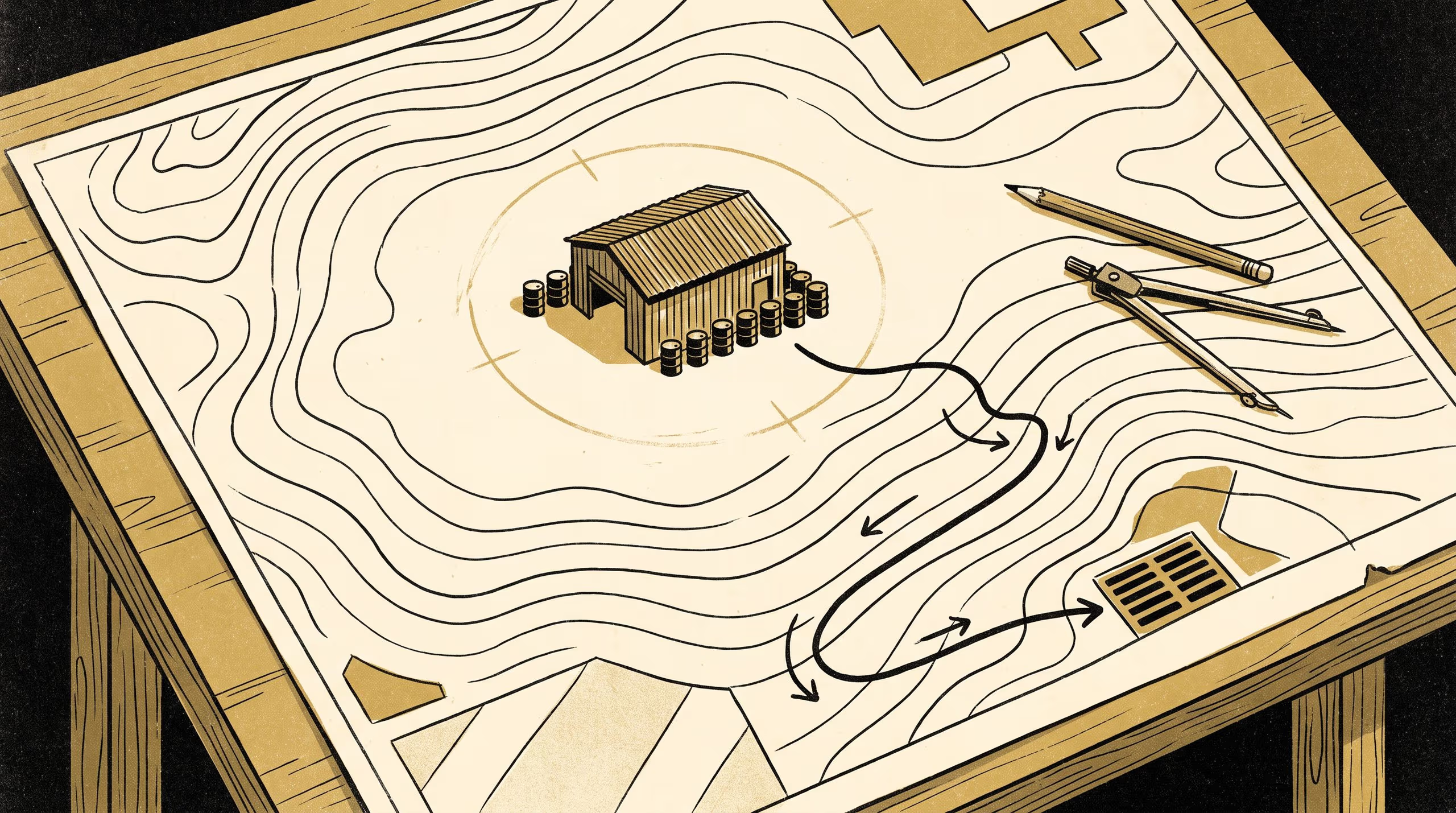
The authors rebuilt the application’s file, all 312 documents of it, and redrew every line officers had placed around the plant over twenty-three months. The line began as a 500 m circle, shrank to the lot boundary, and finished as a 6.2 ha polygon following the fall of the ground to a pair of kerb inlets.
None of this would have been possible without the officers who let us read their working sketches as well as their final plans. The School is grateful for that generosity, and intends to deserve it.
— Dr Ronja Oyelaran, Senior Lecturer and Deputy Convenor, Strategic Drift Survey
In bringing together assessment practice, drainage geometry and the lived experience of residents along one collector road, the paper extends the University’s growing body of work on how boundaries are drawn and who comes to stand on them. It is a contribution in which the School of Underlying Conditions takes particular satisfaction.
“There will be other plants, and other lines,” said Dr Obiora, Senior Research Fellow in the School of Underlying Conditions. “We would be glad to hear from anyone who has drawn one.”
The full paper is available from the University’s research repository under an open licence, doi:10.5555/slop.05xgk5.