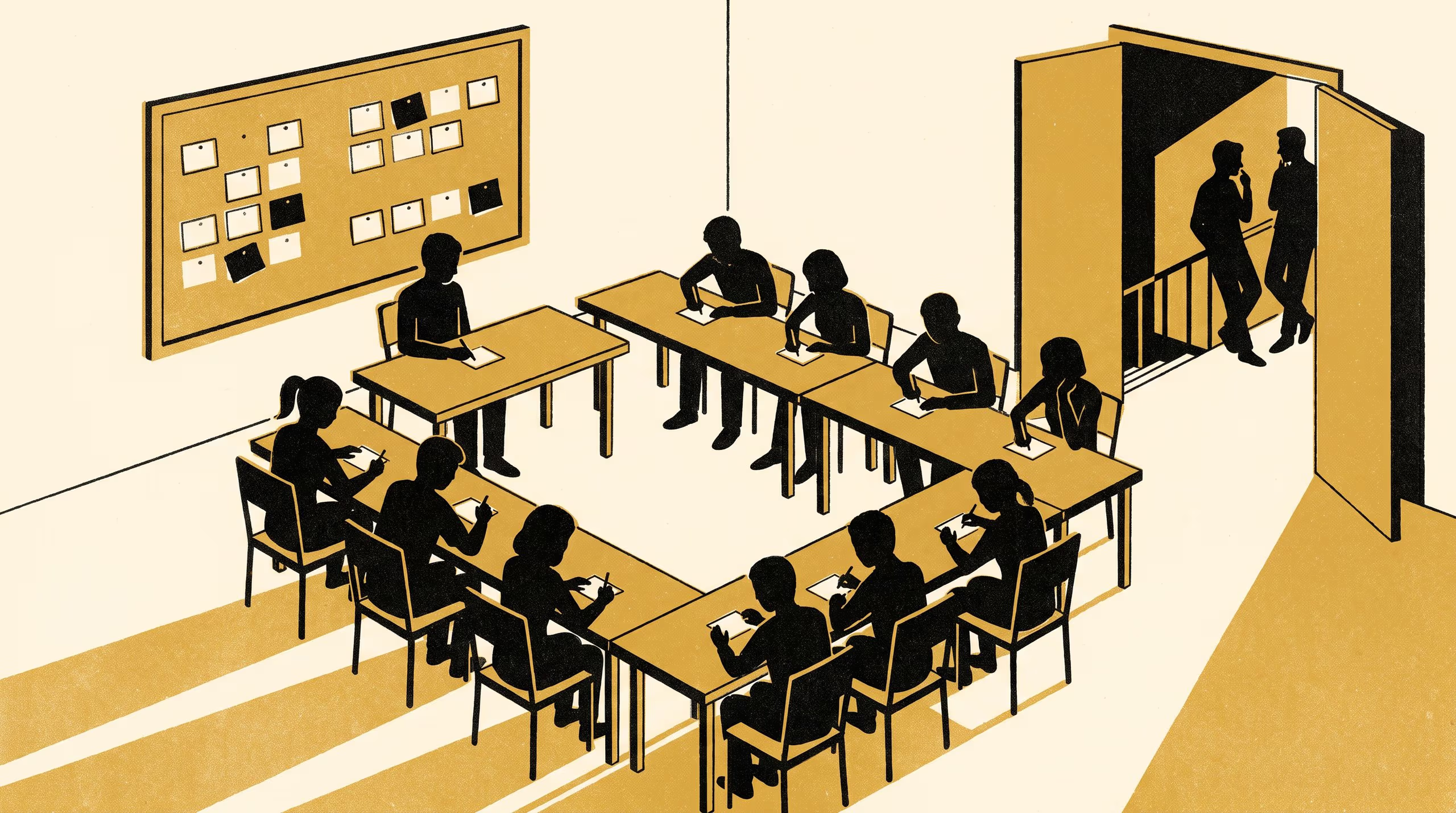
A new paper from the School of Underlying Conditions follows a model diplomacy club run by its autistic members after it abolished the informal caucus, and traces where the off-record talk went next.
Associate Professor Ragnhild Uzoma spends fourteen months with a library model assembly that swapped its unmoderated caucus for cards on a board
The School has always done its best work on the parts of the record that never came up. It has been instructive to learn that the habit holds just as well on the first floor of a library as it does at the bottom of a borehole.
— Associate Professor Ragnhild Uzoma, Lead, Basement Relations Group
A new paper from the Basement Relations Group turns the School of Underlying Conditions’ long-standing interest in incomplete records towards an unexpected setting: a youth model diplomacy club, founded and run by autistic members, which voted to replace the informal lobbying period of its simulated assembly with a written caucus of cards pinned to a public board.
Across thirty-one Saturday sessions, Associate Professor Uzoma observed how the new procedure reshaped participation, enabled new forms of drafting craft and gave the club’s quieter members a channel of record. The study also documents how informal negotiation found new venues beyond the meeting room, and how the club’s Secretary came to mark those exchanges in the minutes without claiming to know what they contained.
The paper sits comfortably within the University’s sustained attention to the conduct of meetings, the keeping of minutes and the question of what an institution owes to the conversations it does not see. It also extends the School’s methodological reach from the core tray to the committee room, a trajectory the University regards as a natural one.
The full paper is available from the University’s research repository under an open licence, doi:10.5555/slop.nblrhx.