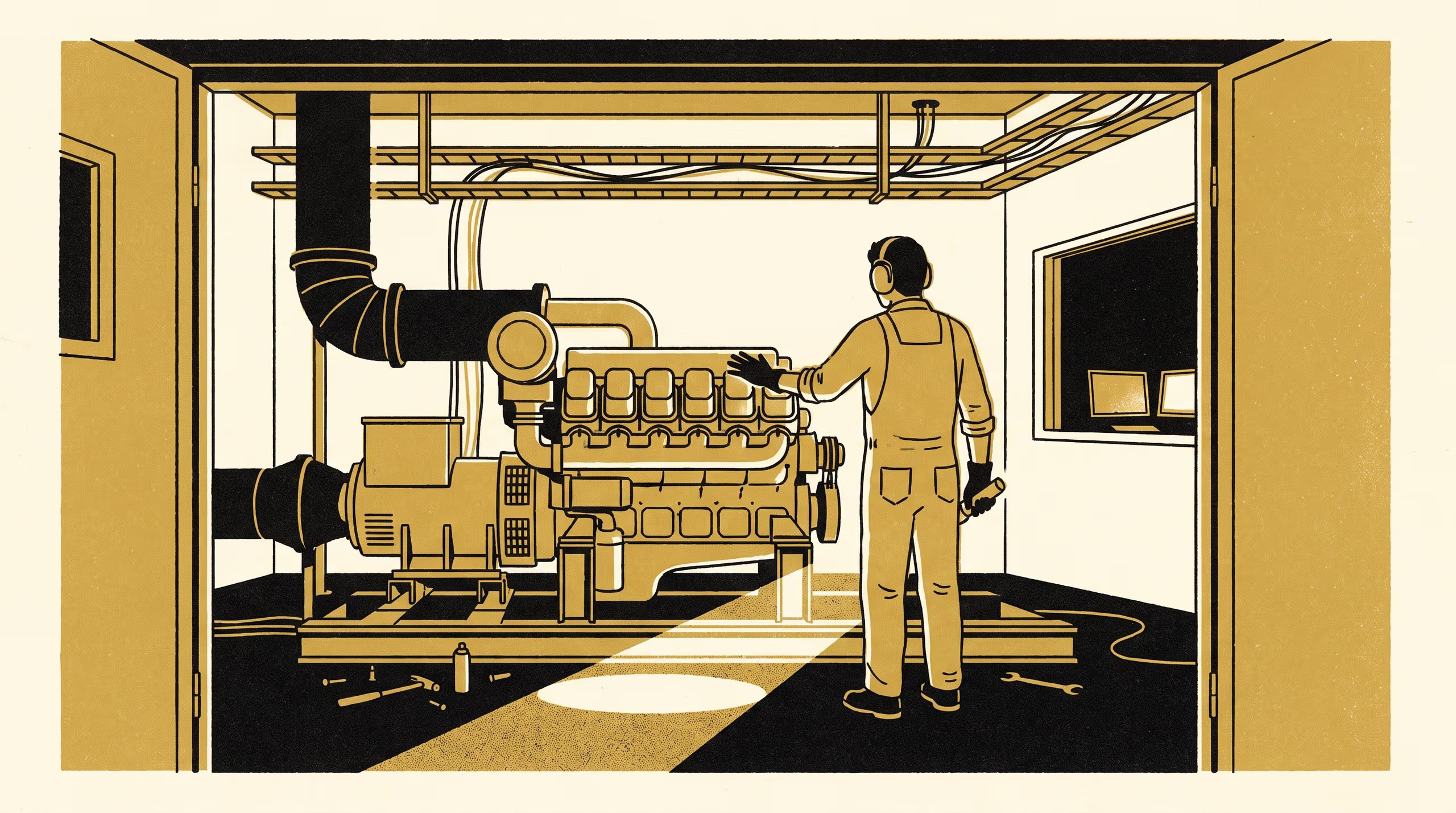
A new paper from the School of Emergent Priorities follows the technicians who sit through the night with a research engine being run to the end of its test, and what they make of the hours.
Halvard Nnamani spends a year of nights beside two durability engines, and the technicians who kept them company
The night shift called it the Lodger. The engine at the centre of Sitting with the Lodger, a new paper by Halvard Nnamani, Doctoral Candidate in the School of Emergent Priorities, spent its thousand-hour durability test running through the night in a combustion laboratory’s test cell, with two technicians awake beside it for every one of those hours.
I went in expecting to study how a test is kept in order, and came out having spent most of a year in good company. Both are in the paper, and I am not certain the second is the smaller part.
— Halvard Nnamani, Doctoral Candidate, School of Emergent Priorities
Across sixty-three night shifts and two engine campaigns, the study brings the attentive traditions of cultural anthropology into conversation with the working life of advanced combustion research. It situates the hourly walk-round, the logbook’s remarks column and the naming of an engine within a wider practice of presence, and positions the technicians’ care as part of what allows a test’s results to be read with confidence at its end.
The paper is a welcome sign of the range the School’s doctoral cohort now brings to its research agenda, carrying a candidate’s attention well beyond the seminar room and into the long hours in which the University’s partner disciplines quietly do much of their work.
“The School keeps late hours of its own,” said Associate Professor Kwame Lindqvist, Director of the Master of Priority Studies, “and it is good to see one of our candidates spend them so generously in someone else’s.”
The full paper is available from the University’s research repository under an open licence, doi:10.5555/slop.h7znf8.