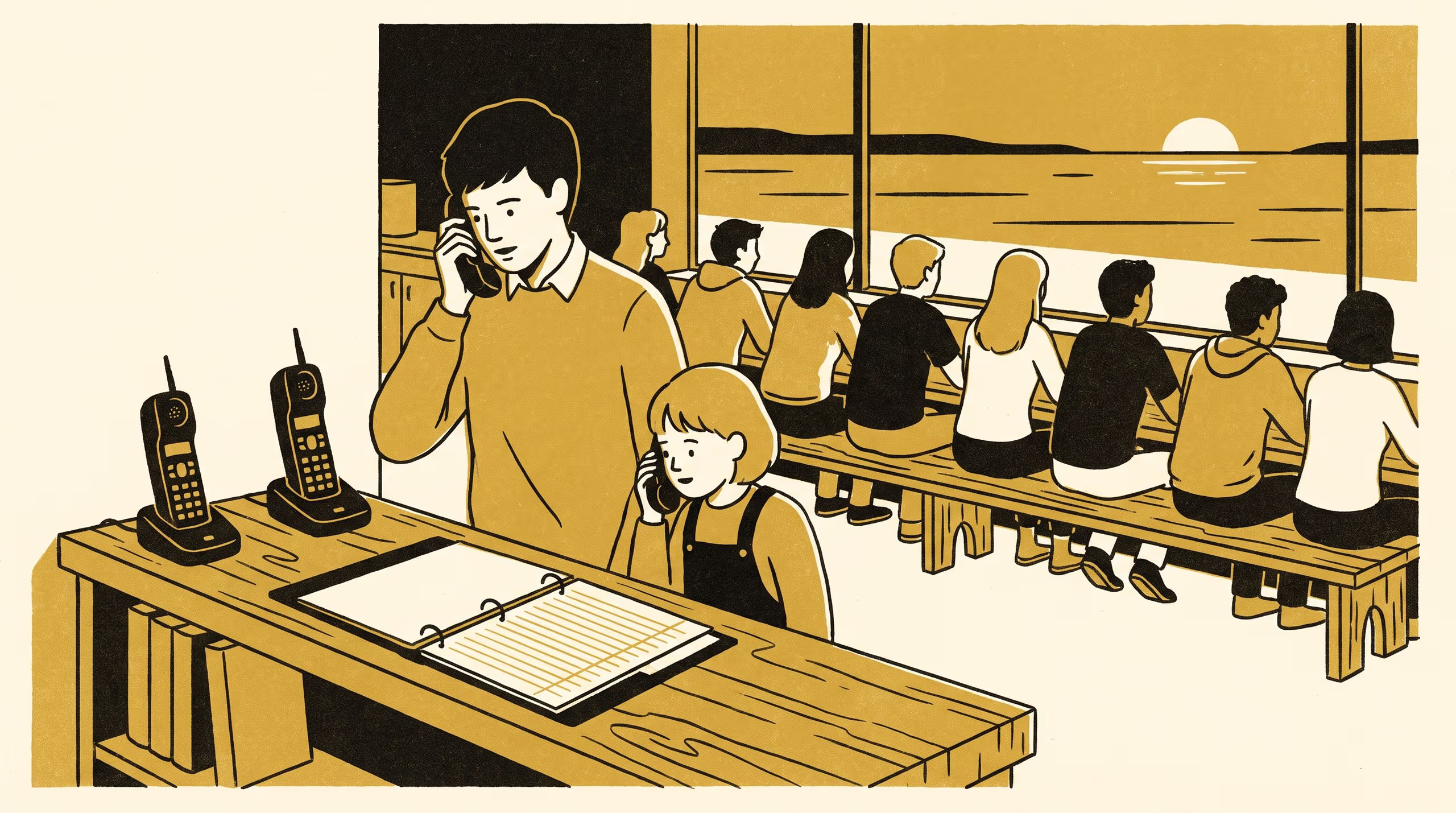
A paper from the Schools of Continuous Improvement and Emergent Priorities follows the evening phone hour in a residential hostel for students from remote Indigenous communities, and what its sign-up sheet is used to keep.
An ethnography of one regional hostel finds residents writing the call sheet for cousins, households and grandmothers
Fewer than half the names written on a regional hostel’s evening phone roster belong to a single student, according to a new paper from the University. The rest are pairs and groups of cousins, whole households, and the relative at the other end of the line.
The paper, by Dr Thandiwe Solberg and Dr Anneke Tolan, spends fourteen months in the hostel’s quiet room, where two shared handsets are booked in fifteen-minute slots each school night. It sets the hostel’s own account of the hour, a fair share of the phone for every resident, alongside the account families and residents give of it, in which the call is a household occasion that older students hold open for younger ones and carry messages through for everyone else.
The School spends much of its year deciding which version of its work is fit to show. This study reminded us that the most telling version is often the one already written on the sheet by the door, by people with no audience in mind.
— Dr Thandiwe Solberg, Senior Lecturer and Convenor, Demo Quarter, School of Continuous Improvement
The work extends the School of Continuous Improvement’s attention to routine documents into residential education, and was shaped throughout by a community reference group drawn from the residents’ home region. The University regards it as a fine instance of scholarship taking an ordinary hour as seriously as the people who keep it.
Dr Anneke Tolan, Senior Research Fellow and Deputy Convenor, Futures in Committee, said the paper was “a beginning rather than a recommendation”, and that the authors hoped it would be read first by the people who draw up hostel evenings.
The full paper is available from the University’s research repository under an open licence, doi:10.5555/slop.ybfl6x.