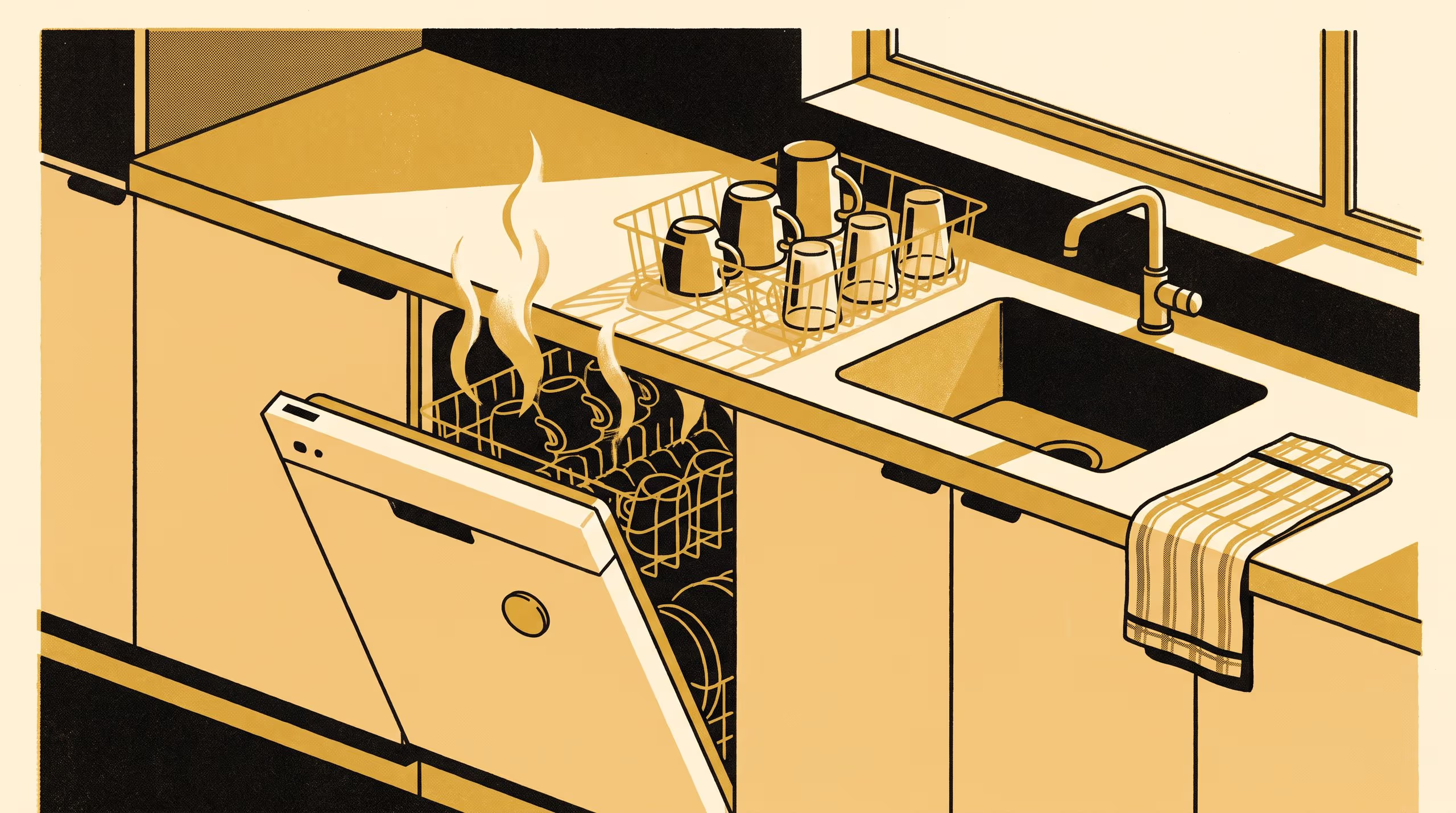
A new display advertisement prepared by Mr Halvard Nnamani brings the University's research on how shared things come back clean to the portrait signage panels under the line "Clean enough to use again."
A portrait poster sets the University's work on cleaning and reuse at an open machine at the end of the working day
Somewhere on campus this afternoon a dishwasher door will be lowered, and someone will have to decide whether what is inside is ready to be used again. Clean Enough to Use Again, a new display advertisement for the portrait signage panels, puts that moment in front of everyone who passes. It was prepared by Mr Halvard Nnamani, Doctoral Candidate in the School of Emergent Priorities.
I have spent most of my candidature reading what people type into boxes, so it has been a change to make something with almost no words on it. The kitchen seemed the right place to start, because everyone who walks past already has a view about it.
— Mr Halvard Nnamani, Doctoral Candidate, School of Emergent Priorities
The poster shows an office kitchenette after hours, racks still steaming and a tea towel left over the door. Its supporting line carries the University’s interest in cleaning and reuse from the shared sink to the steriliser, and its small print points readers to the School’s paper on clean/dirty magnets on shared workplace dishwashers, alongside related work on rack loading, on finding things in a home kitchen’s cupboards and on a reaction vessel’s own history of use.
The campaign extends the University’s practice of placing everyday research where everyday decisions are made, so that a question asked at the bench can be met again at the bus shelter.
“It is lovely to see the magnet given a wider audience,” said Dr Anneke Tolan, Senior Research Fellow and Deputy Convenor of Futures in Committee. “It has always been a public instrument.”
The full poster is available from the University’s research repository under an open licence, doi:10.5555/slop.zeai5m.