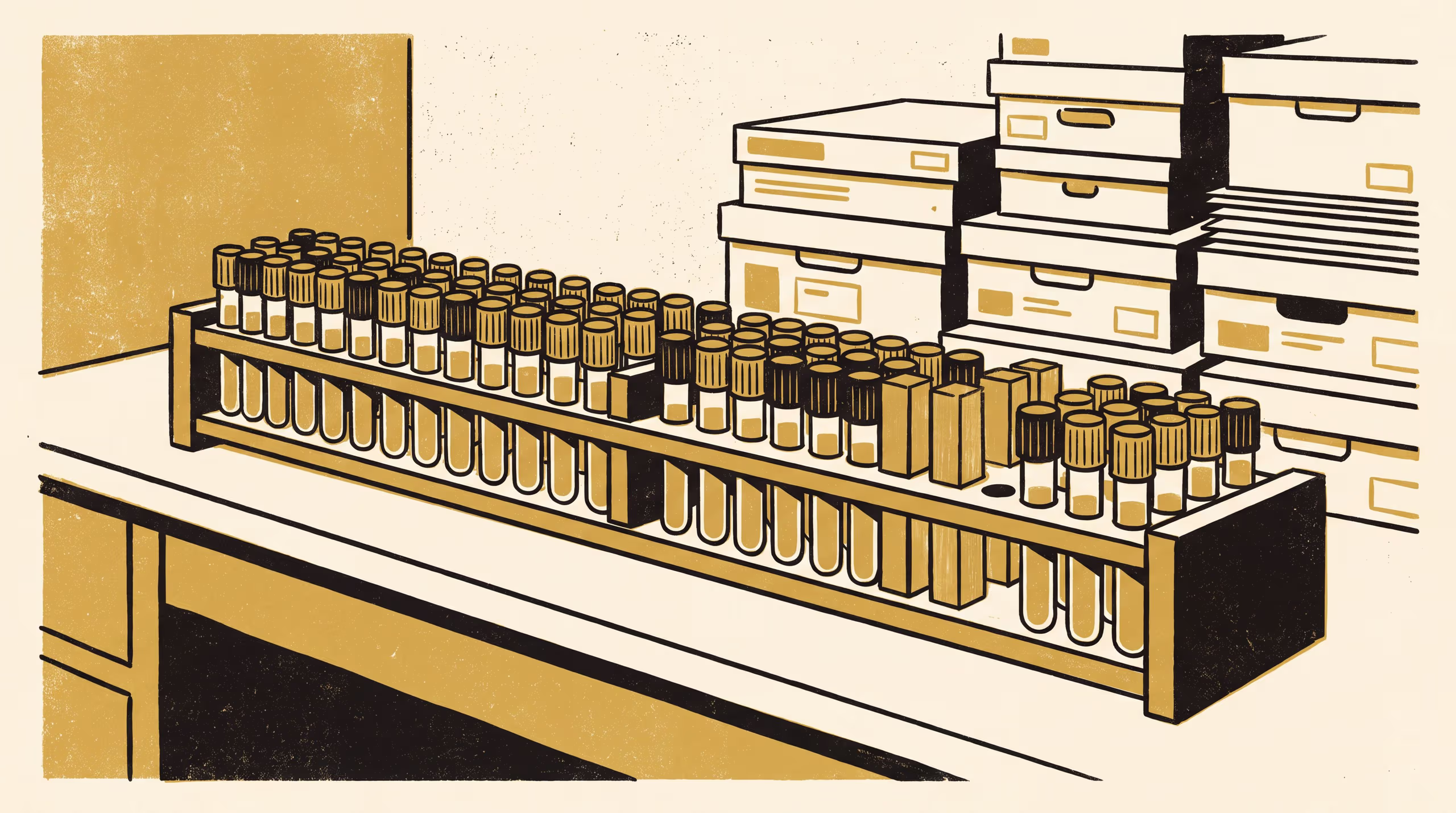
A new research poster from the School of Underlying Conditions treats the genotypes an archive fails to return as part of its record.
An archived pharmacogenetic collection's no-calls, mapped by storage age and collection device
Loss, in the School of Underlying Conditions, is something to be written down rather than written off. A new research poster from the School extends that habit from the core tray to the sample freezer, following a long-held collection of cheek swabs through a fresh round of genotyping and recording exactly where each answer failed to arrive.
My thanks go to the people who gave these swabs years ago, for a purpose none of them could have pictured, and to the colleagues who kept the boxes in order long after anyone asked after them.
— Associate Professor Ragnhild Uzoma, Lead, Basement Relations Group
Rather than setting incomplete results aside, the team positioned each missing call within a structured interval log, aligning storage history, collection practice and assay behaviour into a single account of what the archive still holds. Across 3,412 swabs, the gaps proved anything but evenly spread, gathering around one collection device and one hard-to-read stretch of the genome.
Senior Research Fellow Brynjar Obiora called the archive “a set of decisions made a long time ago, some of which, it turns out, are still speaking.” Thandiwe Solberg, Senior Lecturer and Convenor, Demo Quarter, who brought the School of Continuous Improvement’s interest in home sampling to the project, said she would be “carrying the interval log back to every bench where samples outlast the question they were taken for.”
The poster joins a growing body of University scholarship on what collections keep, and on the care it takes to know.
The full poster is available from the University’s research repository under an open licence, doi:10.5555/slop.y39van.