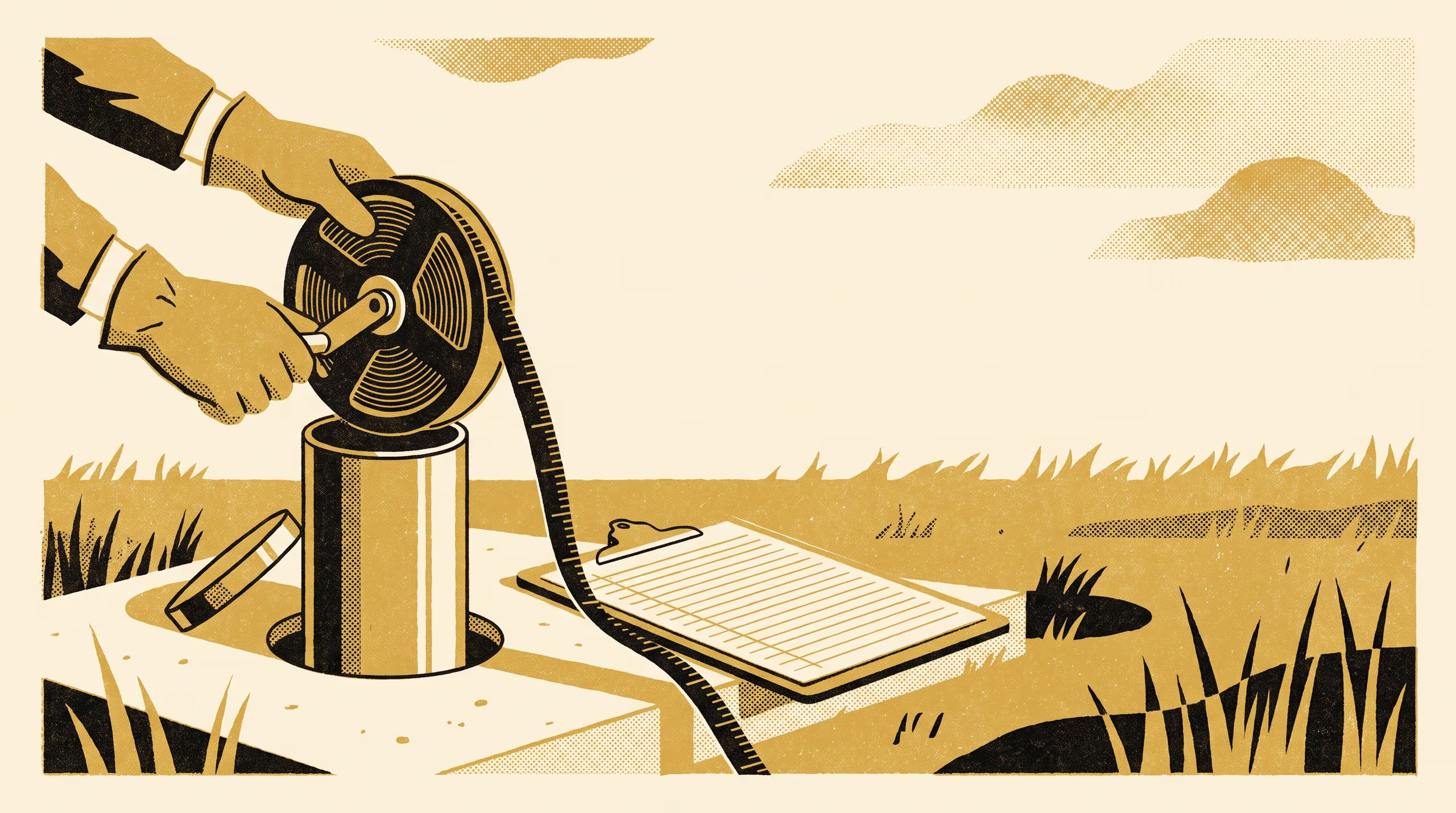
Dr Vigdis Emenike and Dr Mirela Hanke show that a groundwater check dip taken with the first reading in view agrees with the record more closely than with the water.
Forty field operators, a test standpipe and the case for taking the second dip blind
The second look is the oldest safeguard in fieldwork. A new paper from the School of Underlying Conditions finds that it is not always a second look.
In Agreeing With the Sheet, Dr Vigdis Emenike, Senior Lecturer, and Dr Mirela Hanke, Postdoctoral Fellow and Deputy Convenor of the Living Dashboard in the School of Continuous Improvement, bring the methods of experimental psychology to one of the most familiar moments in groundwater monitoring: the check dip that confirms a reading before it is written into the record.
Our students take every reading twice, and the School has always been quietly proud of how well the two agree. This study has given us a more interesting thing to be proud of, which is knowing why.
— Dr Vigdis Emenike, Senior Lecturer, School of Underlying Conditions
Working with forty field operators across 1,440 paired readings in a purpose-built standpipe, the authors examine how the visibility of an earlier value shapes the confidence, pace and convergence of the one that follows, and position the familiar duplicate check within a broader conversation about how agreement is produced, recorded and reported. The paper’s recommendation, that the check be made blind, is offered to the sector as a practical refinement rather than a correction.
The University regards the collaboration as a fine illustration of what its schools can see when they stand at the same bore head. Dr Hanke described the work as “a reminder that the numbers we keep in view are part of the instrument, and a welcome invitation to keep looking at them together.”
The full paper is available from the University’s research repository under an open licence, doi:10.5555/slop.bk5lf1.