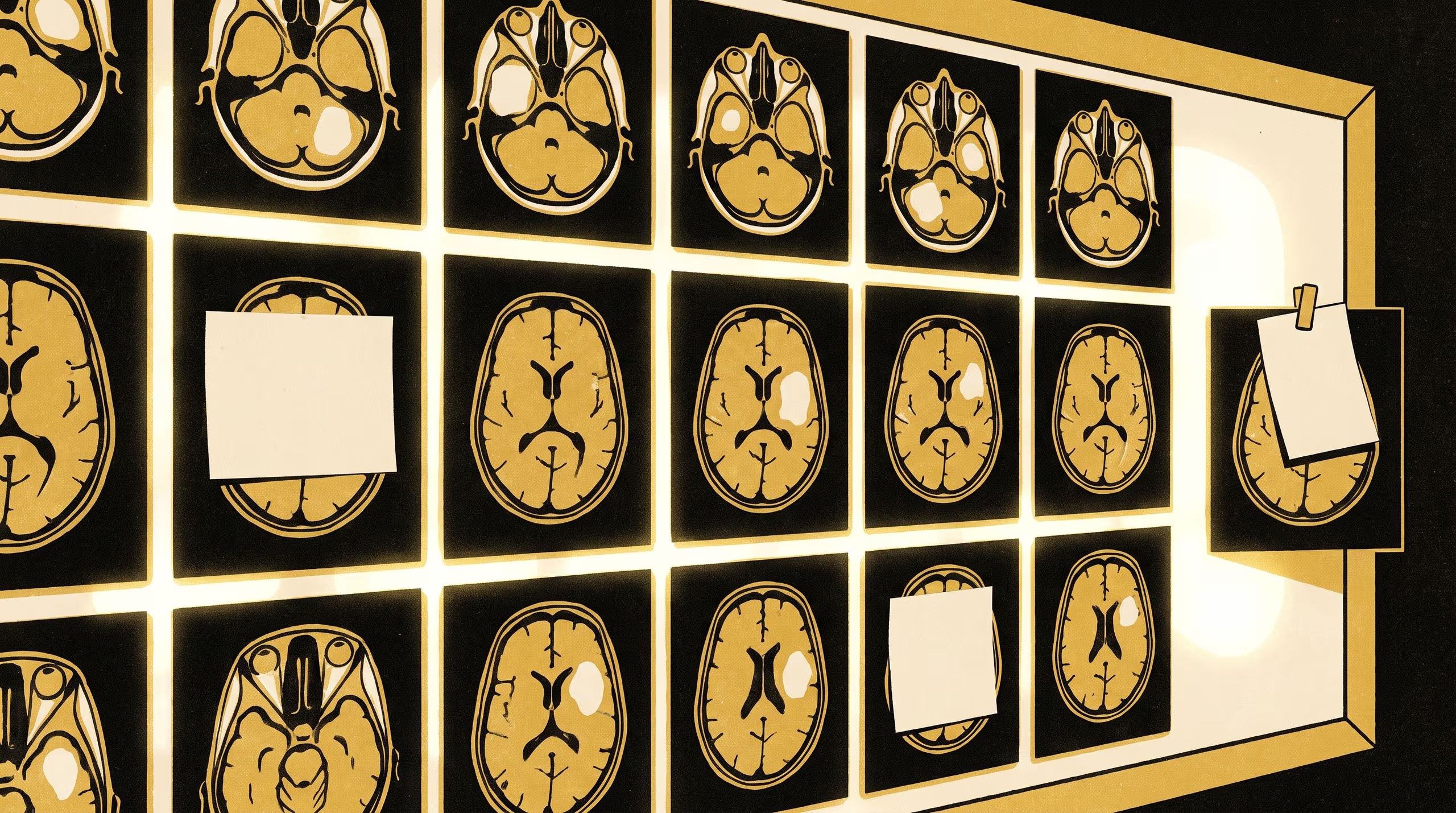
A new paper from the School of Continuous Improvement shows how much of a brain tumour classifier's accuracy survives without the tumour, and proposes a criterion for deciding when a benchmark split has done its work.
A classifier kept naming tumour types after the tumour was masked out, and one archive's long-serving test split has now been stood down
A test split that has served a radiology teaching archive for many years has been formally stood down, on the strength of a new paper from the School of Continuous Improvement. The Tumour Is Optional, by Dr Renke Sabel, Dr Torun Ezeigwe and Associate Professor Casimir Beng, offers the field a way of knowing when a benchmark has told it everything it can.
Most of the measures this School studies are never formally retired. They are reported a little less each year until nobody can say when they stopped meaning anything. It has been a genuine pleasure to write one of the rare retirement notices, and to write it in a form the next split can be held to.
— Dr Renke Sabel, Senior Lecturer and Convenor, Indicator Commons
The study progressively removes information from the images a classifier learns from, mobilising a ladder of lesion-blind baselines to surface what a model can know without looking where it is meant to. With the tumour masked out, accuracy held at 83.7%; with no image at all, 66.2%. A new patient-level split, built from the same archive, now carries the work forward, and the retirement test is reported beside every result computed on it.
The paper evaluates research benchmarks rather than clinical tools, and the University regards it as a natural extension of its stewardship of the instruments its scholars rely on. “Our students meet a great many tests that have been taught to,” said Dr Ezeigwe, Senior Lecturer and Director of the Master of Applied Measurement. “It is a fine thing to show them one that was thanked and allowed to rest.”
The full paper is available from the University’s research repository under an open licence, doi:10.5555/slop.the4tt.