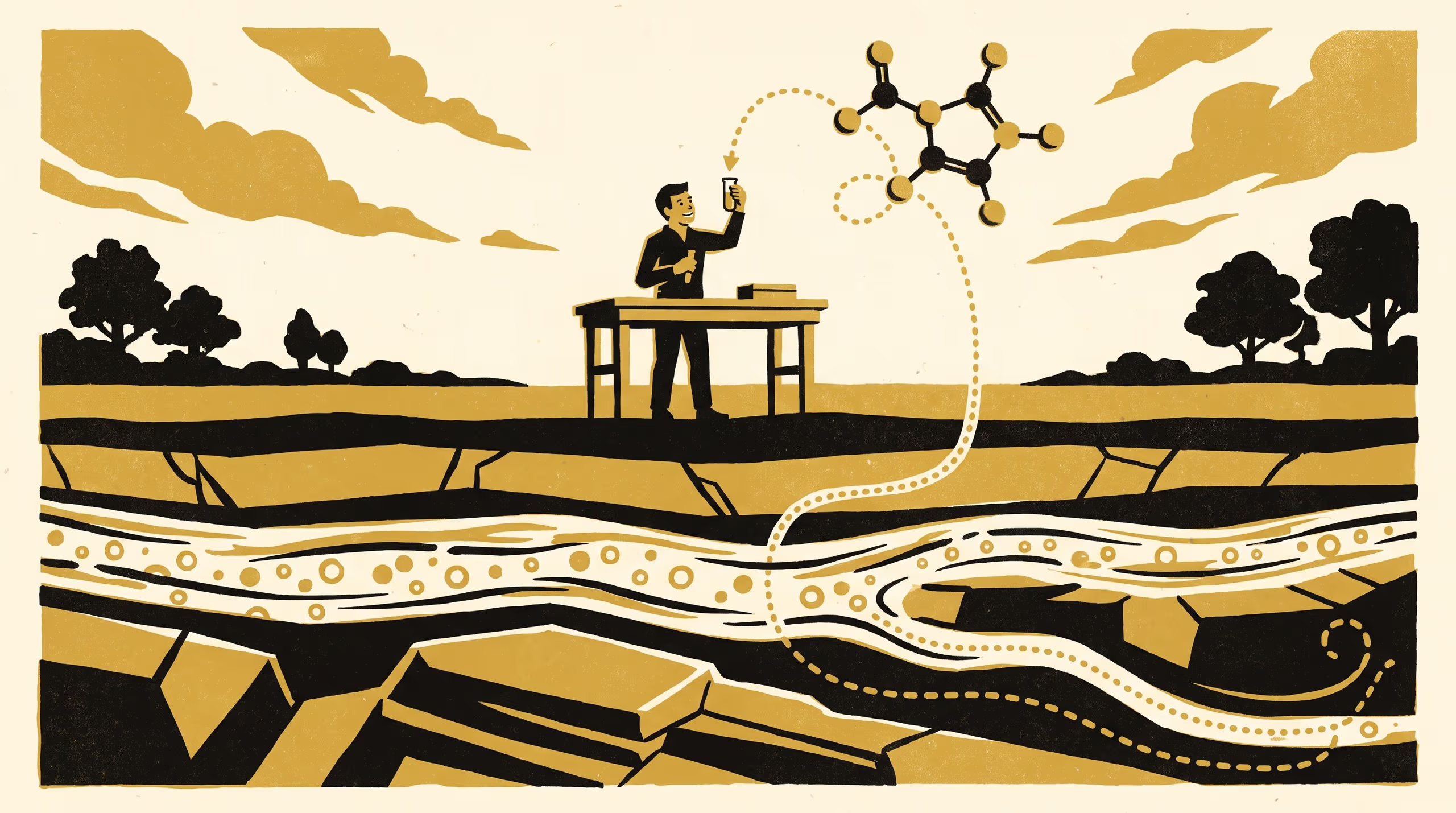
Leave a Trace, a new prospectus from the School of Underlying Conditions, invites prospective research students to learn the craft of the isotopic label, from the laboratory bench to the monitoring bore and the drill core.
Leave a Trace introduces the School of Underlying Conditions' isotope laboratories, field programmes and provenance work to prospective research students
Change one atom in a molecule, and it can be found again wherever it goes. That small idea now anchors the University’s offer to its next generation of researchers. Leave a Trace, a new prospectus led by Associate Professor Ragnhild Uzoma with Dr Sten Okwuosa, introduces the isotope work of the School of Underlying Conditions to students weighing where to begin a research career.
The prospectus moves from the bench to the field and back again. It sets the patient discipline of the labelled standard beside the reading of groundwater for the heavy atoms it carries, and draws the stockroom shelf and the drill core into a single account of where things come from. It anchors each of these pathways in the School’s own recent publications, and closes on the University’s Impact Pathway Atlas, which accompanies every student’s work from its first submission onward.
I have spent most of my career asking where a sample has been. It has taken me rather longer to notice that a School can be asked the same question, and this prospectus is our first attempt at an answer.
— Associate Professor Ragnhild Uzoma, Lead of the Basement Relations Group
For the University, the release extends a commitment to recruitment that is grounded in the work itself rather than in promises about it. “A student’s first poster is the start of a long record,” said Dr Okwuosa, Convenor of the Impact Pathway Atlas. “We would like every new candidate to arrive knowing that record will be kept with care.”
The full brochure is available from the University’s research repository under an open licence, doi:10.5555/slop.ecilhm.