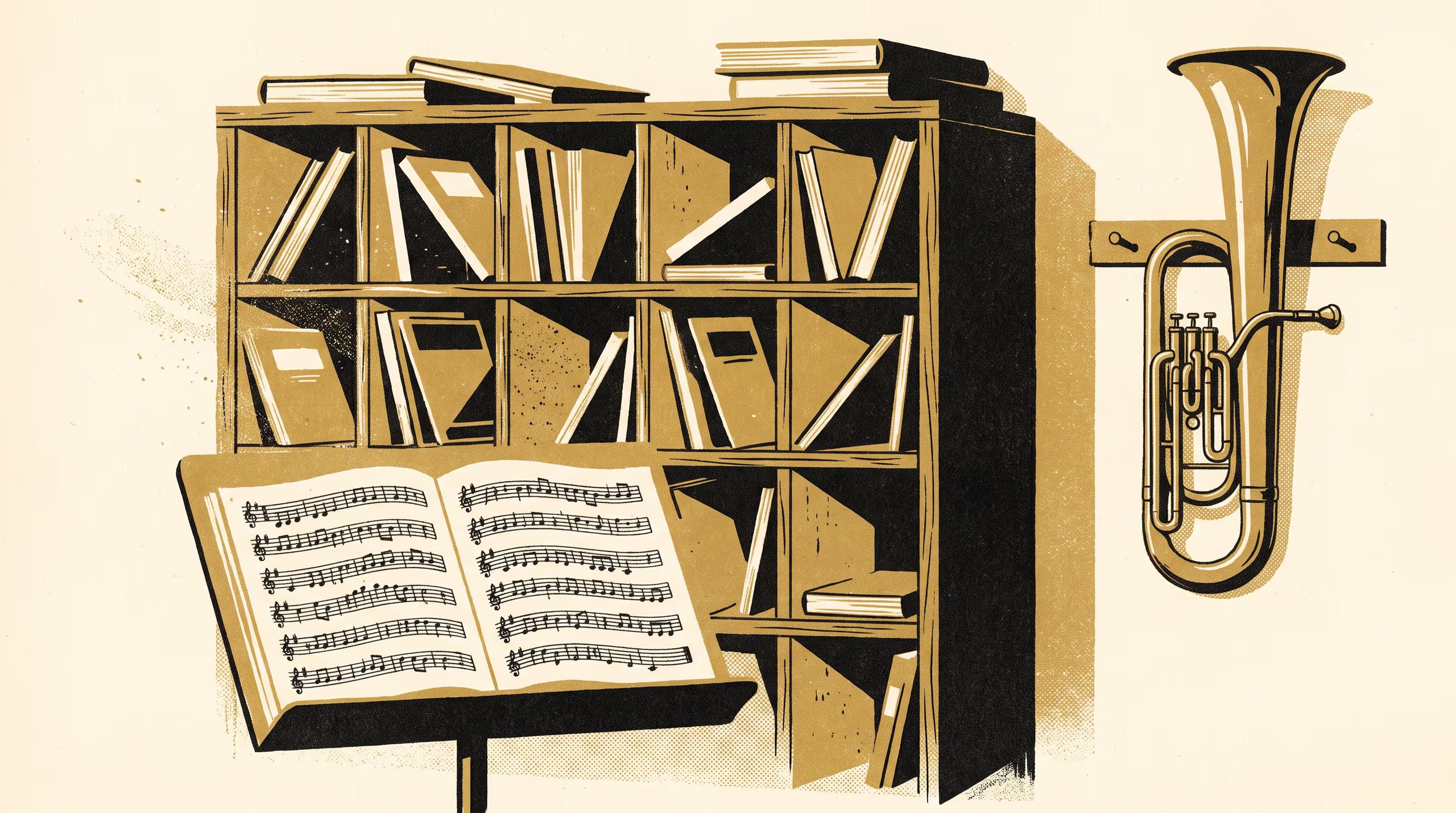
A paper by Dr Vigdis Emenike follows a book headed "Ophicleide" through four sets of a provincial band's part-books, long after the instrument left the band.
A new paper reads a town band's manuscript part-books for how they were copied, and finds the bandmaster's score in a bass book
Slop University has published The Ophicleide Book, a paper by Dr Vigdis Emenike of the School of Underlying Conditions that reads a town band’s surviving manuscript music not for what the band played but for how its parts were made, kept and passed on.
The paper centres on a single book. Across four sets of part-books copied between the 1880s and the middle of the last century, the band went on writing out a part headed for an instrument it no longer owned. Dr Emenike shows that the book did not stay empty: it gathered cue notes, pencil marks and wear until it was serving as the bandmaster’s working score, and that in its last set other players’ parts were copied from it.
None of this would be legible without the people who kept the trunk closed and the books in order for the better part of a century. Every finding in the paper is really theirs, and I am grateful to have been allowed to read it.
— Dr Vigdis Emenike, Senior Lecturer, School of Underlying Conditions
In approach, the study brings the School’s long-standing attention to records that outlast their purpose into conversation with source criticism, scribal hand identification and the history of amateur music-making, positioning the band library as a site where institutional memory, working practice and textual transmission meet.
The paper extends the School’s commitment to reading old instruments of every kind on their own terms, and carries that attention into the study of music.
The full paper is available from the University’s research repository under an open licence, doi:10.5555/slop.c3fbiv.