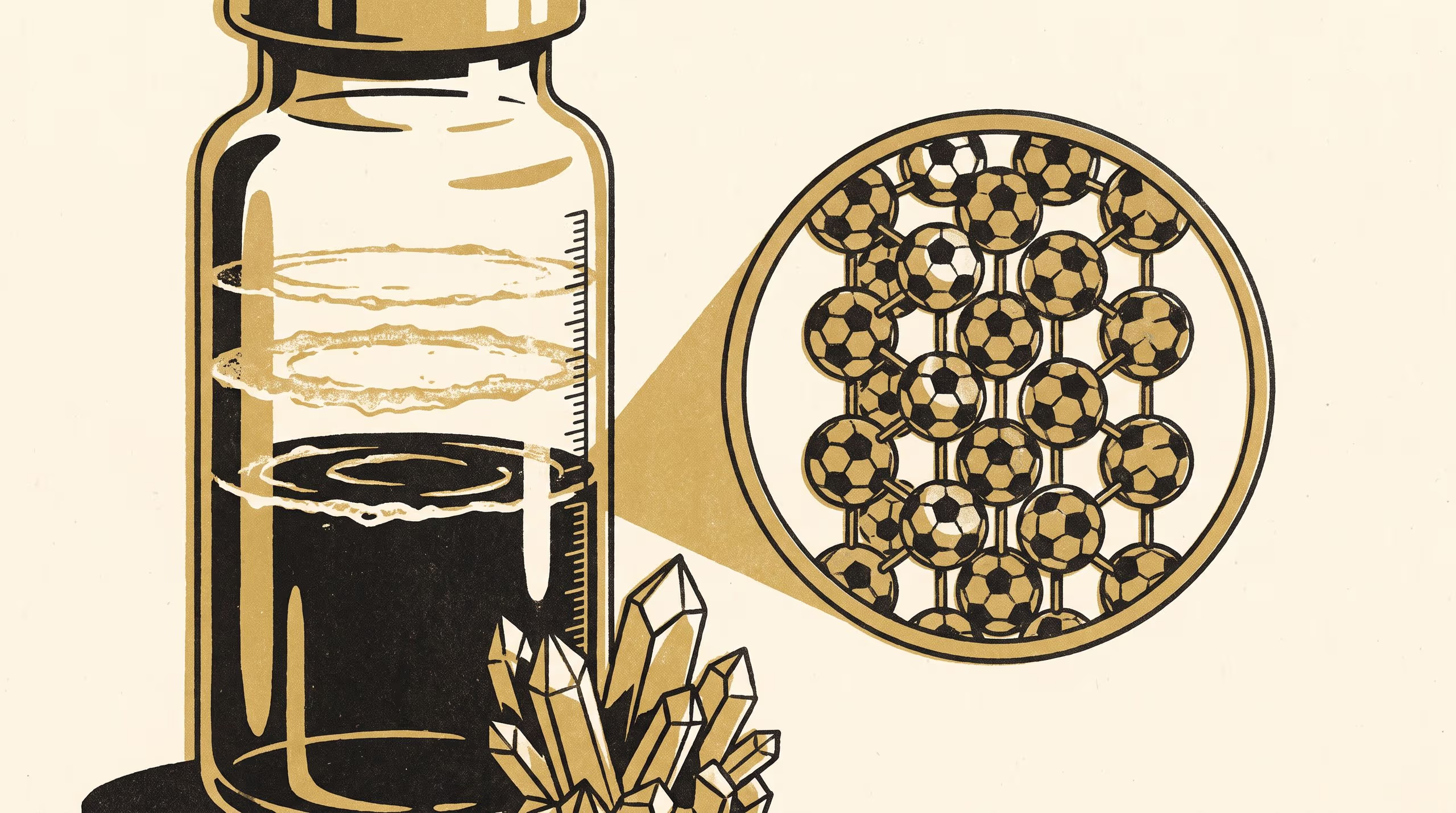
A new research poster from the School of Underlying Conditions reads the falling level of 48 evaporating C60 solutions as a drawdown record and finds every one crystallised only after passing beyond saturation.
A daily level record of 48 evaporating fullerene solutions shows each one carrying on well past saturation before its first crystals
For ten years I was taught that a reading is only as good as the person who took it. A vial, it turns out, keeps a perfectly good record of its own if nobody goes near it, and that has been a restful thing to learn.
— Dr Vigdis Emenike, Senior Lecturer, School of Underlying Conditions
Dr Emenike and Associate Professor Ragnhild Uzoma of the School of Underlying Conditions have published Reading the Drawdown, a research poster that carries the School’s long practice with standing water levels into the chemistry of buckminsterfullerene.
The team set out a bench of 48 small vials of C60 solution across six solvent systems, half under pierced foil and half open to the air, and read each one’s falling level every day through the glass without once dipping it. Placed on that record, the first crystals told a consistent story: every vial went on past saturation before it crystallised, and the open vials went furthest.
The work brings field-hydrology instincts and bench-scale crystallisation practice into a single frame, positioning patient, contact-free observation as a capability the School can extend across its laboratory agenda and, in time, into its teaching.
The University is pleased to see a method learned at the bore head find so settled a home at the bench, and counts the poster among the steadier pieces of work it has had occasion to announce this year.
The full poster is available from the University’s research repository under an open licence, doi:10.5555/slop.oa6xkl.