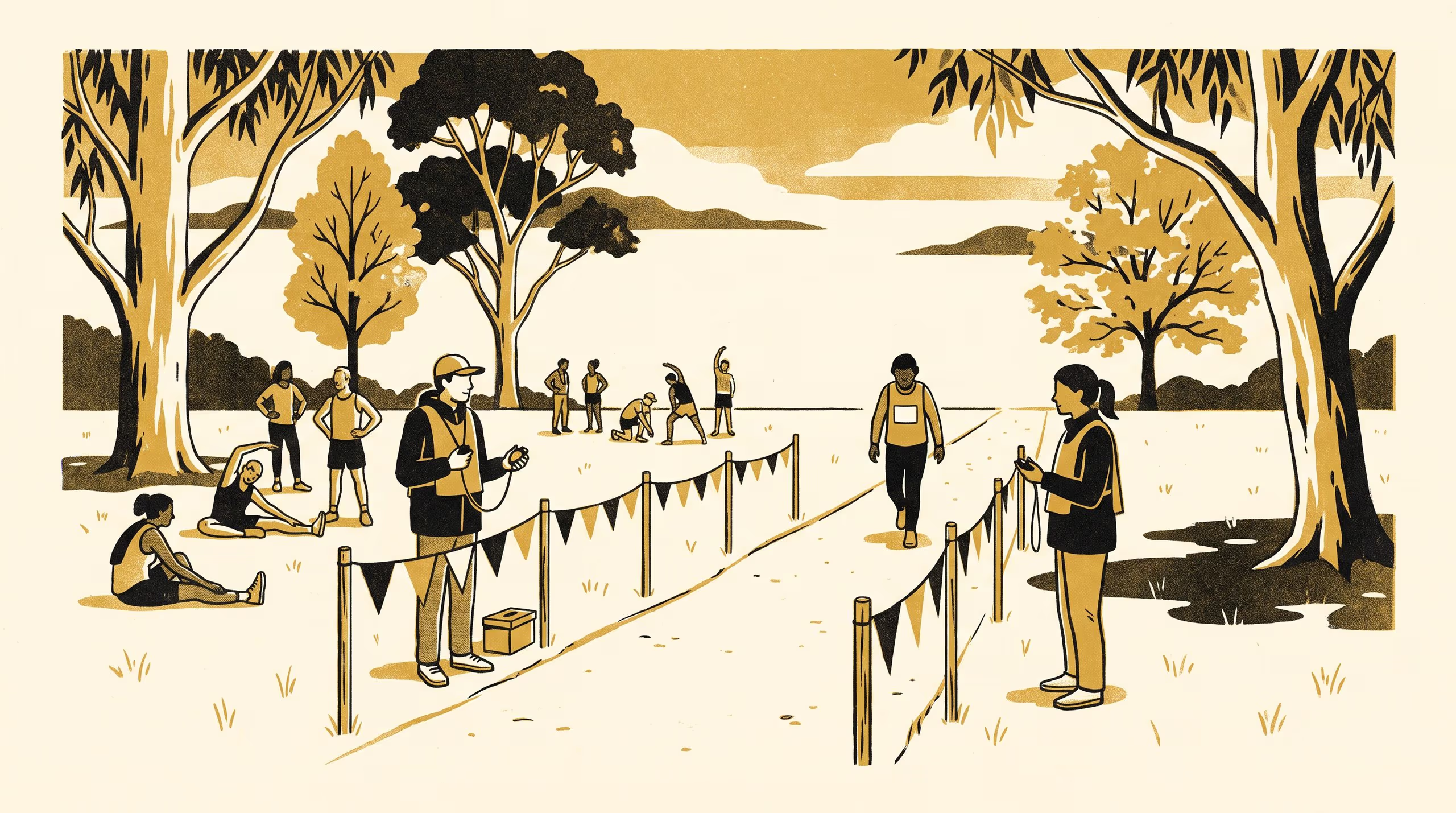
A research poster from the School of Continuous Improvement compares two seasons of community run results sheets with the timer lists behind them and listens closely to the volunteers who publish them.
A psychosocial poster finds the last row of a community run's results is the one most often edited, and asks whose discomfort the edit relieves
Every Saturday afternoon, at fourteen free weekly timed runs, two versions of the same list come into being: the one the stopwatch produces, and the one a volunteer eventually publishes. A new research poster from the School of Continuous Improvement has spent two seasons reading the distance between them.
Across 1,312 published results sheets, the row most often changed between timer and page is the last one: on 27.8% of sheets in series with a written convention for tidying the tail of the field, and on 11.2% in series without. The study pairs that comparison with two unhurried conversations each with 22 of the volunteers who compile the sheets, drawing on the psychosocial tradition’s attention to what people protect without quite saying so.
Somewhere this weekend a results sheet is being finished at a kitchen table. We would like the person finishing it to know that the University has been thinking about them, and will go on doing so.
— Eskil Nwabueze, Doctoral Candidate, School of Continuous Improvement
The poster was prepared with Dr Anneke Tolan, Senior Research Fellow and Deputy Convenor of Futures in Committee, and Dr Ingeborg Nwachukwu, Lecturer and Convenor of Capability Sprints. “An interview that is allowed to wander tends to wander somewhere worth going,” said Dr Tolan.
The work sits comfortably within the School’s long interest in the people who stand between a number and its audience, and the University counts it among the quieter strengths of its doctoral community.
The full poster is available from the University’s research repository under an open licence, doi:10.5555/slop.gmbkrm.