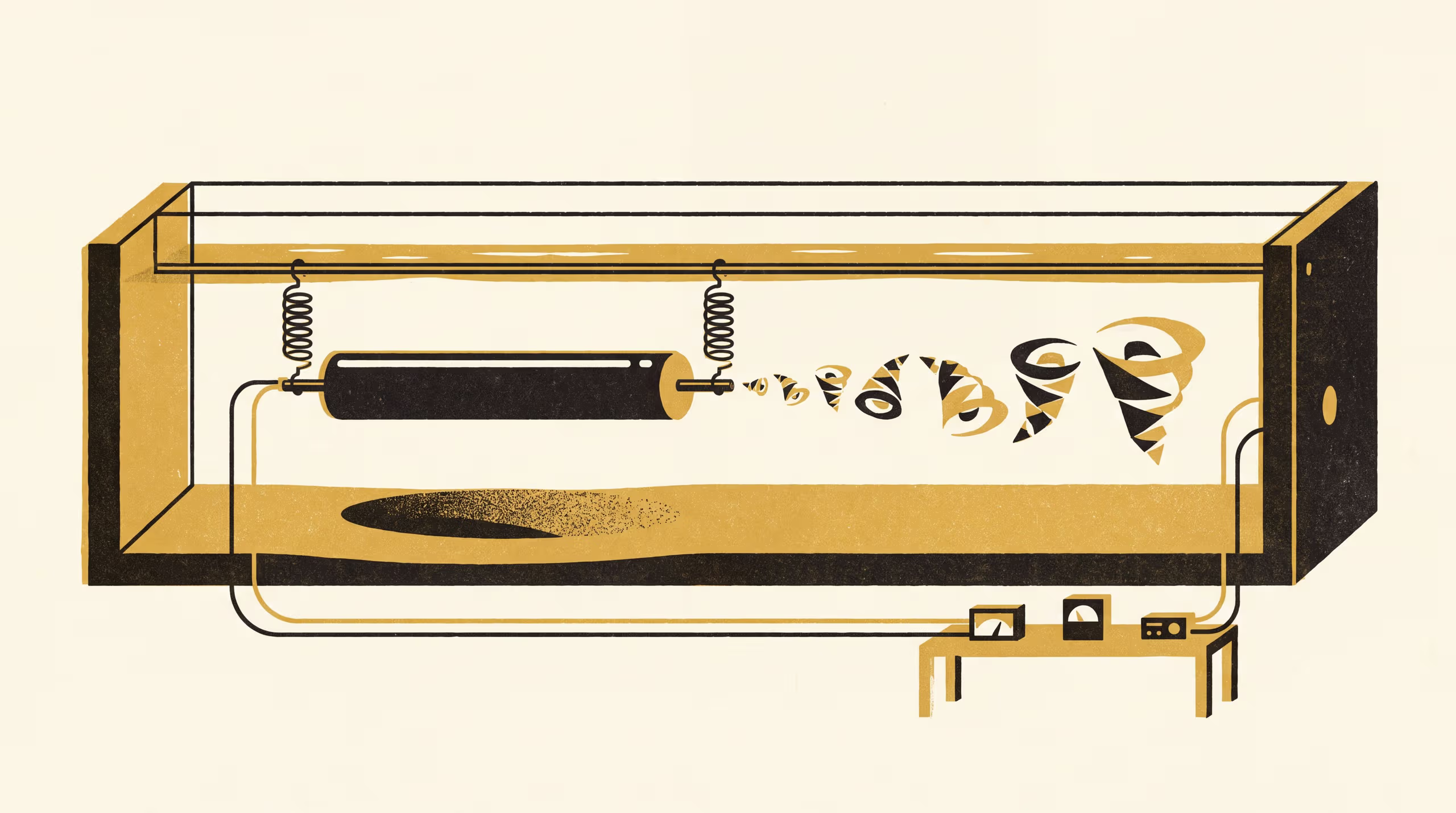
A research poster from the School of Underlying Conditions tracks a spring-mounted cylinder over a sand bed as the hole it digs carries its vibration from one response branch to the next.
A flume study finds that the gap beneath a span is partly the span's own work
In a water channel at the School of Underlying Conditions, a cylinder on springs spent six hours at a time trembling above a bed of sand, and the sand did not stay where it was put. That slow exchange between a structure and the ground beneath it is the subject of The Gap It Digs, a research poster released today.
The work brings the School’s long attention to boundaries into the hydraulics laboratory. Across nine flow settings and three rigid comparisons, the team followed how a vibrating span reshapes its own foundations, and how those reshaped foundations in turn change the way it moves. At the middle of the range, the poster reports, the cylinder dug a hole about twice as deep as a fixed one and moved onto a markedly livelier pattern of response once the gap had opened far enough.
We owe a good deal to the people who raked that bed flat again before every run. Work like this rests on a shared willingness to begin from level ground, and the School has never been short of it.
— Associate Professor Casimir Beng, Lead of the Adaptive Metrics Lab
Senior Research Fellow Brynjar Obiora, who led the study with Senior Lecturer Dr Vigdis Emenike, hoped the poster would “find readers on both sides of the bed: those who design what rests on the ground, and those who study what lies under it.”
The University regards the poster as a fine instance of a school letting its methods travel further than its name suggests, and of the patient laboratory craft that makes such travel possible.
The full poster is available from the University’s research repository under an open licence, doi:10.5555/slop.thy1yk.