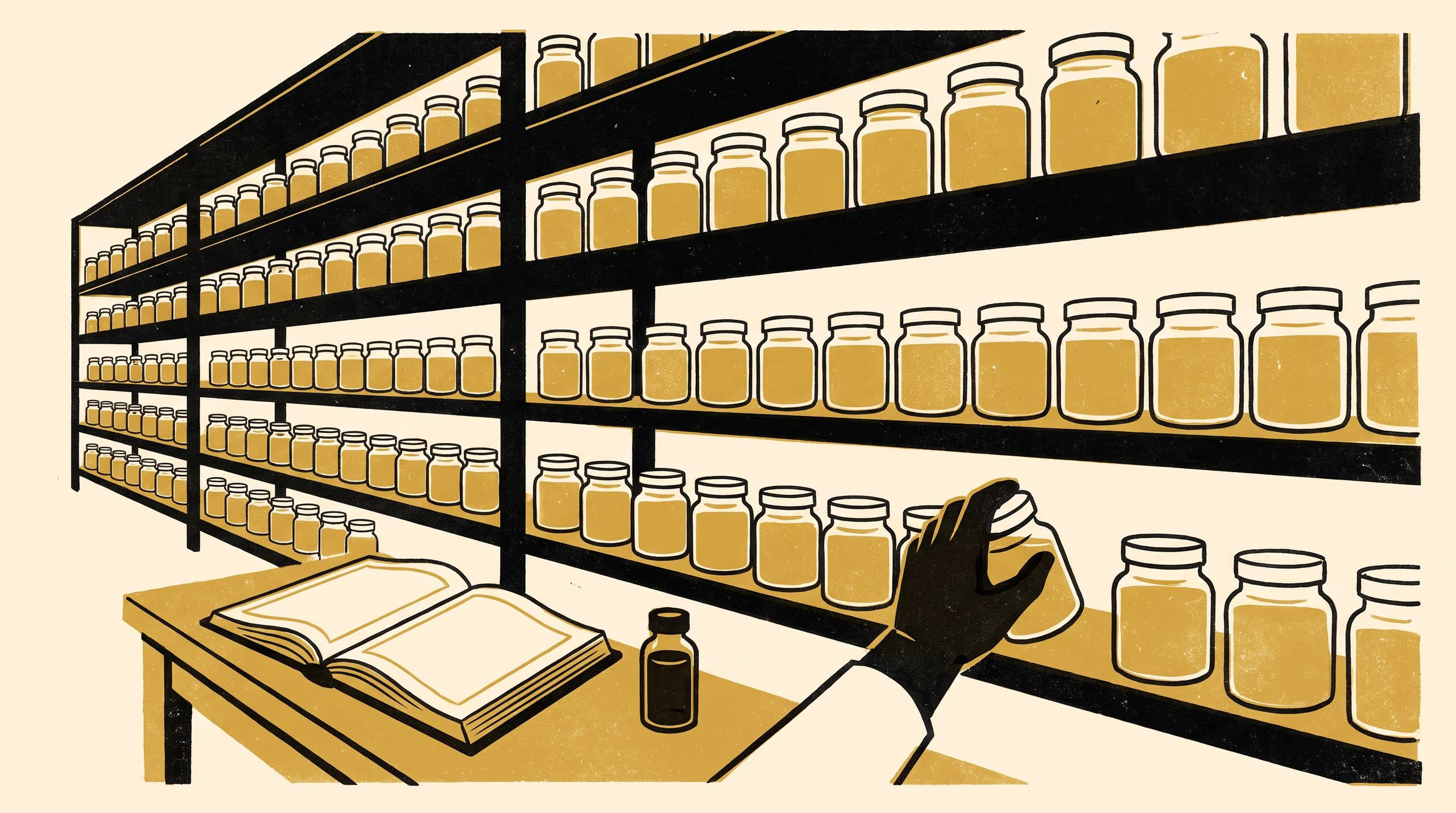
A paper from the School of Emergent Priorities reads a honey-testing laboratory's shelf of retained samples as an archive, and finds its analysts writing down, each time a jar is opened, what it can still be asked.
Ten years of a retention store, 157 opened jars and the short note analysts began writing whenever they opened one
Ten years of a laboratory’s retention register, 157 opened jars of honey and a modest stack of handwritten notes are the materials of a new paper from the School of Emergent Priorities.
A Record That Does Not Keep, by Dr Iben Chikere, Lecturer, and Dr Fenna Okoro, Senior Lecturer and Convenor of the Horizon Register, asks what a regional testing laboratory is keeping when it keeps a sealed portion of every honey it certifies, and what it does when one of those jars is finally taken down from the shelf.
Every archive is opened, sooner or later, by someone who did not fill it. We hope the paper is a small courtesy to whoever that turns out to be.
— Dr Iben Chikere, Lecturer, School of Emergent Priorities
The study sets register entries, dispute correspondence and conversations with laboratory staff side by side, positioning the retained sample at the meeting point of documentation practice, evidential reasoning and everyday laboratory stewardship. At its centre is the opening note, a short document one analyst began writing after a show protest and her successor kept writing because the handover sheet said to.
The paper extends the School’s long interest in what is handed on and what is quietly left behind, and the University is glad to see that interest reach the store cupboard. Dr Okoro said the work had given the Horizon Register “a good deal to think about on the subject of shelf life”.
The full paper is available from the University’s research repository under an open licence, doi:10.5555/slop.kkpjpq.