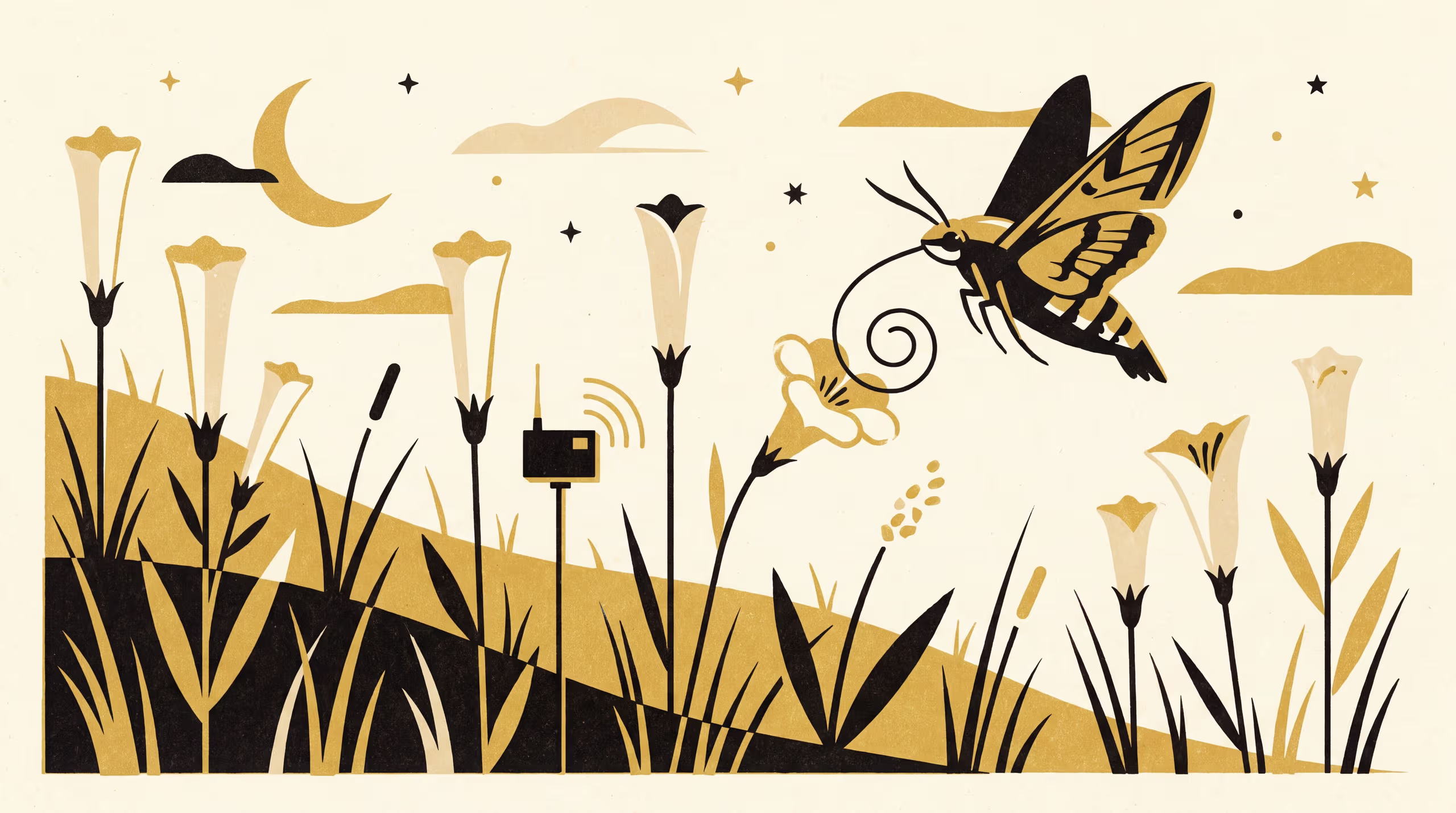
A research poster from the School of Continuous Improvement records a heat-activated current in the tongue-tip neurons of a nectar-feeding hawkmoth and finds that it switches on only above the warmest flower the moth was seen to visit.
Recordings from proboscis neurons place the current's threshold above every corolla temperature logged over a summer of visits
Not every sensor is built to be used. That is the quiet conclusion of Above the Warmest Flower, a new research poster from the School of Continuous Improvement, which follows a single sensory neuron from the tip of a hawkmoth’s tongue to the meadow where the moth feeds.
Dr Renke Sabel, Dr Joost Nwosu and Associate Professor Casimir Beng paired two very different kinds of patience. At the bench, cells taken from the proboscis were warmed slowly under close control while their electrical response was recorded. In the field, small temperature probes sat inside the flowers the moths returned to, and every filmed visit was matched to the warmth of the bloom at the moment of contact. Set side by side, the two records do not meet: the neurons’ current switches on a little above 37 °C, and across 312 visits no flower came within 2.4 degrees of the most sensitive cell.
We went looking for the point at which the moth’s sensor answers, and came back with a better question, which is what a threshold is for when the ordinary day never reaches it. The School is glad to have that question on its books, and expects to keep it there for some time.
— Dr Renke Sabel, Senior Lecturer and Convenor, Indicator Commons
Associate Professor Beng, whose Adaptive Metrics Lab built the bench’s temperature control, described the collaboration as “a reminder that holding something steady for an afternoon is its own kind of contribution”.
The University counts the poster among the clearer signs of how far its people are willing to carry their questions from familiar ground, and of the care they bring with them when they do.
The full poster is available from the University’s research repository under an open licence, doi:10.5555/slop.hzf1pq.