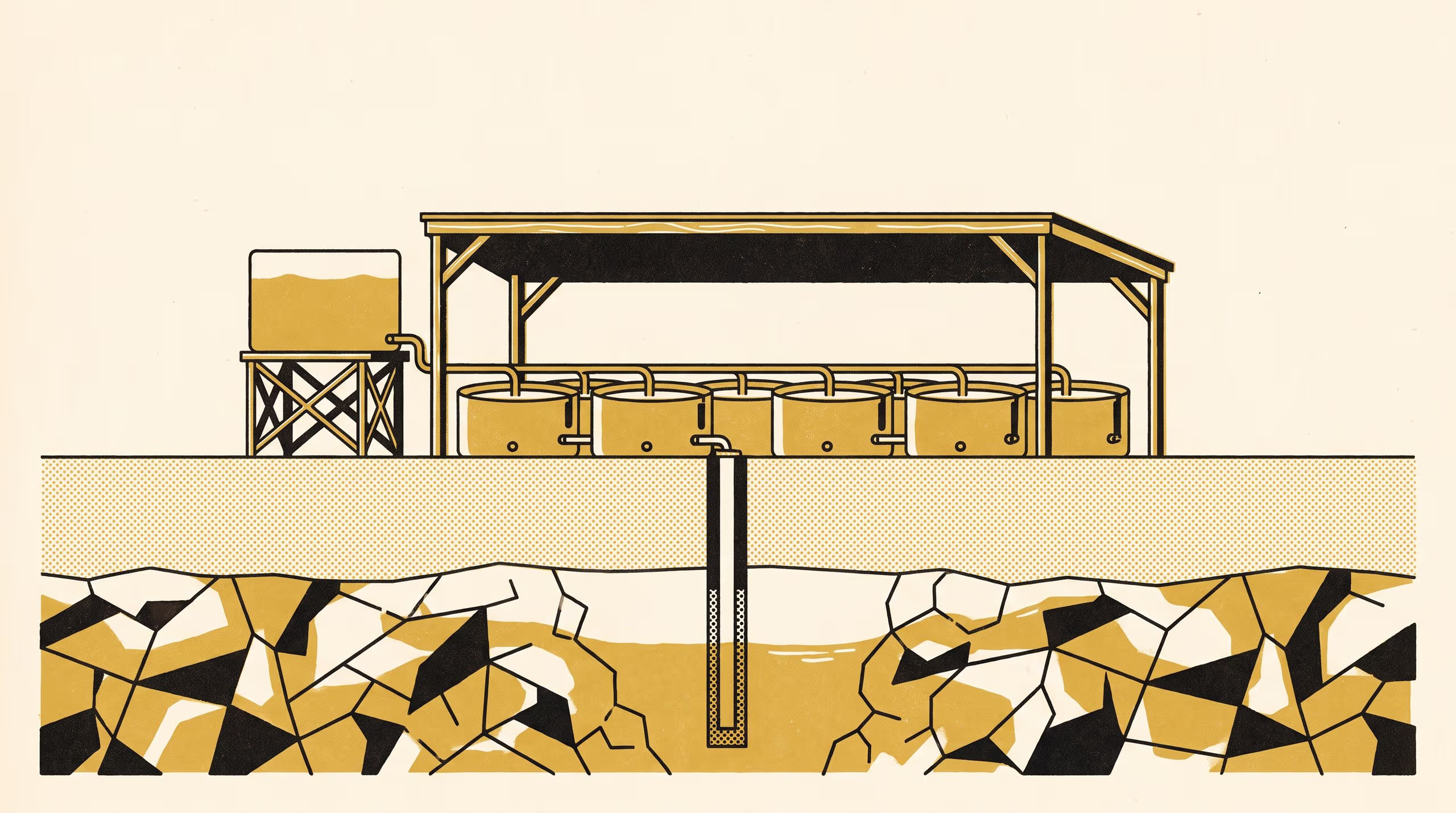
A new research poster from the School of Underlying Conditions finds that the bacteria hatchery larvae first carry depend on which layer of the aquifer the bore happens to be drawing from.
Two aquifer layers, two spawning seasons and 112 pools of larvae at one bore-fed hatchery
The School of Underlying Conditions has taken its groundwater programme as far as the inside of a fish. Its new research poster, Which Water the Larvae Drank, reports that at one bore-fed hatchery, the bacteria settling in young larvae changed with the depth of the water table beneath the sheds.
For a School that studies what lies beneath, it is reassuring to find that the question does not stop at the wellhead. Our work has always assumed the ground had something to say about what happens above it, and here it says it in a new medium.
— Associate Professor Ragnhild Uzoma, Lead of the Basement Relations Group
The study brings together hydrogeological monitoring, microbial community profiling and source-attribution modelling to situate the hatchery tank within a wider subsurface system. Across fourteen cohorts, once the water level fell below the top of the bore’s upper screen, the bore’s median share of the seven-day larval gut community rose from 9% to 30%, and the share kept pace with the water level rather than the calendar.
The poster takes its place in a growing body of work in which the School carries its instruments a little further from the ground than its name might suggest, and the University is pleased to see that reach extended once more.
“A water level is a small number, read down a pipe once a week,” said Dr Vigdis Emenike, Senior Lecturer in the School of Underlying Conditions. “We will go on reading it, and we are curious to learn who else might find a use for it.”
The full poster is available from the University’s research repository under an open licence, doi:10.5555/slop.hybta2.