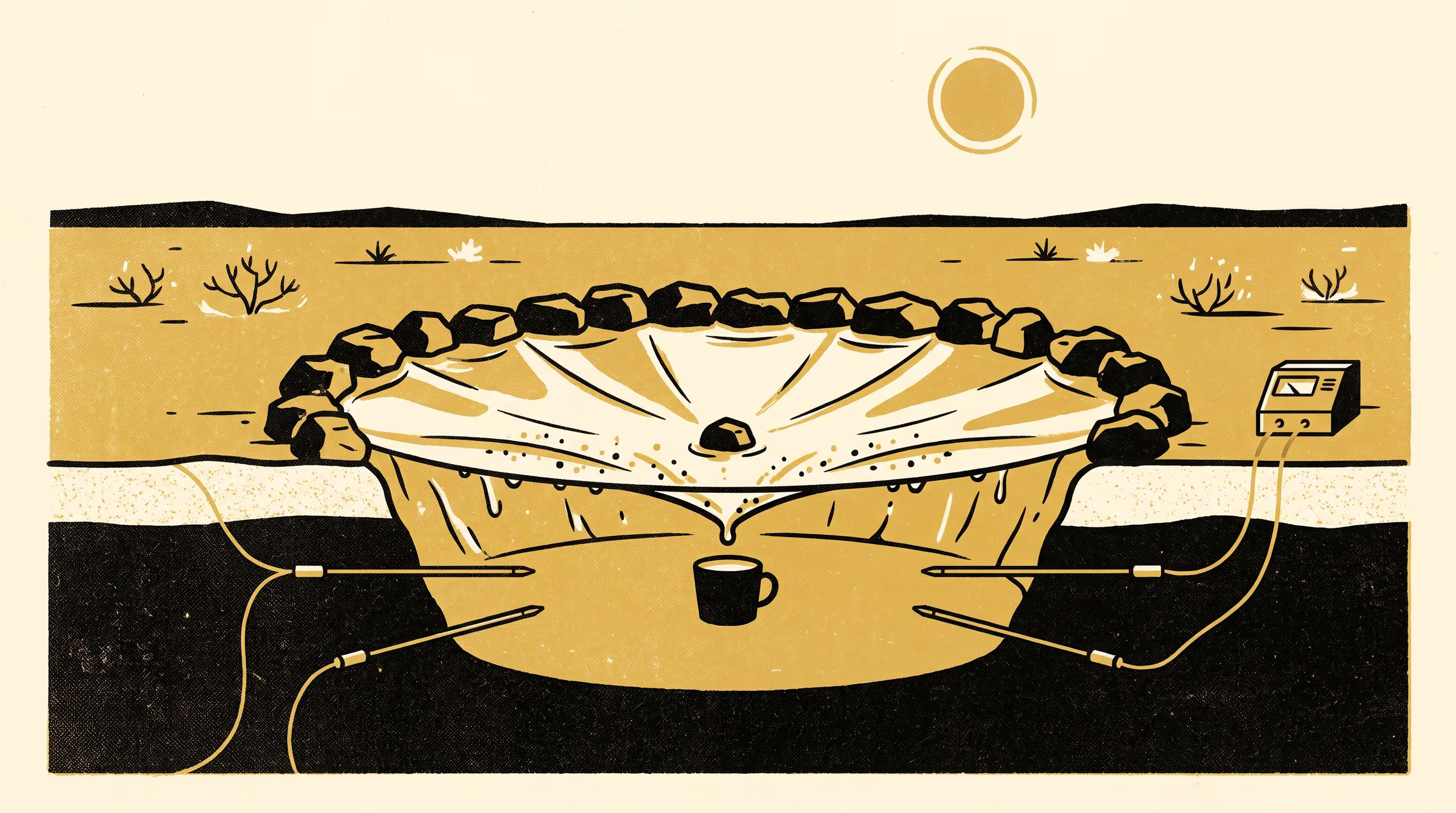
Dr Brynjar Obiora and Dr Vigdis Emenike report a month-long field record of pit solar stills drawing water from the soil they were dug into.
Three covered pits left where they were dug gave half their month's water in the first eight days, as the soil beneath them dried
Half a month’s water arrives in the first eight days. That is the central finding of Twenty-Eight Days in One Pit, a new paper by Dr Brynjar Obiora and Dr Vigdis Emenike of the School of Underlying Conditions, which follows three pit solar stills left in place through 28 days without rain.
Every pit is a question put to the ground. We left this one open for four weeks and the soil went on answering, a little more quietly each morning. There is a good deal more still to ask it.
— Dr Brynjar Obiora, Senior Research Fellow, School of Underlying Conditions
The study brings the School’s soil survey and groundwater fieldwork together around a single, patient question: how a device that draws its water from the earth beneath it keeps pace with an earth that is slowly giving up. Through a combined programme of daily weighing, profile monitoring and energy-balance instrumentation, the team traces how the still’s output, the drying soil and the sunlight held in the ground move together across the month, and what that movement means for how such stills might be tended.
It is the kind of unhurried field record the University has always made room for, and one that sits comfortably within the School’s longer conversation about water that stays, or does not stay, where it is found.
Dr Emenike described the paper as “a careful month, carefully kept,” and said the School would be glad to see the record read alongside its earlier work on soils and the heat they carry.
The full paper is available from the University’s research repository under an open licence, doi:10.5555/slop.ntxgeb.