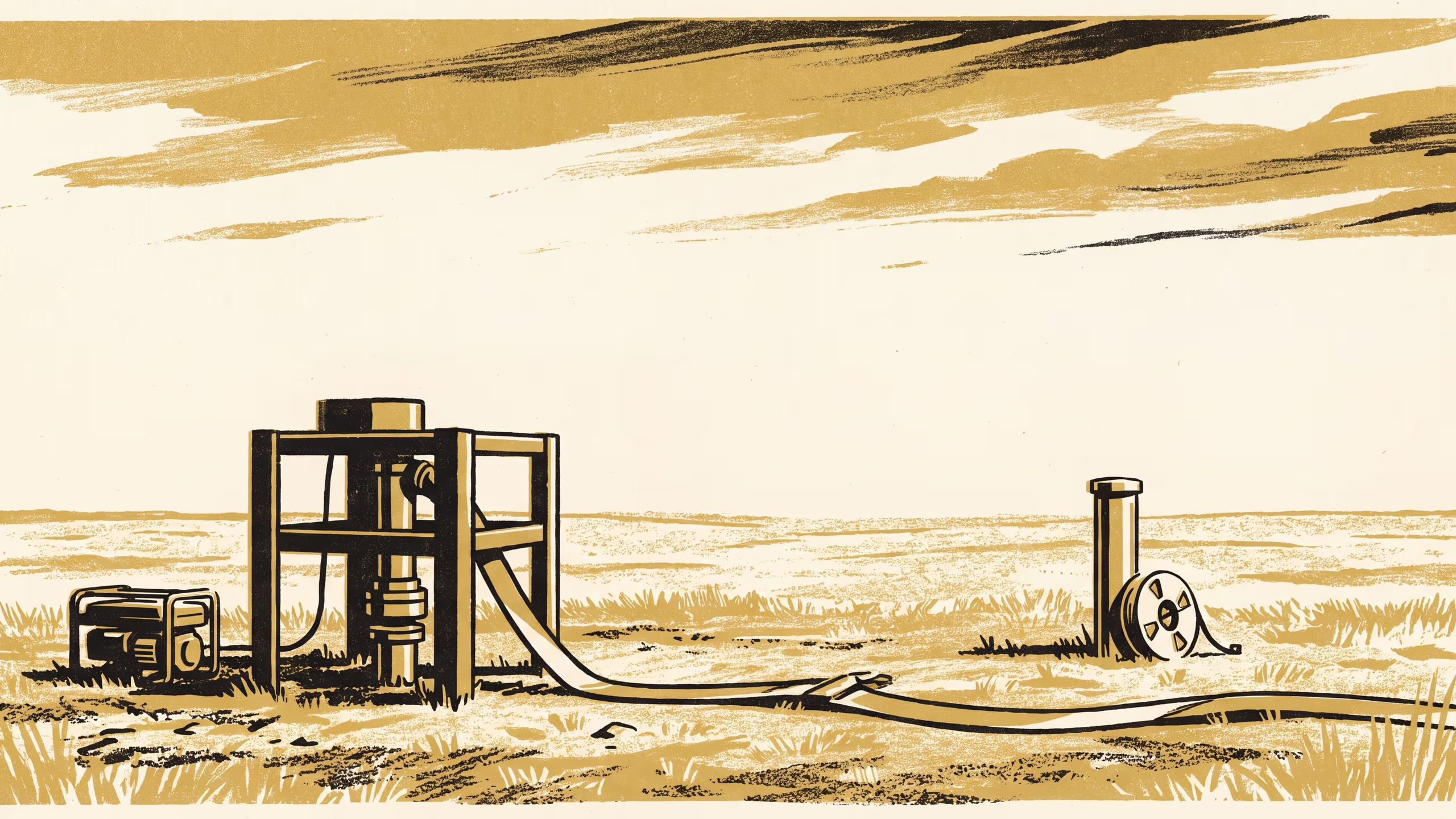
A research poster from the School of Underlying Conditions shows that when groundwater flow carries memory, the straight line a pumping test is read from reports the memory as transmissivity.
A fractional-order model of bore drawdown shows the classical straight line folding that order into transmissivity
Mathematics has long done its work quietly at the back of the School of Underlying Conditions’ field programme, and a new research poster brings it briefly to the front. Hidden in the Slope, by Dr Vigdis Emenike and Dr Bram Ntuli, asks what the familiar straight line of a pumping test is actually telling the people who draw it.
I dipped bores for ten years and trusted that line every time. I still trust it. I now have a clearer sense of what I have been trusting it with.
— Dr Vigdis Emenike, Senior Lecturer, School of Underlying Conditions
The poster sets a long-standing analytical tradition in hydrogeology beside the newer language of fractional calculus, aligning a closed-form solution with careful numerical practice to clarify how a single monitoring bore registers an aquifer that responds with memory. Its central proposition is that the drawdown and recovery slopes both scale with the fractional order, so the standard consistency check between them passes in every case, and the order is reported as transmissivity. The authors suggest that a second observation bore, at a different distance, is what separates the two.
The collaboration links the School of Underlying Conditions with the School of Continuous Improvement, and the University counts it among the clearer signs that its earth sciences and its improvement sciences now share a working vocabulary. Dr Ntuli described the project as “a conversation between two Schools that both draw lines through data, held for once at the same bench”.
The full poster is available from the University’s research repository under an open licence, doi:10.5555/slop.rkrow9.