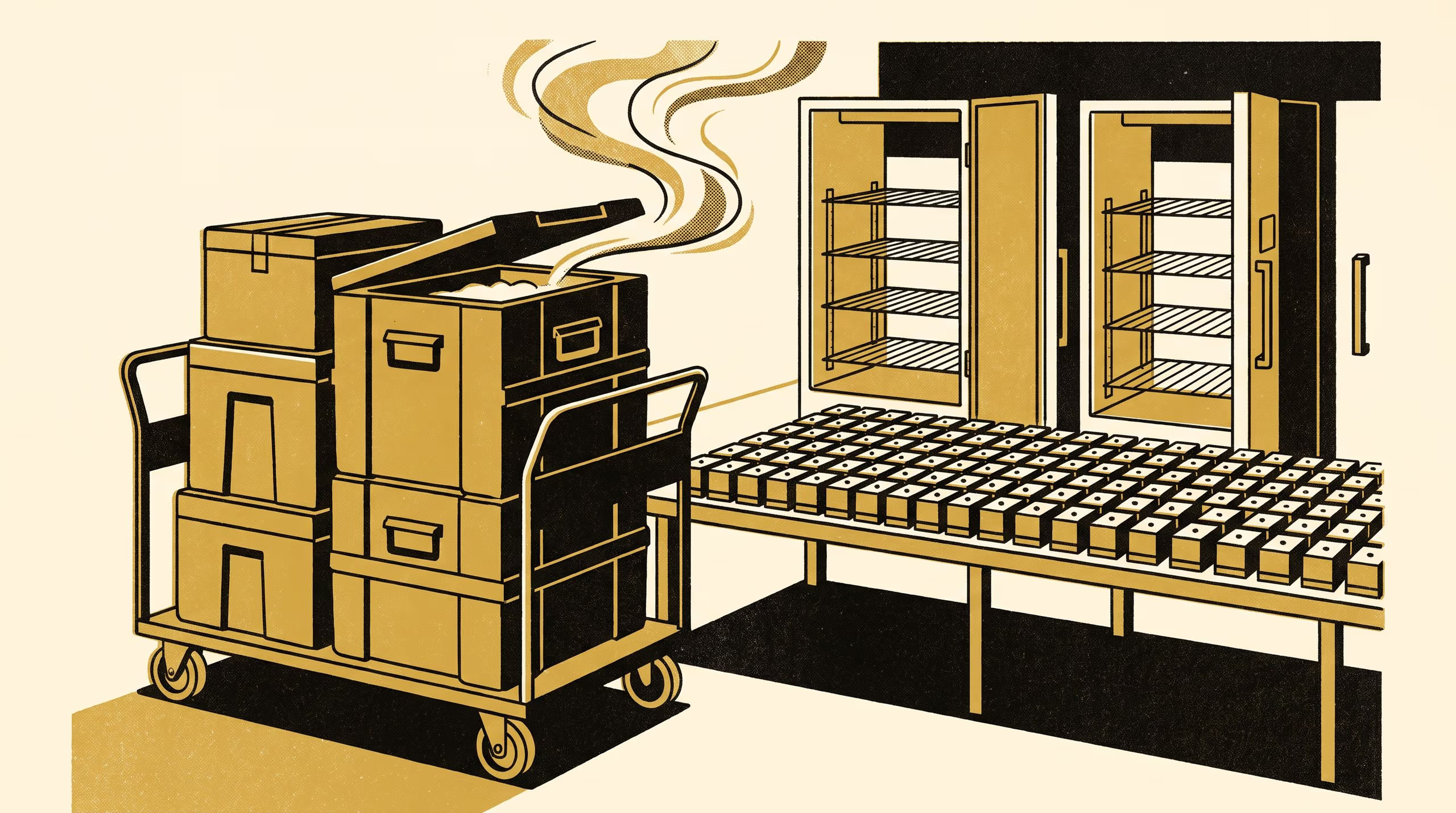
A new paper follows a bioanalytical laboratory's serum archive through a staged relocation and finds that how its crates were packed, not how warm one of them got, decides whether a transit loss reaches the comparison the archive exists to support.
A paper from the School of Emergent Priorities on crating a biosimilar study's serum archive for a laboratory move
Every move teaches you something about what you chose to keep together. This one taught us that the order of a packing list is a scientific decision, and we are grateful to the colleagues who let us stand beside the trolley while they made it.
— Ms Hedvig Anyanwu, Doctoral Candidate, School of Emergent Priorities
With those words, Ms Anyanwu introduces Pack by Pair, a new paper from the School of Emergent Priorities written with her supervisors, Dr Iben Chikere and Dr Ronja Oyelaran.
The paper accompanies a laboratory’s retained serum archive, 1,344 aliquots from a completed biosimilar study, across a three-stage move in twelve dry-ice shippers, one of which warmed during a delayed handover. Through travelling and resident control samples and a structured re-assay, the team connects sample-level stability practice with the study-level comparison it ultimately underpins, and sets out a packing approach that keeps a single crate’s misfortune shared evenly between the two arms of a study.
The paper extends the School’s doctoral programme on organisational relocation from the office restack into the laboratory, and in doing so brings the discipline of the moving crate into conversation with bioanalytical method.
“The School has always believed that priorities take shape in the small logistics of an institution,” said Dr Oyelaran, Senior Lecturer and Deputy Convenor of the Strategic Drift Survey. “It is a pleasure to see that belief travel, carefully, at minus eighty.”
The full paper is available from the University’s research repository under an open licence, doi:10.5555/slop.3q4xk5.