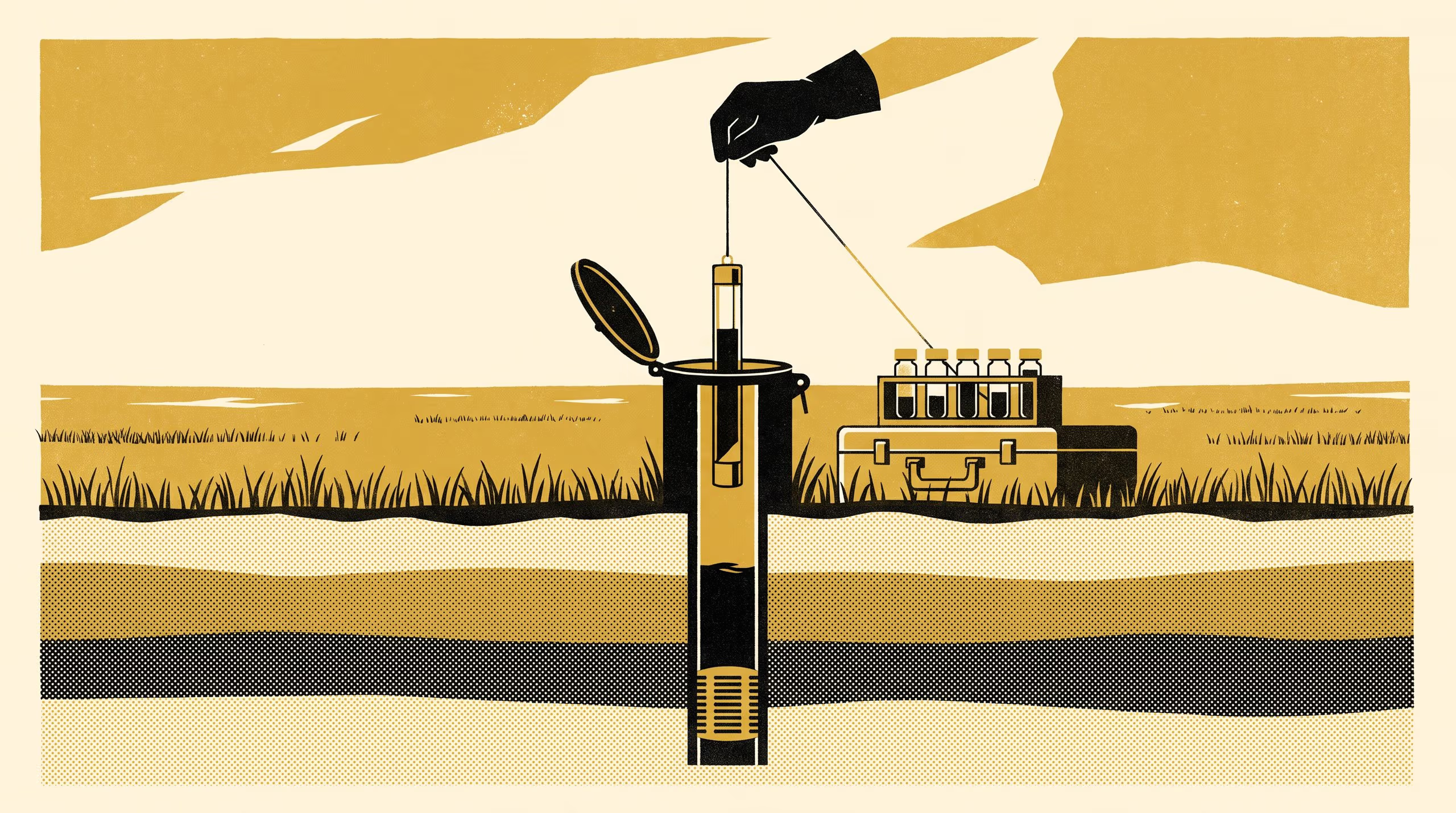
Dr Vigdis Emenike and Associate Professor Ragnhild Uzoma show that the radon missing from water standing in a bore casing can date the last purge to within a day, for about a fortnight.
A School of Underlying Conditions paper reads radioactive decay in the water left in a monitoring-bore casing as a clock with a two-week dial
Groundwater fieldwork at Slop University can now put a question directly to the water in a monitoring bore: how long have you been standing there? A new paper from the School of Underlying Conditions answers it with radon-222, which leaves standing casing water at a known pace once the bore stops being pumped.
We would be delighted to hear from anyone who has lifted the cap on a bore and wondered how long it had been waiting for them. That curiosity is where the School does its best work.
— Dr Vigdis Emenike, Senior Lecturer, School of Underlying Conditions
The study brings together field sampling, laboratory counting and a carefully sealed logbook to position the bore casing as an instrument in its own right. Measured against twenty purges whose dates the authors were not told, the radon clock dated fifteen within its stated uncertainty and was candid about the remaining five, reporting only that the water had stood for at least nineteen days.
The paper takes its place in a growing body of School scholarship on the instruments that sit quietly in the ground between visits, and on what they can be asked once someone returns.
“The next fortnight in the life of any bore is now a little less private,” said Associate Professor Ragnhild Uzoma, Lead of the Basement Relations Group.
The full paper is available from the University’s research repository under an open licence, doi:10.5555/slop.lfv4xz.