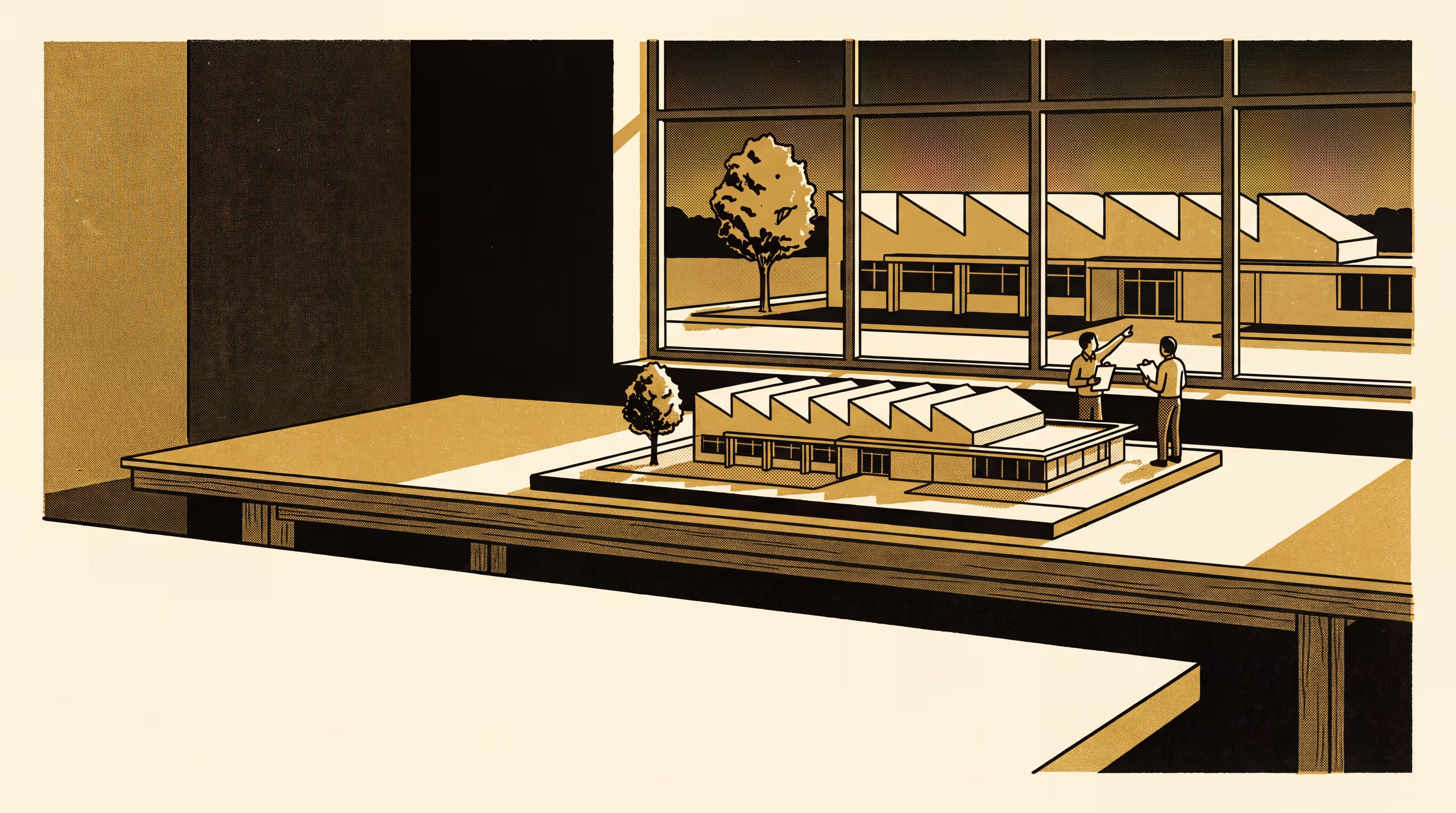
A display advertisement for the Master of Priority Studies brings the School of Emergent Priorities' Strategic Drift Survey to the University's landscape screens, prepared by Associate Professor Kwame Lindqvist.
A landscape signage campaign sets a planning-room model beside the building it became, matched line for line
The School of Emergent Priorities has always held that a priority is tested twice: once when it is decided, and again when it is carried out. A new display campaign for the School’s Master of Priority Studies, prepared by Associate Professor Kwame Lindqvist, Director of the program, takes that second test to the University’s landscape screens.
The poster draws on the Strategic Drift Survey, the School’s annual instrument for tracing the distance between stated and enacted priorities, and translates its findings into a single scene: a scale model on a planning-room table and, through the window behind it, the building it became. The campaign positions the program’s graduates at the hinge between intention and delivery, where decision-making in complex settings is understood to show its quality, and invites prospective students to build a program of their own.
Priorities usually reach a budget line long before they reach a definition. It is a rare pleasure to show one that arrived where it was pointed, and the program would welcome more people in the room when the next one does.
— Associate Professor Kwame Lindqvist, Director, Master of Priority Studies
The campaign extends the School’s long attention to the afterlife of a decision, and the University regards it as a fitting public face for that work. It runs in matched daylight and after-dark renderings, and its small print points readers to three earlier outputs from the University’s record.
The full poster is available from the University’s research repository under an open licence, doi:10.5555/slop.dpkz1r.