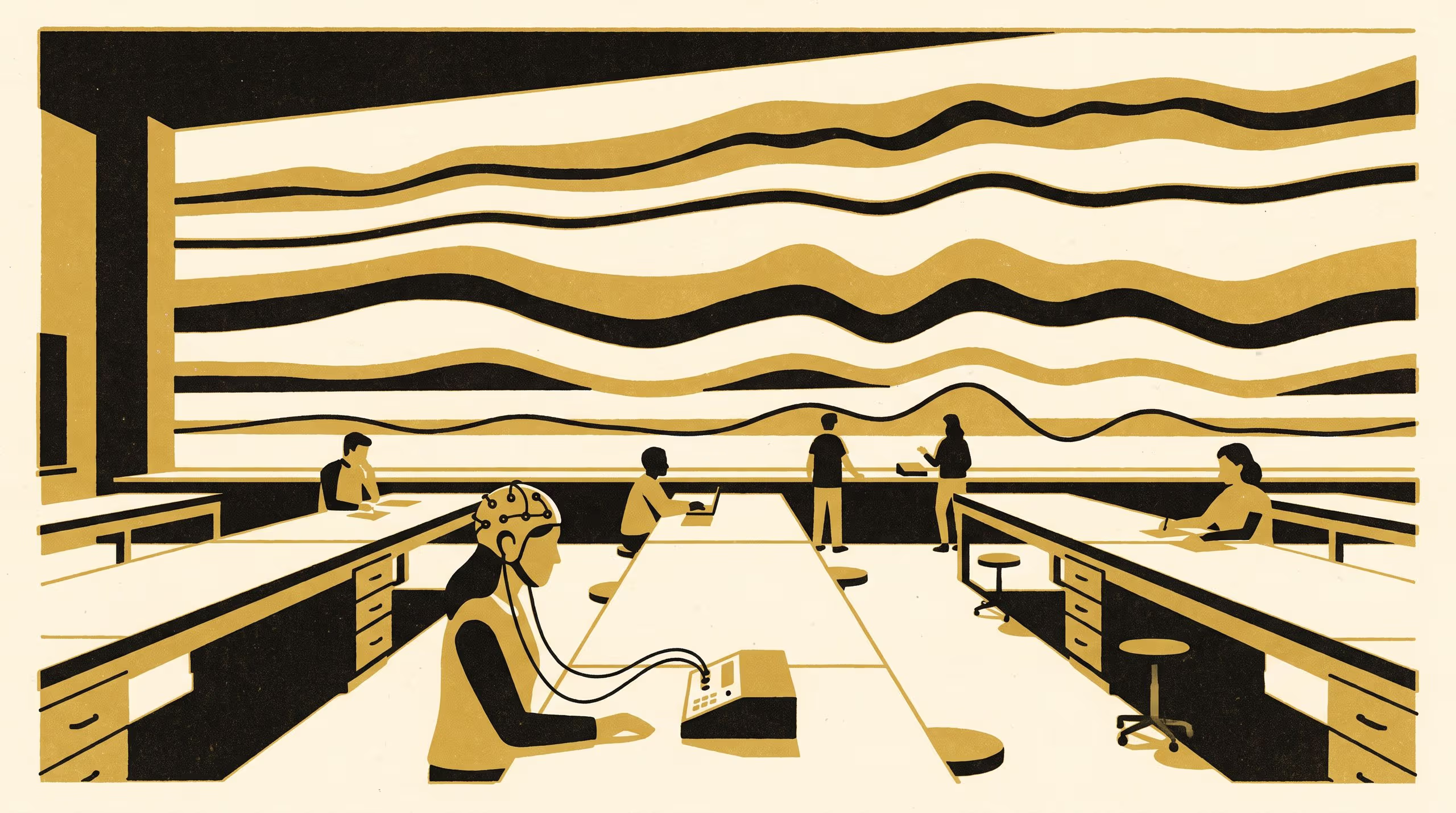
A new prospectus campaign from the School of Underlying Conditions asks prospective students to look at what the brain keeps doing when it has been given nothing to do.
A portrait signage campaign recruits students to the slow rhythms that run beneath every task
The School of Underlying Conditions has built its research agenda on the layer beneath the one everybody else is looking at. Its newest campaign, Study What the Brain Does Between Tasks, carries that agenda indoors, inviting prospective students to take up the slow, spontaneous activity the brain sustains when no task has been set.
The poster, prepared for the University’s portrait signage panels, shows a single student seated quietly under an electrode cap before a wall of traces banded like strata in a cutting. Its supporting line promises that graduates will learn to read those rhythms layer by layer, positioning the School’s stratigraphic sensibility as a natural foundation for an emerging capability in neural dynamics.
A resting brain is busier than most people expect, and most of what it does there goes unrecorded. We are looking for students who would rather sit with that than hurry past it, and there is a stool waiting.
— Associate Professor Ragnhild Uzoma, Lead of the Basement Relations Group
The campaign reflects the University’s settled view that a discipline is best introduced through the questions it has not finished asking. Its small print directs readers to three of the School’s recent outputs: a paper modelling which layer of a cortical column leads it into each up state of the slow oscillation, a prospectus on the brain’s two unequal halves, and an essay in political theory on hemispatial neglect.
Associate Professor Uzoma described the reading list as “a place to begin, rather than a syllabus,” and encouraged applicants to arrive with their own sense of what lies underneath.
The full poster is available from the University’s research repository under an open licence, doi:10.5555/slop.dwr8vx.