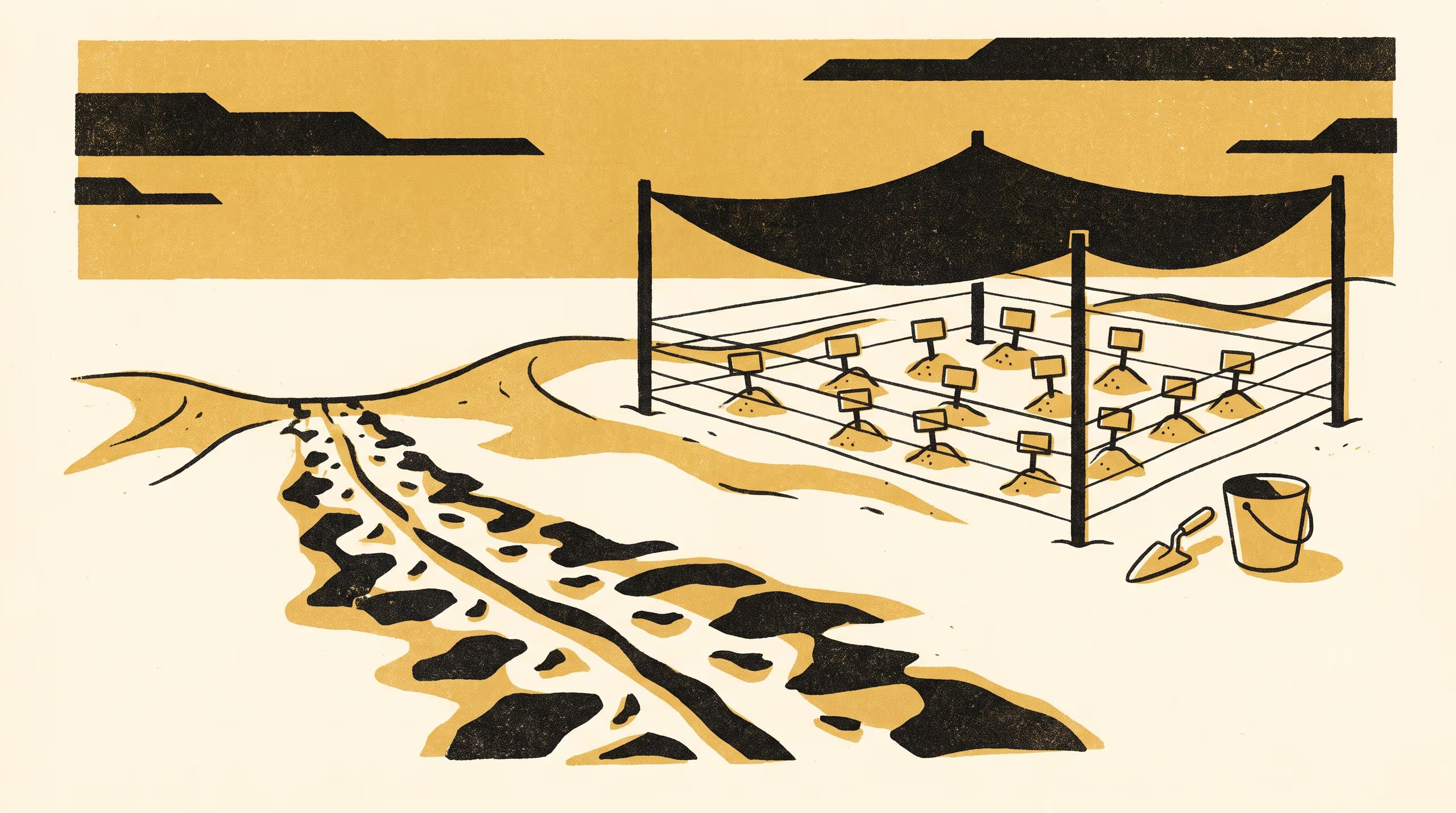
A new case note from the School of Continuous Improvement examines a divided appellate decision on whether moving marine turtle eggs to a hatchery destroys a protected nest.
Doctoral Candidate Eskil Nwabueze reads an appellate decision on hatchery relocation, and follows its reasoning to the chambers volunteers dig by hand
Every volunteer who has knelt over a clutch at first light has been doing a little law without being asked to. This note is, in a modest way, my thanks to all of them.
— Mr Eskil Nwabueze, Doctoral Candidate, School of Continuous Improvement
The School of Continuous Improvement today publishes Nests Dug by Hand, a case note by Mr Nwabueze on a recent appellate decision about marine turtle eggs, a volunteer hatchery and a single undefined word in a wildlife statute. The Court of Appeal held, by majority, that a turtle’s nest is not its eggs but the chamber of sand they incubate in, so that relocating a clutch destroys a nest even when every egg hatches. The note supports that reading and carries it one step further, to the hatchery itself.
Bringing close statutory reading into conversation with the incubation science of marine turtles, the note positions the shaded hatchery as a meeting point between conservation practice, legislative intent and the evolving settings of the permit framework. It is the kind of patient, cross-disciplinary scholarship the University has come to regard as part of its ordinary business.
“A School like ours asks, sooner or later, where a thing stops and its circumstances begin,” said Associate Professor Casimir Beng, Lead of the Adaptive Metrics Lab, who welcomed the note on the School’s behalf. “It is good to learn that the question has a beach in it.”
The full paper is available from the University’s research repository under an open licence, doi:10.5555/slop.7qanwf.