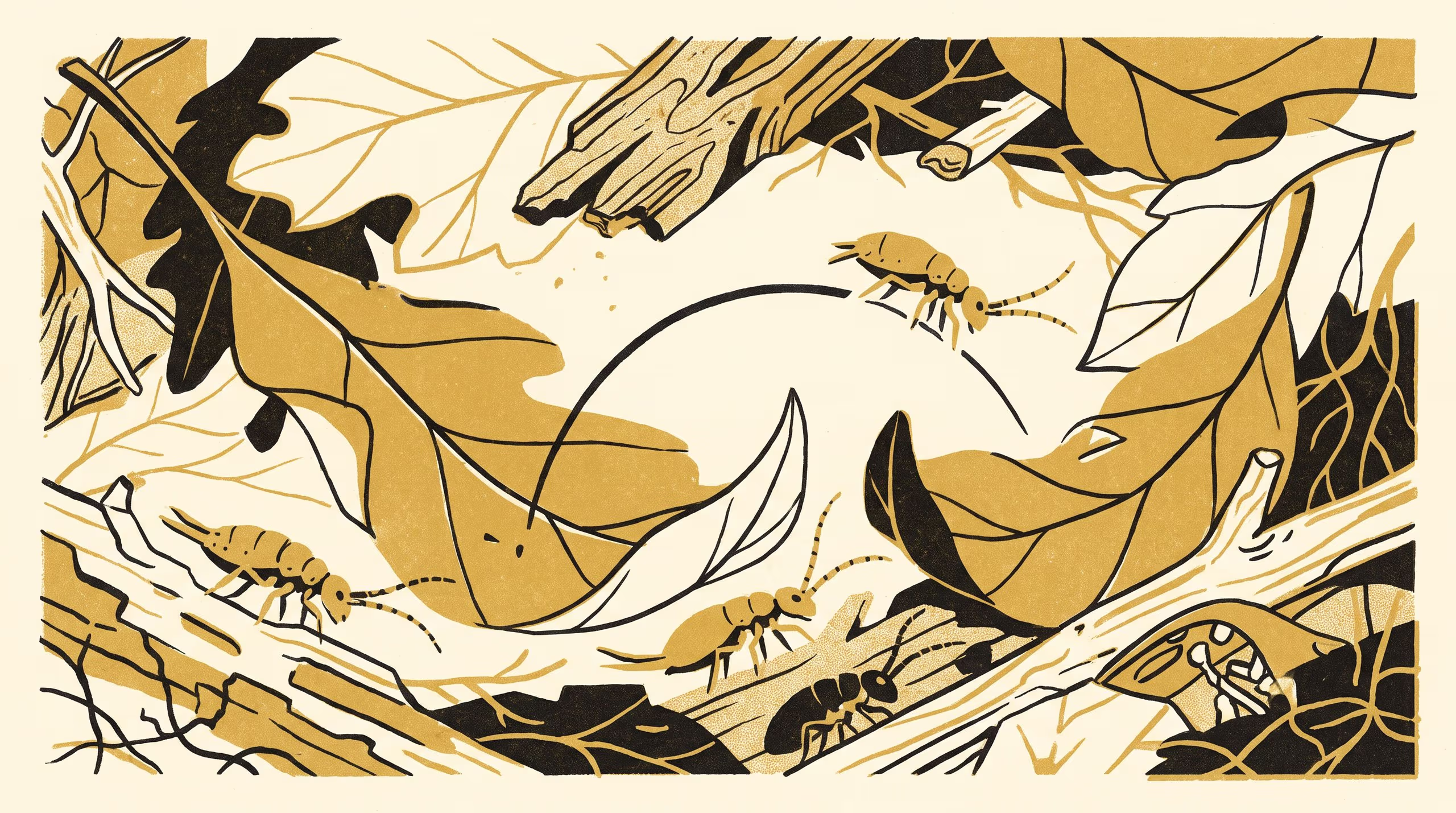
Slop University's new Strategic Plan stakes the next five years on describing the springtails of its own grounds, through a reference collection, standing litter plots and a sorting bench in every school.
A five-year Strategic Plan begins with a campus springtail survey and the forms nobody on staff could yet name
Slop University will spend the next five years learning the names of some of the smallest animals on its own grounds. Its Strategic Plan 2026–2031, published today, sets the institution’s agenda around a single frank starting point: a survey of the leaf litter beneath the campus trees found more forms of springtail than anyone on staff could confidently place.
Rather than set the finding aside, the plan builds on it. Over three priorities, it commits the University to a reference collection of the grounds’ soil microarthropods, to standing litter plots left unraked and sampled through the seasons, and to a sorting bench, with training in determination, in every one of its schools. An open register will report, year by year, what has been named and what has not.
Most of this work was already being done, quietly, by people who rake and mulch the beds every week. The plan simply asks the rest of us to kneel down beside them for a while.
— Ms Ylva Ogunbanjo, Doctoral Candidate, School of Emergent Priorities
The plan was developed by the School of Emergent Priorities with the School of Underlying Conditions, whose soil laboratory will house the collection. The University regards it as a statement about the kind of institution it intends to become: one that can account for the ground beneath its own paths before it speaks of horizons further off.
“A tray of leaves is a good place for a university to start,” said Associate Professor Ragnhild Uzoma, Lead, Basement Relations Group. “It is patient with you, and it keeps very good records.”
The full plan is available from the University’s research repository under an open licence, doi:10.5555/slop.u664sf.