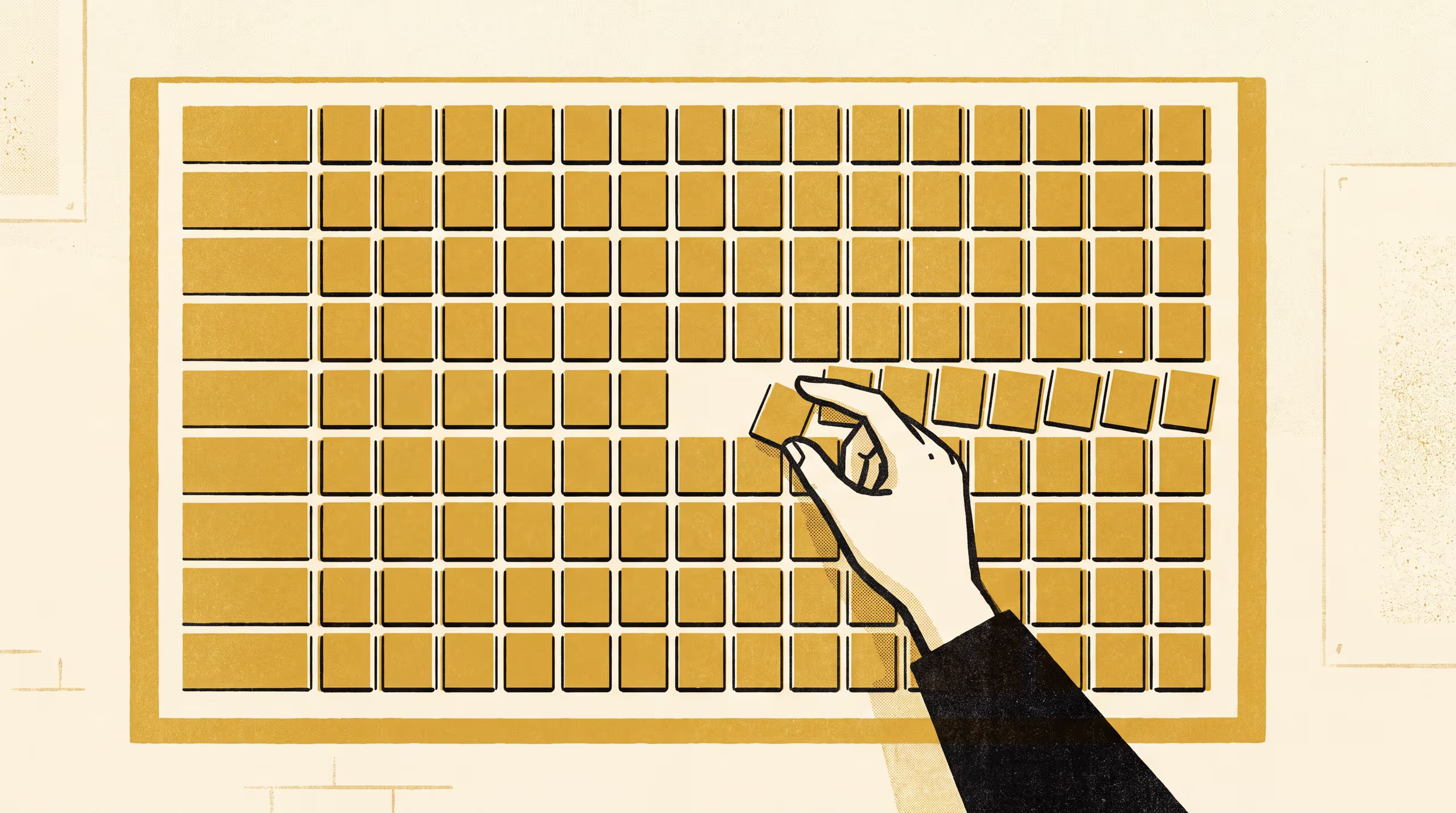
A new research poster from the School of Emergent Priorities borrows the physics of jamming to explain why room changes made for a single term so often stay for good.
A jamming model of one secondary school's timetable, from the School of Emergent Priorities
The School of Emergent Priorities has long kept an eye on arrangements that were only ever meant to be brief. Its newest research poster, Why the Temporary Room Swap Stays, carries that interest into the school timetable, and into the language of theoretical physics.
Led by Doctoral Candidate Tove Ilesanmi, with Dr Bram Ntuli and Associate Professor Casimir Beng, the poster treats a secondary school’s rooms and periods as a tightly packed system and follows 147 room changes entered as temporary across one teaching term. It finds that as the timetable fills, undoing any one change asks more and more of everything around it, until a swap made for the term is, in practice, the arrangement the school keeps.
I came in expecting to find that temporary arrangements last because nobody gets round to them. It seems the timetable gets round to them first, and I have found that oddly reassuring.
— Mr Tove Ilesanmi, Doctoral Candidate, School of Emergent Priorities
The work brings together constraint modelling, close attention to a working room-change log and a careful reading of occupancy across the term, positioning the School’s agenda on provisional arrangements alongside the wider conversation about how institutions allocate shared space. It sits comfortably within the University’s continuing investment in research that takes everyday administration seriously as an object of study.
Associate Professor Beng described the finding as “a useful thing for any organisation with rooms to keep in mind, ourselves very much included,” and the team will extend the model to a second school with a different mix of rooms.
The full poster is available from the University’s research repository under an open licence, doi:10.5555/slop.uozmus.