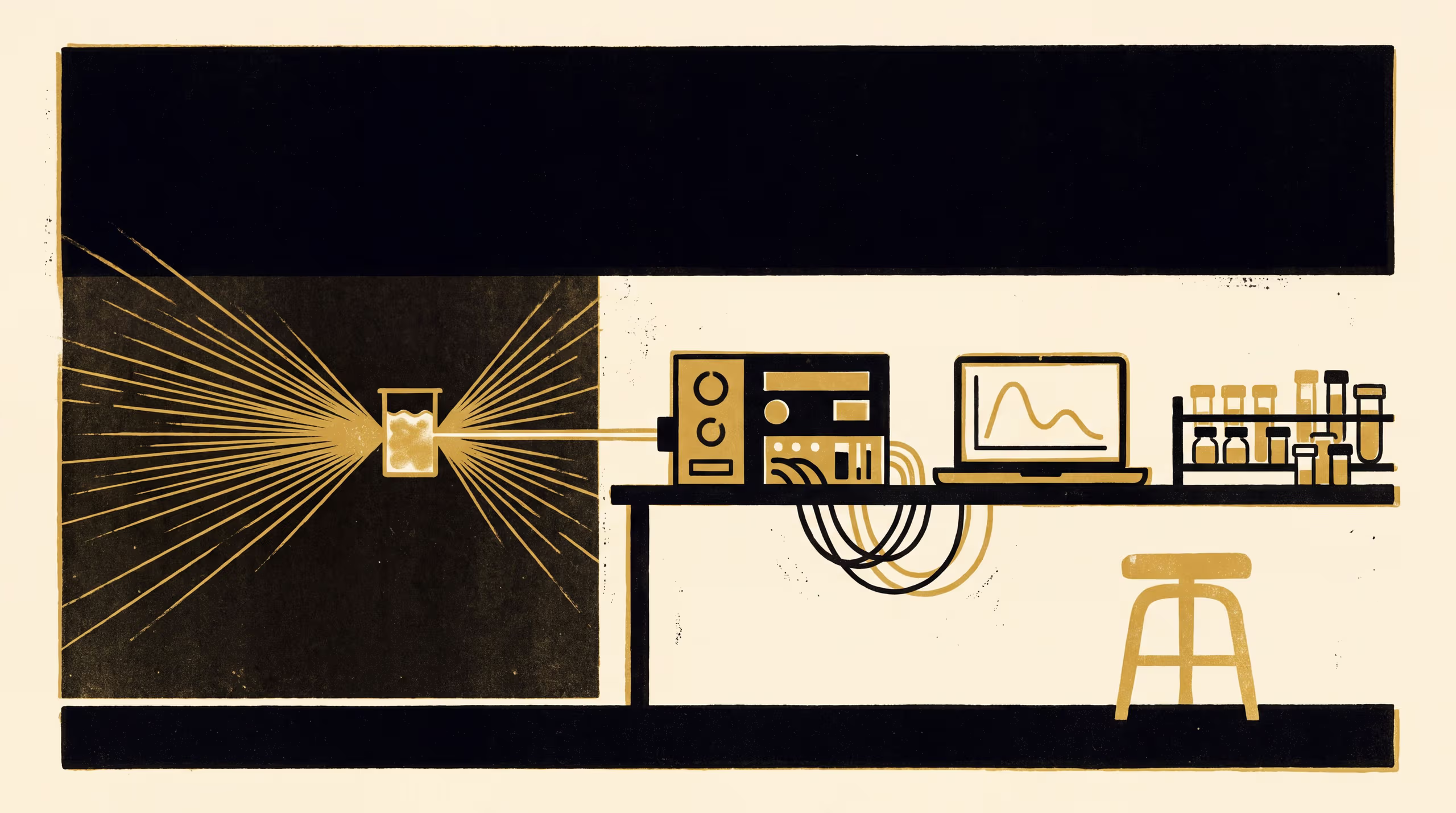
A new research poster from the School of Underlying Conditions puts a surfactant laboratory's light-scattering analysis software through six tests the physics guarantees, and finds its rare failures gathered where the program decides whether a sample holds one population of particles or two.
A metamorphic testing study of one colloid laboratory's in-house light-scattering pipeline, and where its answers move when they should hold still
Before a laboratory reports the size of anything it cannot see, a short program has already made up its mind. A new research poster from the School of Underlying Conditions asks that program to make up its mind twice, and checks that it arrives at the same place.
The study, One Peak or Two, brings the discipline of software testing to the analysis code behind six years of routine micelle and emulsion sizing in a single surfactant laboratory. By pairing each archived measurement with a deliberately altered twin, the team built a framework for interrogating scientific software where no answer key exists, and traced the handful of lines in which its occasional disagreements begin.
A soil surveyor learns early that every boundary on the map was drawn by somebody. It was a pleasure to meet a boundary drawn by a program for once, and to be able to ask it how it decided.
— Dr Brynjar Obiora, Senior Research Fellow, School of Underlying Conditions
Associate Professor Casimir Beng, Lead of the Adaptive Metrics Lab, described the work as an instance of the University’s patient attention to the tools it relies on. “An instrument that can be asked the same question twice is a generous instrument,” he said. “We intend to keep asking.”
The poster adds to a growing body of work at the University on the software that sits quietly between an apparatus and its result.
The full poster is available from the University’s research repository under an open licence, doi:10.5555/slop.wh134j.