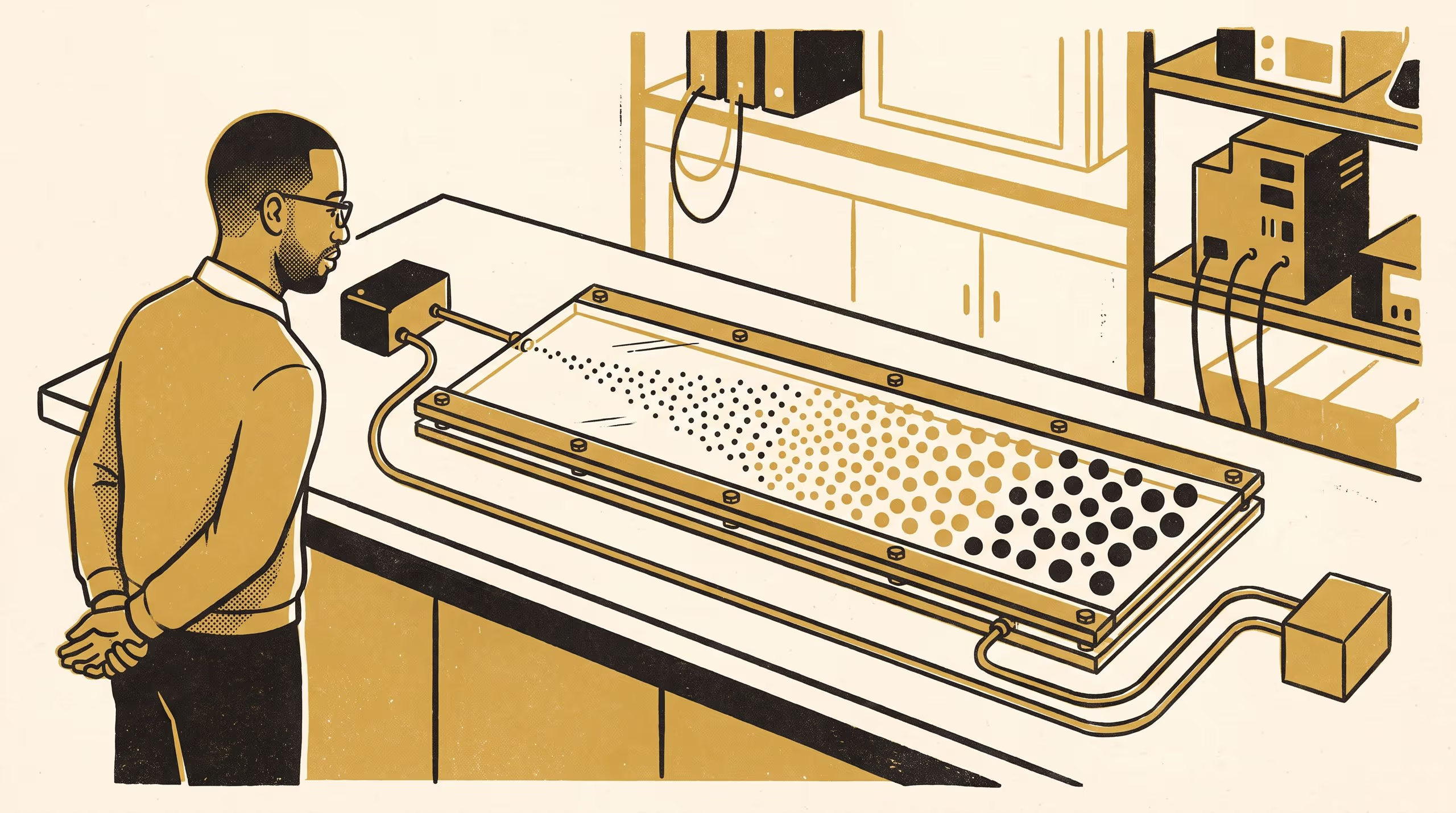
A new marketing poster from the School of Emergent Priorities features Doctoral Candidate Halvard Nnamani and the patient sorting of a field-flow fractionation channel.
Halvard Nnamani fronts a campaign built around field-flow fractionation, a way of sorting a sample with nothing in its path to catch on
On the University’s portrait signage panels, a figure in a lab coat now stands over a flat, clamped channel and watches a cloud of particles come apart into bands. The figure is Halvard Nnamani, Doctoral Candidate in the School of Emergent Priorities, and the poster is Everything Elutes in Its Own Time.
The campaign takes its image from field-flow fractionation, in which a sample carried along a thin channel is pressed gently towards one wall by a cross-flow and sorts itself by size as it travels, with no filter or packing for anything to catch on. The School has found in that apparatus a fitting account of its own posture: separation offered as a courtesy, rather than enforced as a gate.
I spent seven seasons deciding which registration went in which column. It has been a quiet pleasure to work somewhere that lets the sample decide.
— Halvard Nnamani, Doctoral Candidate, School of Emergent Priorities
Built around a single full-bleed illustration in the University’s two-ink house style, the poster pairs the channel with a short reflection from Mr Nnamani and directs its readers to three of the University’s published works: his doctoral thesis on the “Other (please specify)” box, a School of Underlying Conditions study of what happens to a gravitational fractionation channel when its bench is not level, and a taxonomy of the instructions households leave for whoever feeds the cat.
The University regards the campaign as a clear expression of how the School would like to be met, and of the patience its research culture extends to every idea in the channel.
The full poster is available from the University’s research repository under an open licence, doi:10.5555/slop.7poj2x.