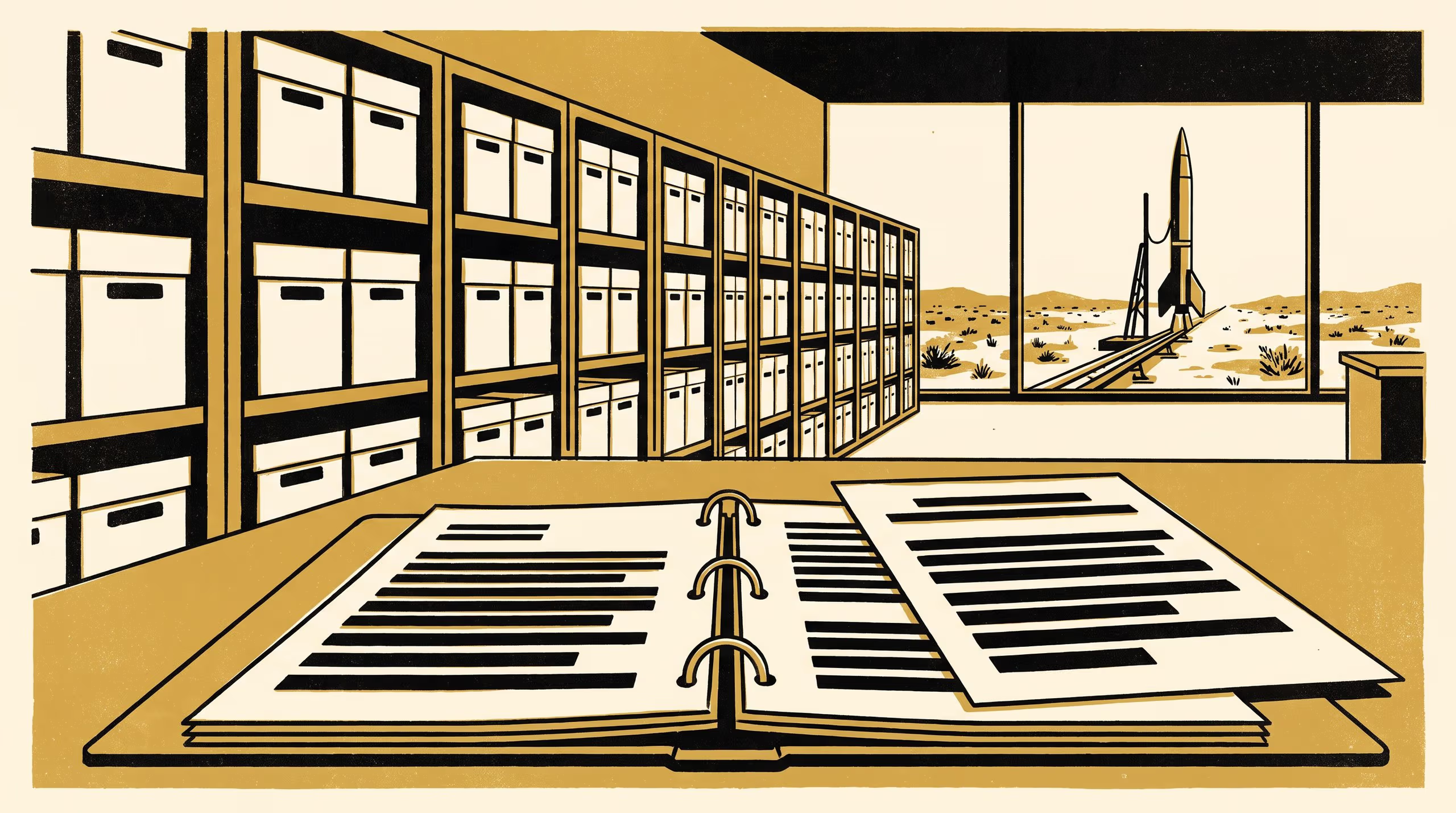
A new paper from the School of Emergent Priorities traces every condition in fourteen years of a small national space regulator's licences back to where it was first written, and finds a requirement drafted for a sounding rocket still at work in the permit for a small satellite.
A study of one small regulator's archive finds that most conditions in a new licence were written for an earlier one
The School of Emergent Priorities, whose researchers study what institutions keep of their own past decisions, has published its first paper on the regulation of space activities.
The Inherited Condition is by Dr Petra Umbile, Postdoctoral Fellow, with Dr Iben Chikere, Lecturer, and Dr Anneke Tolan, Senior Research Fellow and Deputy Convenor of Futures in Committee. Working from fourteen years of a licensing office’s instruments, the team assembled a genealogy of every condition the office has issued, then sat beside its officers as they drafted the next one.
Every document we write at the School begins as somebody else’s. We would be glad if this paper did too, for whoever drafts the next one.
— Dr Petra Umbile, Postdoctoral Fellow, School of Emergent Priorities
The paper situates licence drafting at the intersection of organisational memory, routine dynamics and regulatory practice, mobilising text-alignment methods to surface the lineages that connect one instrument to the next. Its central contribution is the carried condition: a requirement that has travelled further than the activity it was written for, and that the authors read as the way an office remembers.
Dr Tolan described the fieldwork as “a privilege, and a reminder that careful work and quick work are often the same work, done by the same people on the same afternoon”.
The study is the kind of patient, archive-first scholarship the University has come to count among its quieter strengths.
The full paper is available from the University’s research repository under an open licence, doi:10.5555/slop.t7lz6t.