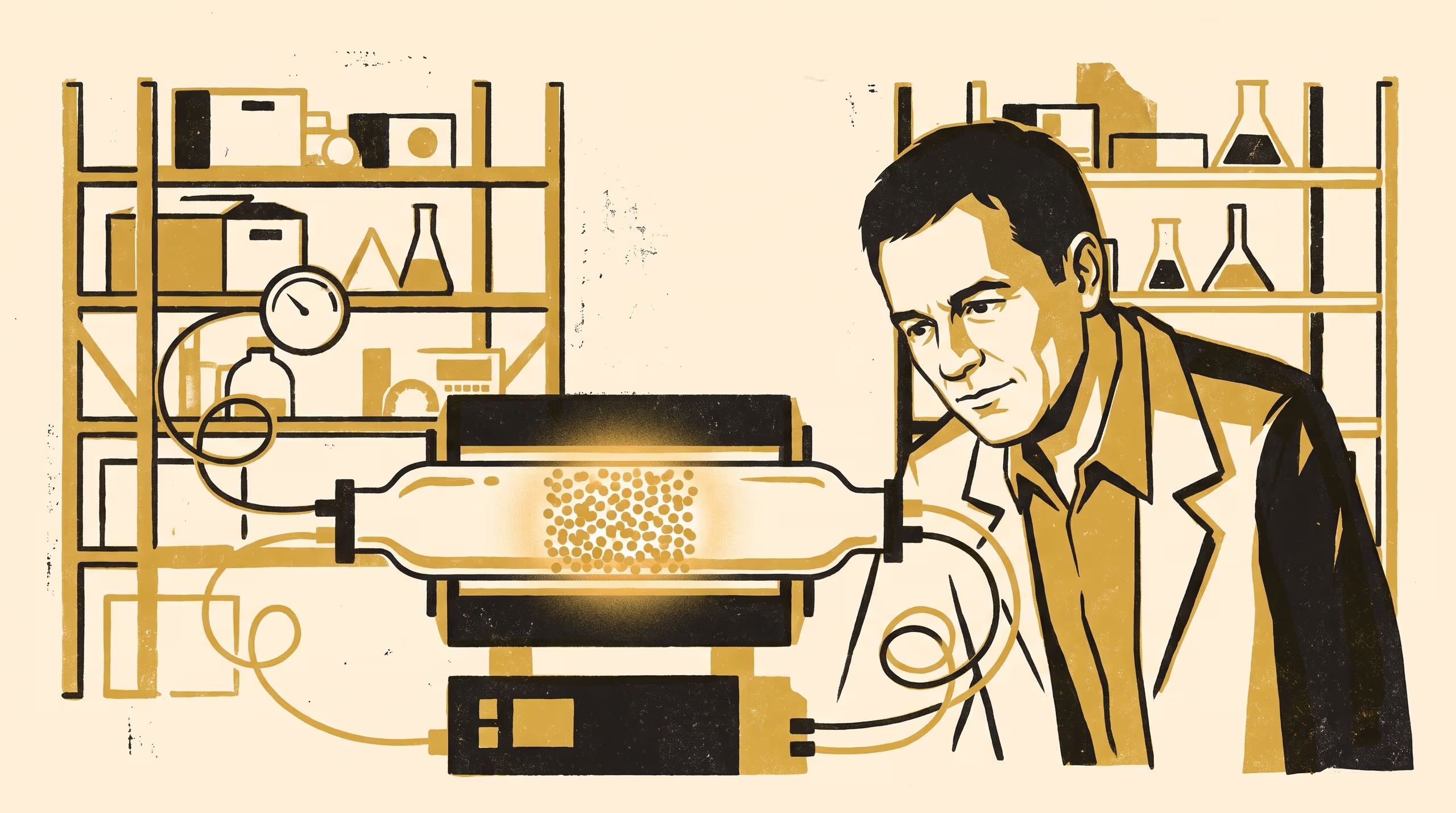
The School of Continuous Improvement's newest display campaign places Dr Sten Okwuosa at a laboratory catalyst bed, and invites the public to meet the researchers behind the University's published record.
Dr Sten Okwuosa fronts a display campaign set beside a catalyst bed that takes ethane most of the way, and no further
Some of the most careful work in chemistry happens a step before the end. A catalyst bed asked to oxidise ethane is asked, in effect, to carry it most of the way and then to hold back, and the School of Continuous Improvement has made that restraint the subject of The Hard Part Is Knowing When to Stop, its newest display campaign, now in the portrait rotation of the University’s campus screens.
The campaign features Dr Sten Okwuosa, Senior Research Fellow and Convenor of the Impact Pathway Atlas, at a laboratory tube furnace, attending to the narrow gold band of a packed reactor tube.
The Atlas usually follows a finding after it has left the bench. Standing at the bench for once, our School has learned that the most telling part of a pathway is often the step it declines to take.
— Dr Sten Okwuosa, Senior Research Fellow and Convenor, Impact Pathway Atlas, School of Continuous Improvement
The poster sets the School’s established attention to pathways, thresholds and sufficiency alongside the selectivity questions that animate catalytic oxidation, and lets a single quiet scene carry the connection. Its small print directs readers to the University’s own published work on where a recycled palladium catalyst goes, on the record a retired ammonia converter’s iron bed keeps of its deactivation, and on the University’s wider thinking about ammonia synthesis.
In mounting the campaign, the University affirms a conviction it holds with growing confidence: that a well-judged stopping point is itself a contribution, and that the people who find one deserve to be seen.
The full campaign poster is available from the University’s research repository under an open licence, doi:10.5555/slop.5nb3ge. The University’s researchers may be met at slop.university/people.