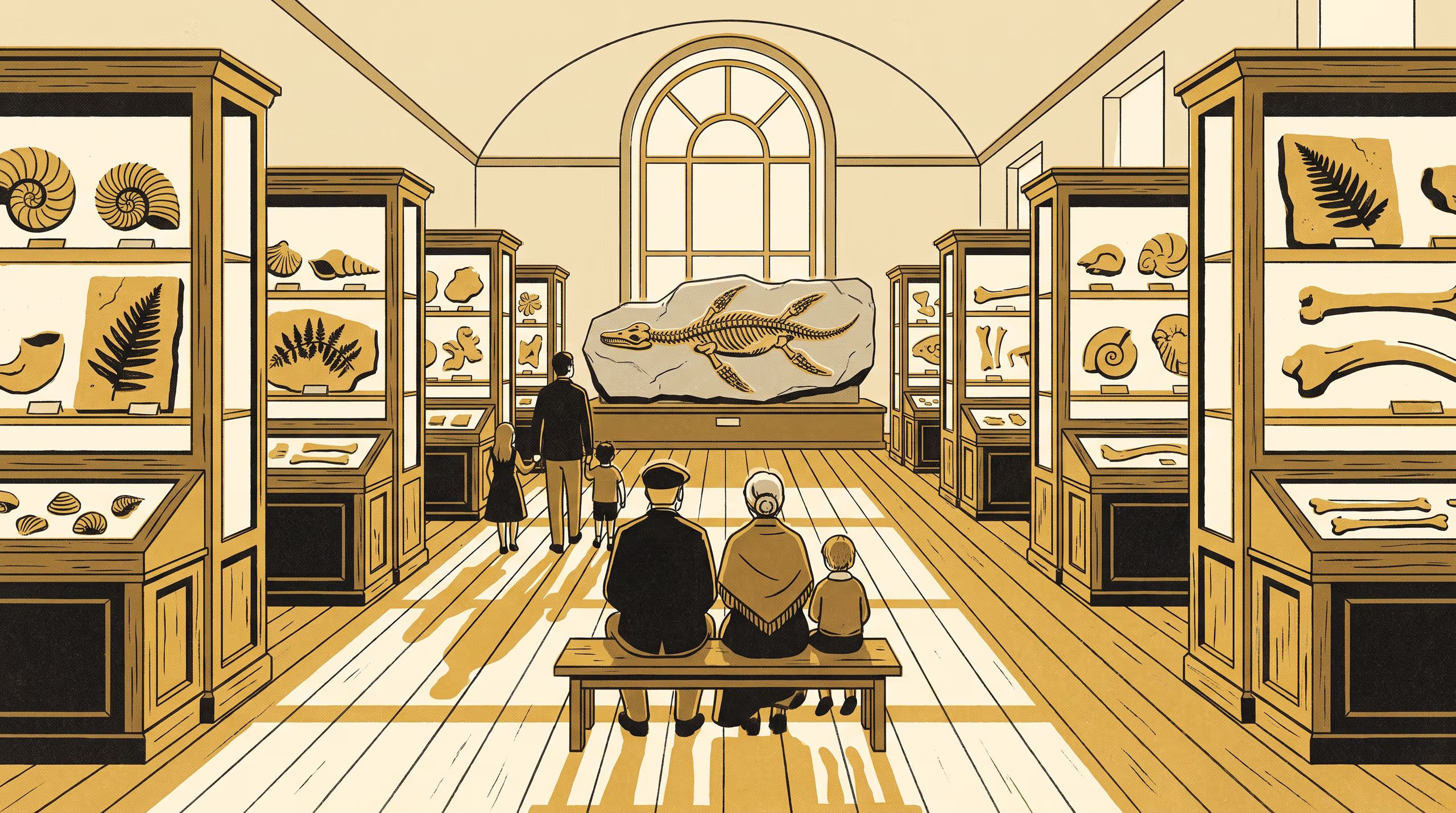
A paper from the School of Continuous Improvement follows thirty years of Sunday afternoons in a borough's fossil gallery, and finds its working visitors met the deep past as a walk of fixed length taken between two bells.
A provincial museum fitted its fossil gallery between chapel services, and its keeper fitted the ages of the earth into a thirty-minute walk
Cadence is the School of Continuous Improvement’s home ground: how often an institution looks at a thing, and what the interval does to the looking. In The Half-Hour of the Ages, Dr Osei Vandermeer, Research Fellow and Convenor of the Review Cadence Observatory, carries that interest back to a fossil gallery in a manufacturing borough, which opened its doors on Sunday afternoons from 1868.
The School has always been interested in the rhythm an organisation keeps. It was a privilege to spend a year with one that kept its rhythm so carefully, and so courteously, with the neighbours on either side of it.
— Dr Osei Vandermeer, Research Fellow and Convenor, Review Cadence Observatory, School of Continuous Improvement
Working across committee minutes, a keeper’s daybook, a printed handbill and a visitors’ book kept on Sundays alone, the paper situates the gallery within a wider ecosystem of chapel, Sunday school and shift, and traces how its hours, its route through the cases and its visitors’ own remarks came into alignment around a single afternoon interval. The keeper’s walk, it finds, took a family from the present day to the oldest rocks of the district in thirty minutes, and closed seated before the bells for evening service. When the gallery was rehung on a branching plan in 1896–97, the walk could no longer be given.
The paper is a welcome addition to the University’s growing body of work on institutional timekeeping, and a reminder that the scheduling of attention has a longer history than any one review cycle.
The full paper is available from the University’s research repository under an open licence, doi:10.5555/slop.27v2ie.