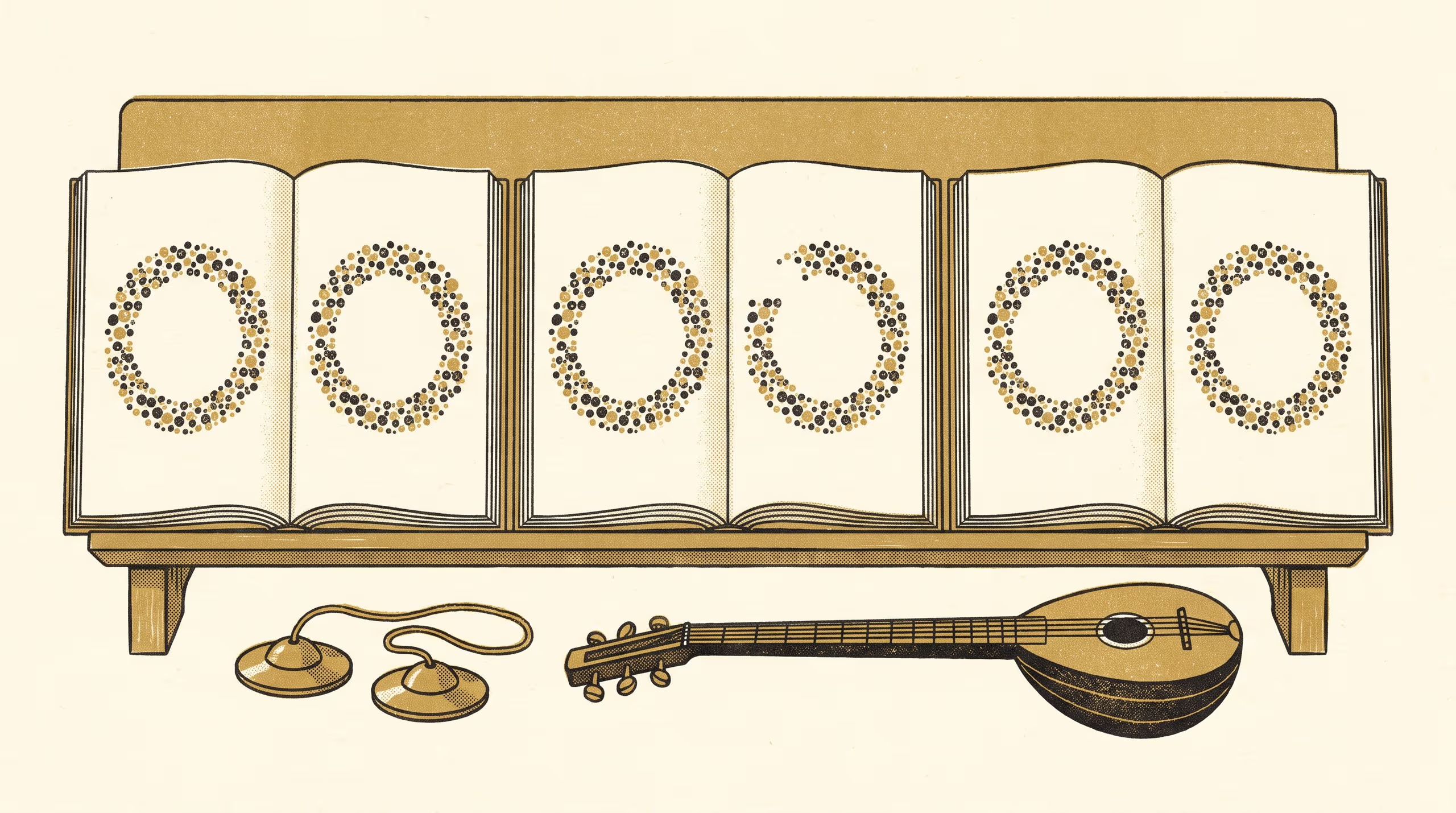
A new paper from the School of Continuous Improvement argues that fourteen incomplete rings in an anonymous commentary on rhythmic cycles were drawn open deliberately, and that the copyists who completed them were settling a question about time.
Three copies of an anonymous commentary on rhythm show its later scribes closing what the first had left for the coming round
Some gaps are left on purpose. A new paper by Dr Renke Sabel of the School of Continuous Improvement makes that case for fourteen rings of dots in an anonymous commentary on rhythmic cycles, each drawn with one place empty in the oldest surviving copy, and each completed by the copyists who came after.
Our School gives most of its days to making things better, so it was a pleasure to spend a few months with a copyist who stopped three times and left the page as he found it. I like to think there is something in that for all of us.
— Dr Renke Sabel, Senior Lecturer and Convenor, Indicator Commons, School of Continuous Improvement
The commentary sets out each cycle as a ring, one dot to every beat. Working across all three copies, the paper aligns the oldest manuscript’s open rings with the commentary’s own sign for a cycle that comes round again, sets each empty place against the spacing of its neighbours, and follows the later scribes as they add dots, strike through glosses and write new ones. Along the way it finds that one copyist left open exactly the three rings whose glosses argue for the gap at length.
The paper joins a widening thread of University scholarship that treats the copy as a document in its own right, and the corrector as an author worth reading closely.
Dr Vigdis Emenike, Senior Lecturer in the School of Underlying Conditions, whose own work on an anonymous keyboard cycle the paper cites, said she was “delighted to see an empty place given a whole paper, and a little envious of the copyist who knew when to stop”.
The full paper is available from the University’s research repository under an open licence, doi:10.5555/slop.bntkrb.