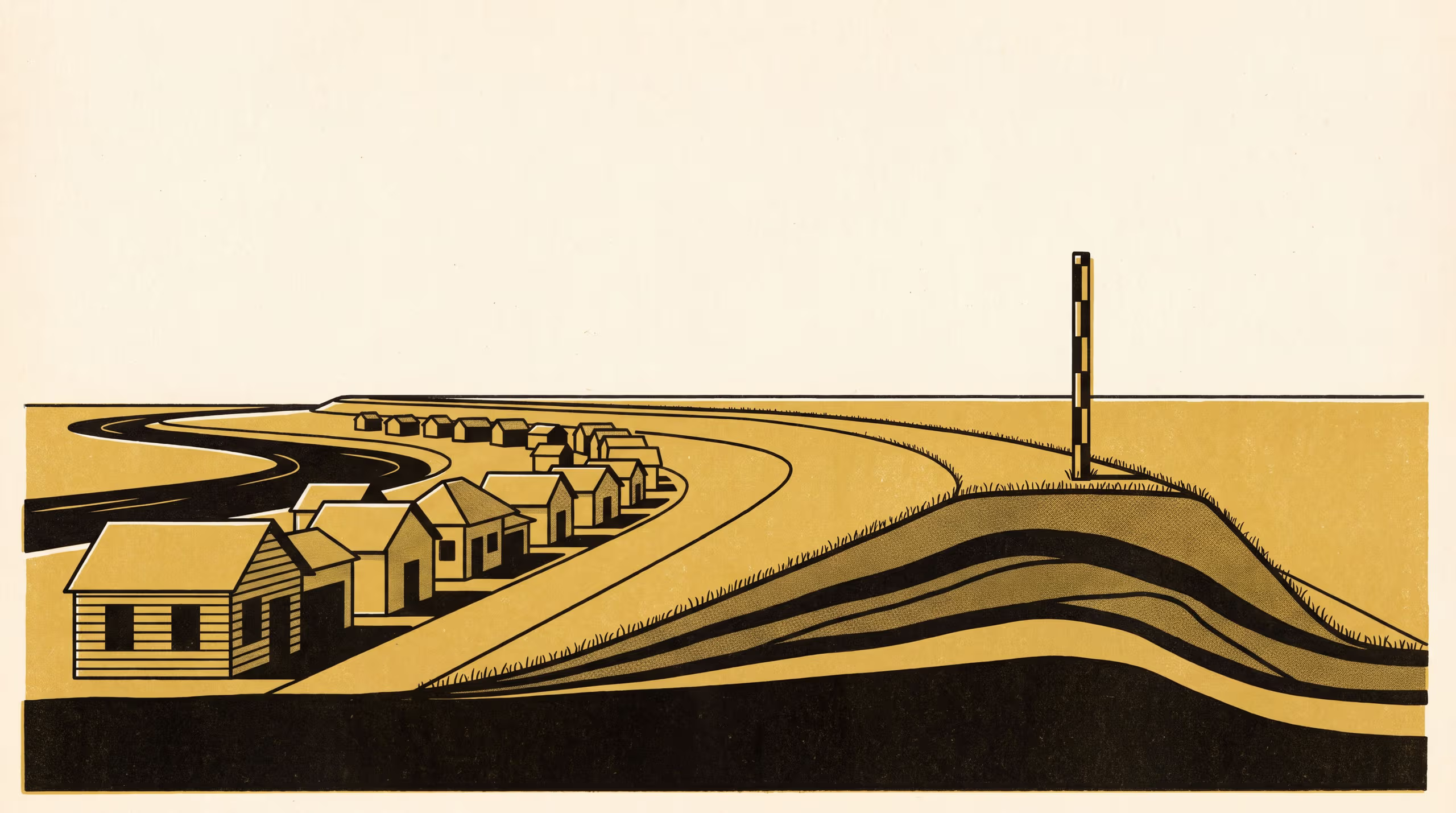
A new research poster from the School of Continuous Improvement follows seven raisings of one river town's levee through its minutes, and the changing names its council gave the people the levee would protect.
A century of council minutes moves a flood levee's beneficiaries from children to ratepayers to users
A flood levee that has kept one small inland river town dry for a century has also, according to a new research poster from the School of Continuous Improvement, been kept for a steadily changing cast of people. Who the Levee Is For follows the levee through seven raisings and the council and levee-trust minutes that authorised them.
Every institution builds for somebody it will never meet. It was a privilege to spend time with a town that wrote that somebody down so carefully, and I suspect the School will be looking at its own minutes a little differently for a while.
— Eskil Nwabueze, Doctoral Candidate, School of Continuous Improvement
The poster brings the philosophy of responsibility into conversation with the everyday documentary infrastructure of local flood protection, tracing how the levee’s future beneficiaries move through the minutes from “our children” to future ratepayers and, in recent decades, to the asset’s users. Working across 398 passages, the authors situate each shift alongside the financing and planning settings of its raising, surfacing the relationship between how a community describes its future and what it understands itself to owe it.
The project brings together Mr Nwabueze with Ylva Onyekwere, Doctoral Candidate in the School of Emergent Priorities, and Dr Marek Solheim, Lecturer and Deputy Convenor of the Horizon Register, whose work on what becomes of an institution’s priorities informed the reading. “The long view is never finished,” Dr Solheim said. “Someone is always adding the next layer.”
The study sits within the University’s continuing investment in the humanities of infrastructure, and is supported by the Anticipatory Capability Fund.
The full poster is available from the University’s research repository under an open licence, doi:10.5555/slop.fr5tdl.