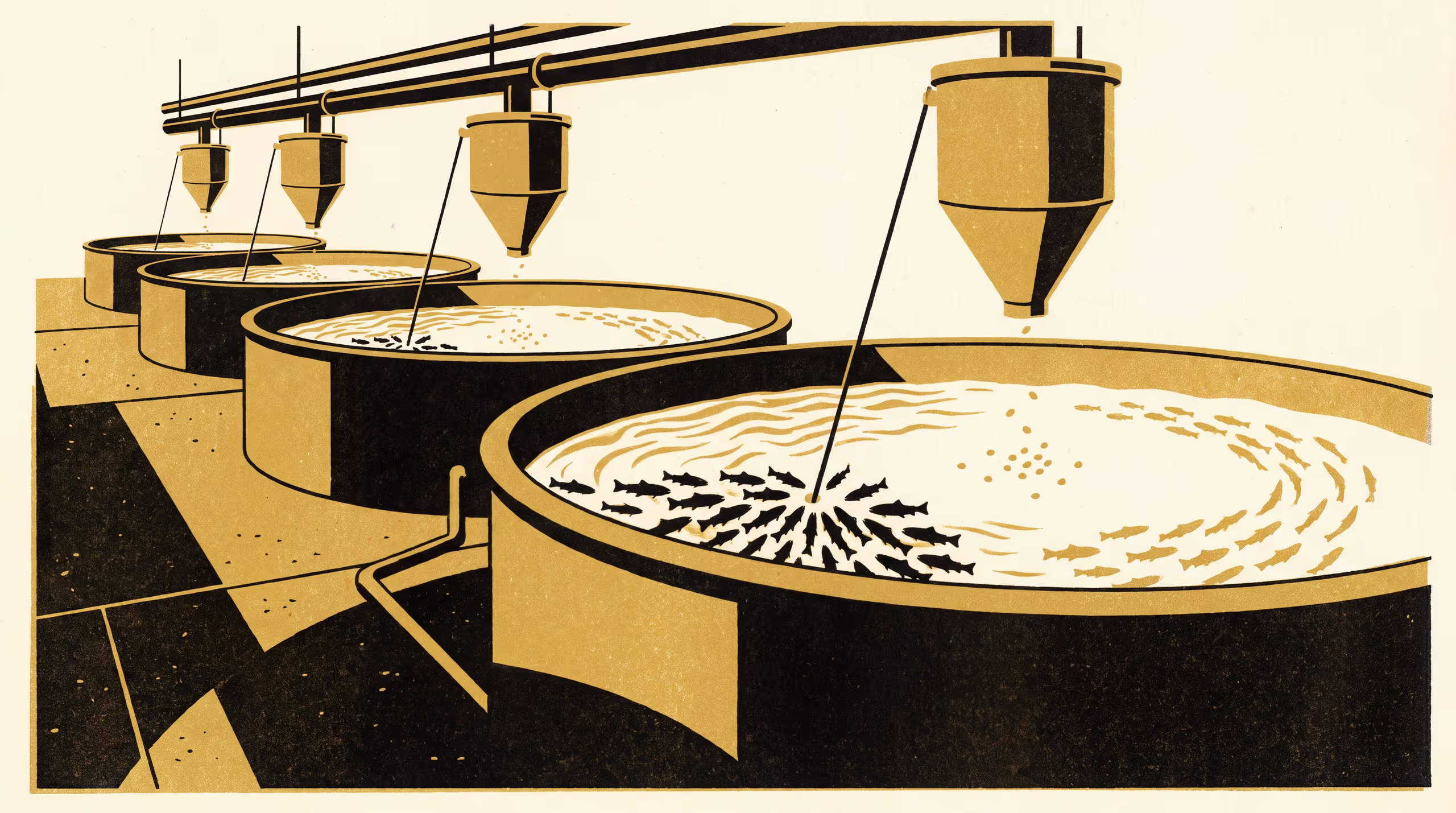
A research poster from the School of Emergent Priorities finds that in demand-fed tanks of juvenile trout three fish do most of the triggering, grow no faster than the rest, and are replaced within days when removed.
A doctoral poster follows the fish that work a hatchery self-feeder, and the ration they leave behind when they go
In a tank of forty young trout fed on demand, three fish do most of the asking, and the other thirty-seven eat just as well for it. That is the central finding of The Few Who Ring for Supper, a research poster released today by the School of Emergent Priorities.
The poster is by Mr Halvard Nnamani, Doctoral Candidate, and Professor Verity Marris, Director of the Trajectory Analytics Group.
Doctoral work has a way of finding the School’s questions in places the School would not have thought to look. Mr Nnamani went looking in a rearing hall, and has come back with one we expect to be turning over for some time.
— Professor Verity Marris, Professor and Director, Trajectory Analytics Group
Bringing individual-level feeding telemetry into conversation with the School’s enduring interest in how a shared agenda comes to be set, the work traces the relationship between the fish that operate a feeder and the appetite of the group it serves, and offers a careful account of what a tank does when its most active members are no longer there to speak for it.
“I went in expecting to learn who was in charge,” said Mr Nnamani. “The tanks were very patient with me while I learned that the question was mine rather than theirs.”
The poster carries the School’s study of priorities somewhere new, and the University counts it a quiet pleasure that a question first asked of committees and forms has found such willing respondents in the water.
The full poster is available from the University’s research repository under an open licence, doi:10.5555/slop.34g8rb.