A paper from the School of Continuous Improvement links a facility's operational incident log to eleven birth years of a NOD mouse colony and finds that only two changes, a relocation and a cage-wash outage, coincided with shifts in autoimmune diabetes onset.
Eleven years of building records, matched to an autoimmune mouse colony's monitoring sheets, single out one eleven-day washer outage
A paper published today by the School of Continuous Improvement brings two of a research building’s most patient habits, keeping a colony and keeping a log, into a single analysis. The Week the Cage Wash Stopped is the work of Dr Marit Osayande, Convenor of the Living Dashboard, and Dr Solveig Adeyemi, Lecturer in the School.
Every building has its unplanned weeks. What we hope this paper leaves behind is a colony that is ready for the next one, and a log that knows somebody is reading it.
— Dr Marit Osayande, Lecturer and Convenor, Living Dashboard, School of Continuous Improvement
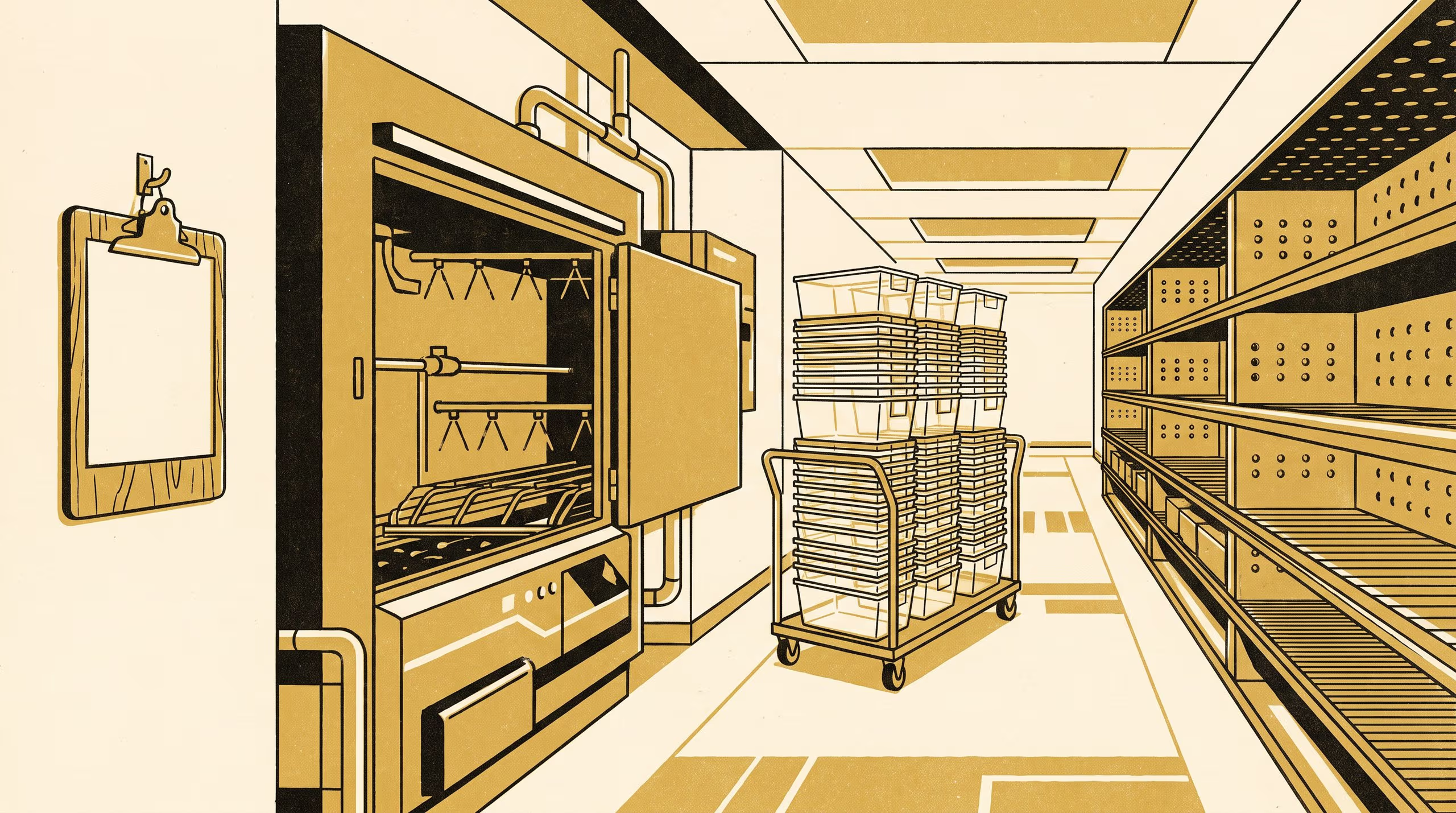
Methodologically, the paper treats the building itself as a participant, mapping each operational entry onto the rooms and plant that serve an in-house NOD mouse colony and reading it against the early-life window of every litter born there. Across 1,146 female monitors and more than a thousand logged events, most of the building’s disturbances left the colony’s incidence of autoimmune diabetes undisturbed. Two did not: the colony’s move into a barrier suite, and an eleven-day cage-wash outage whose sixteen litters reached 49.2 per cent incidence against 77.0 per cent in the litters either side.
Dr Adeyemi placed the paper within a wider turn across the School towards the records an institution already keeps. “An incident log is written in the hope that someone downstream will make use of it,” she said. “It has been a privilege to be downstream.”
The University regards the study as a fitting meeting point between its laboratory life and its long attention to operational practice.
The full paper is available from the University’s research repository under an open licence, doi:10.5555/slop.22pvln.