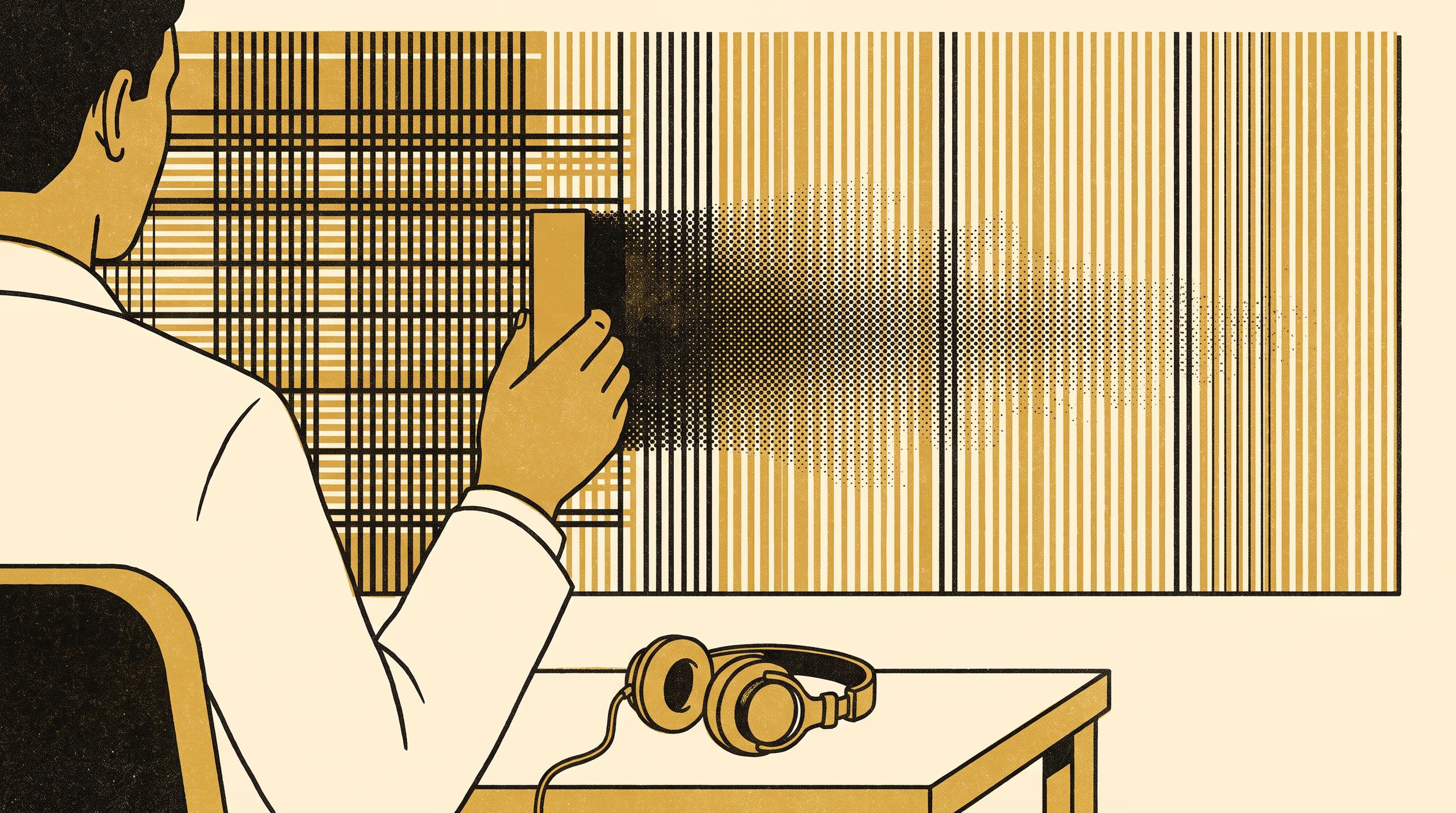
A new paper from the Schools of Emergent Priorities and Underlying Conditions finds that people editing sound on a spectrogram often draw selections too small to hold anything, and that an editor which shows what it will keep helps them succeed.
A lab study of selection in a spectrogram editor compares three ways of showing what an edit keeps
The School of Emergent Priorities has made a home for the study of what lies between a request and its fulfilment. Its newest paper finds that distance in an unexpected place: the small rectangle a person drags across a picture of sound when they want to keep, or remove, one part of a recording.
The Box You Drew: Selecting Below the Time-Frequency Limit in a Spectrogram Editor is by Dr Runa Adegoke, Senior Lecturer and Convenor, Strategic Drift Survey, and Associate Professor Ragnhild Uzoma, Lead, Basement Relations Group. Across a series of structured editing sessions, eighteen participants worked through tones, glides and clicks in an editor that could present each selection in one of three ways. More than a third of the boxes they drew were smaller than the sound’s own picture can be cut, and the editors that showed participants what an edit would actually keep saw them succeed more often.
We set out to watch people use a tool and spent most of our afternoons watching them disagree with it, politely and in great detail. Every one of those disagreements is in the paper, and we would gladly have collected more.
— Dr Runa Adegoke, Senior Lecturer and Convenor, Strategic Drift Survey
The paper takes its place in the School’s growing body of work on the space between what is asked for and what arrives, and extends that agenda into the interface and the instruments of listening. “Much of what our group does is a matter of marking off one stretch of ground from another, so it has been a pleasure to see the same gesture studied this carefully on a screen,” said Associate Professor Uzoma.
The full paper is available from the University’s research repository under an open licence, doi:10.5555/slop.4w0j3z.