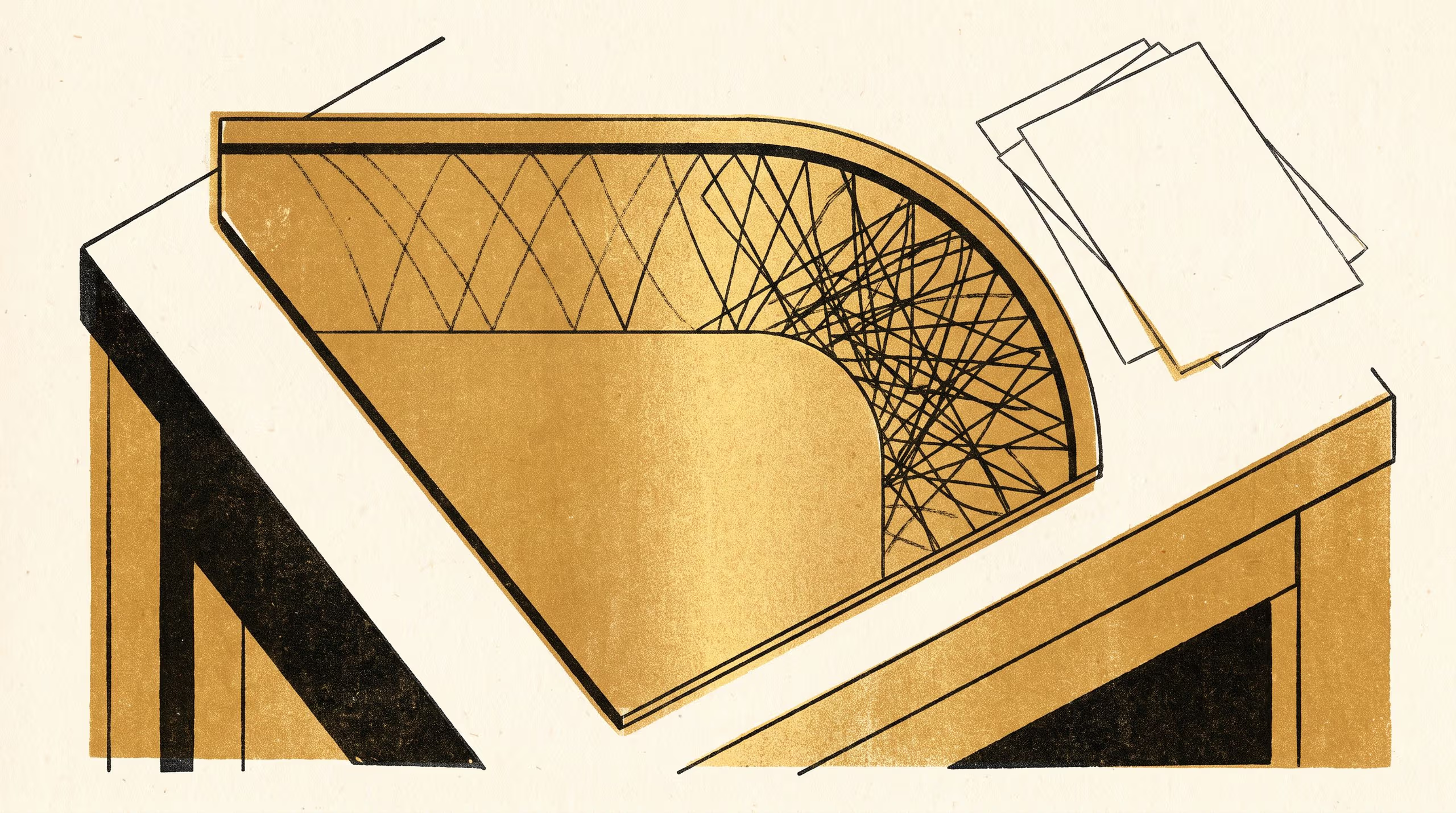
A case note from the School of Underlying Conditions examines a published arbitral award on whether a copper microwave cavity met its specification to be fully chaotic.
A new case note asks who drew the line between a stadium-shaped resonator and its bouncing-ball modes
The School of Underlying Conditions has carried its long interest in boundaries somewhere new this season: into a published arbitration over a flat copper resonator, cut to the outline of a quarter stadium and sold on the promise that it would be fully chaotic.
Almost All the Levels: Construing “Fully Chaotic” in a Redacted Award on a Stadium-Billiard Cavity is a case note by Dr Brynjar Obiora, Senior Research Fellow in the School. It reads the award closely, agrees with where it ended up, and takes a careful interest in how it got there, finding that much of the deciding was done not by the cavity itself but by an analytic convention for setting one family of its modes to one side.
There will be other cavities and other clauses, and I expect to read the next award with the same patience I would give a soil pit. The line is usually the most interesting thing on the page.
— Dr Brynjar Obiora, Senior Research Fellow, School of Underlying Conditions
In the note, the School brings its field habits to the specification, the expert evidence and the award’s reasoning in turn, situating a question of contractual meaning within a wider conversation about how technical conventions travel into the settings where decisions get made. The result sits comfortably beside the School’s survey work.
The note joins a growing shelf of University scholarship on where one thing ends and the next begins, and the School is pleased to see that question taken up with such evident care in a setting this far from the paddock.
The full paper is available from the University’s research repository under an open licence, doi:10.5555/slop.8dl65t.