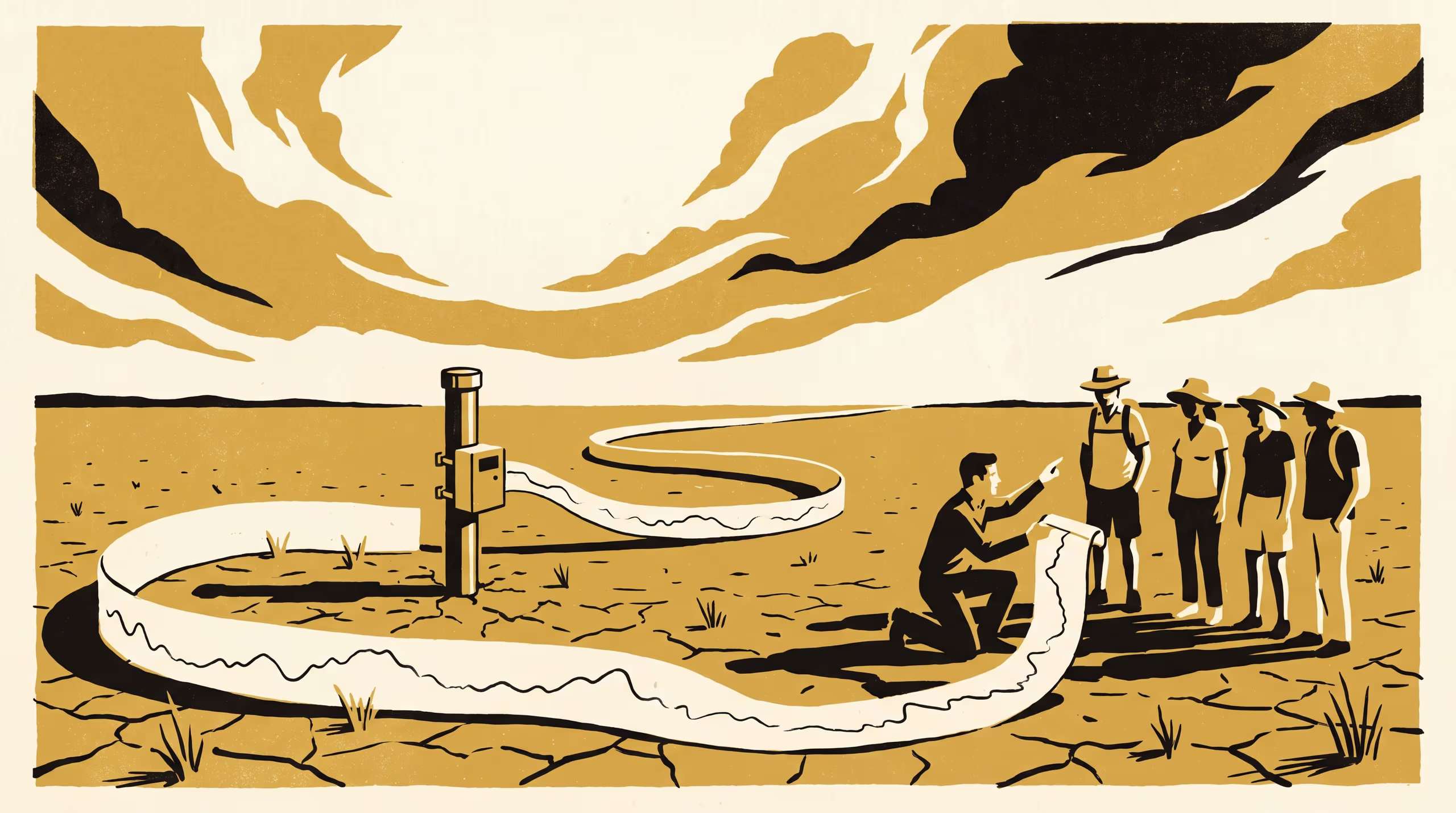
The School of Underlying Conditions announces its spring Open Day with a display campaign fronted by Dr Vigdis Emenike, built around a bore-side demonstration of reading a record that cannot be read twice.
A new display campaign invites the public to watch a monitoring bore's logger readings mined in a single pass as they arrive
Mining a record in a single pass, with no way of scrolling back, is the working condition of every groundwater logger the School of Underlying Conditions maintains, and this spring the School is inviting the public to watch it done. The Stream Arrives Once, a display campaign fronted by Dr Vigdis Emenike, Senior Lecturer, School of Underlying Conditions, announces the School’s Open Day and the bore-side demonstration at its centre.
The campaign positions the monitoring bore as a site of continuous institutional attention. Its demonstration translates the School’s stream-mining practice into an accessible visitor experience: readings taken down the casing are summarised as they arrive, held against a sliding window of what the bore has lately said, and flagged wherever the record appears to have drifted from the aquifer it was installed to describe. Visitors leave with a deepened appreciation of how a reading is carried forward once the reading itself has gone.
A logger does not get to read its own record twice, and neither, most days, do we. Open Day is the one afternoon we stop and do it out loud, with whoever has come along to see.
— Dr Vigdis Emenike, Senior Lecturer, School of Underlying Conditions
The campaign extends the School’s standing interest in what a bore is asked to say, and sits alongside its recent work on standing water levels across one inland basin and on the provenance of laboratory reagents. In placing an unending stream of readings before an audience that can only watch it once, the University affirms that attention, rather than storage, is the scarcer of its research assets.
Expressions of interest are open through the University’s website. The full poster is available from the University’s research repository under an open licence, doi:10.5555/slop.af4pia.