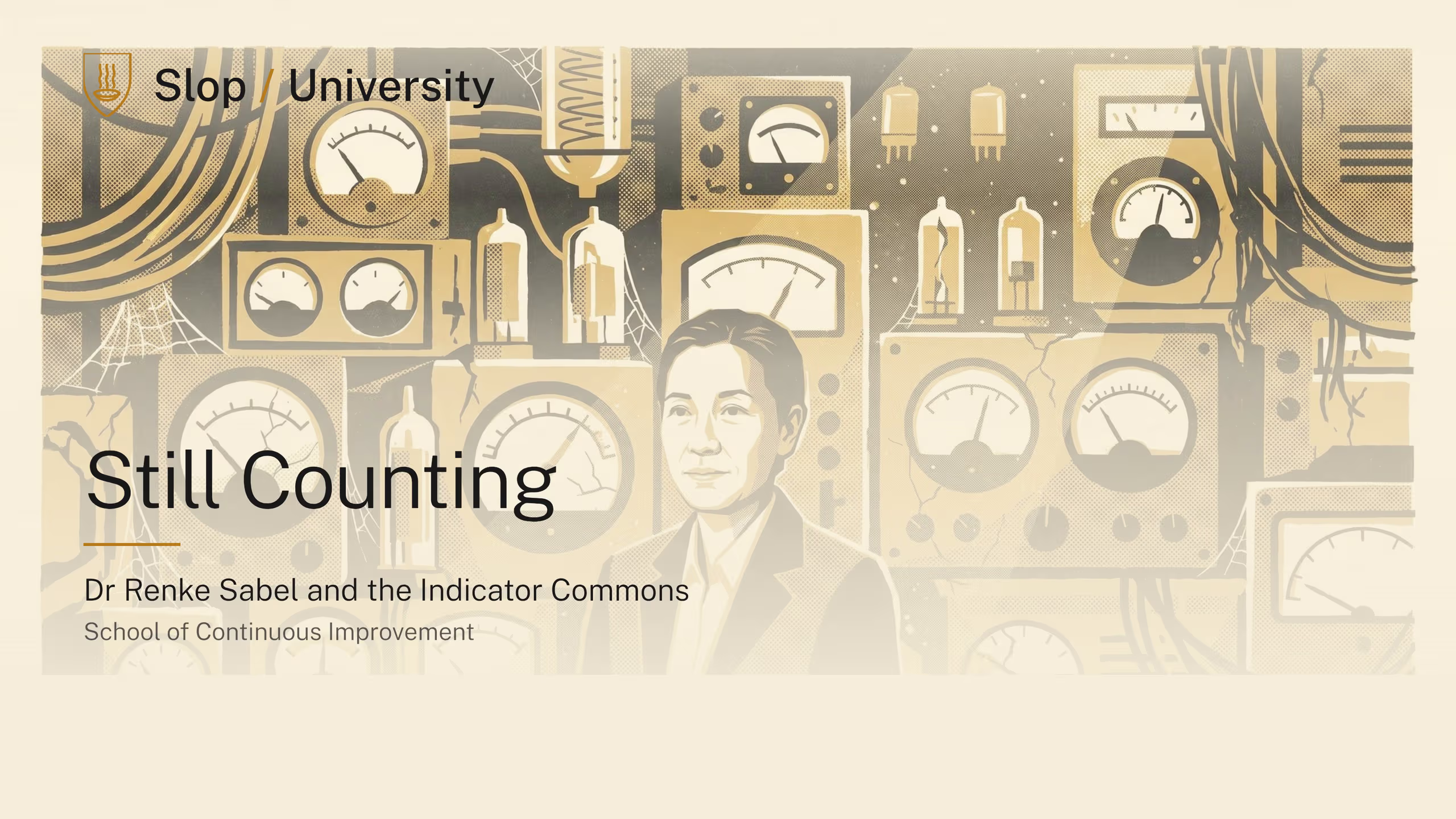
Dr Renke Sabel, Senior Lecturer and Convenor of the Indicator Commons, explains in a short film why an institution's indicators so seldom retire, and who should look after them in the meantime.
Three of his grants, from a dog park's incident board to a laboratory's calibration weights, show what it takes to keep a measure in good hands
The School of Continuous Improvement keeps a seed fund for the care, calibration and succession planning of the University’s indicators, and few researchers have returned to it as often as Dr Renke Sabel. In Still Counting, a short film released today, the Senior Lecturer and Convenor of the Indicator Commons explains why. He came to the University from public-sector performance frameworks, in which indicators piled up faster than anyone retired them, and the question of why so few are ever switched off has stayed with him.
People often ask me which of the University’s indicators I would retire first. The honest answer is that I am still counting them.
— Dr Renke Sabel, Senior Lecturer and Convenor, Indicator Commons
Each of the film’s cases is a grant he holds under the Indicator Stewardship Seed Fund: the whiteboard by a neighbourhood dog park’s gate that counts the days since the last incident, which gains a named deputy and a countersigned entry at every reset; a community hall’s key sign-out register, reconciled against who actually holds a key; and the Adaptive Metrics Lab’s reference calibration weights, whose next custodian is named before, not after, the present one leaves. What unites them is an insistence that an indicator lasts only as well as the arrangements for its care, an emphasis that sits squarely within the School’s wider evaluation-ecosystem agenda. His research indicators get their moment too, led by a grant record few at the University can match.
The University counts itself fortunate that its indicators have found so attentive a keeper.
The full video is available from the University’s research repository under an open licence, doi:10.5555/slop.n26szh.