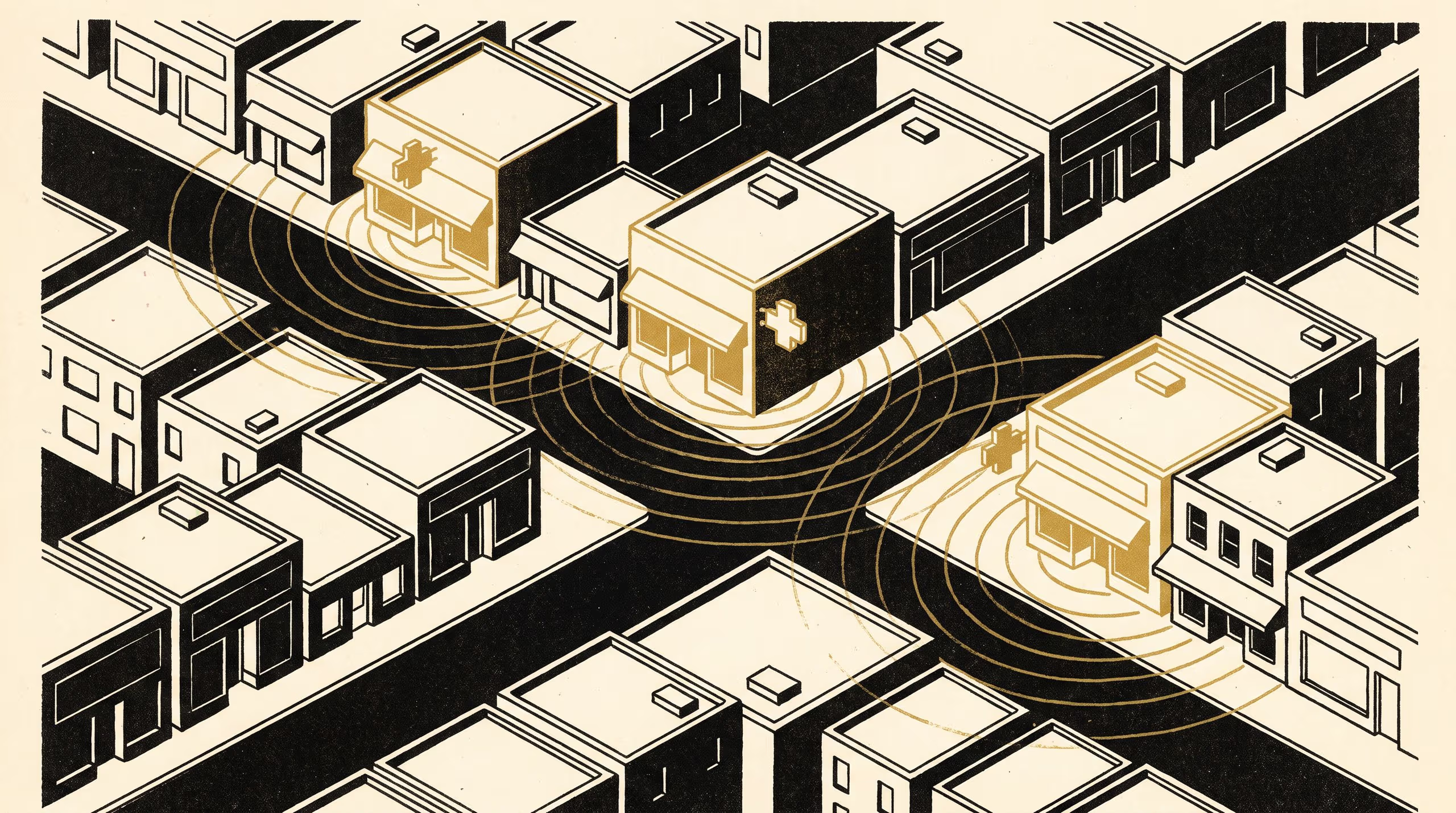
A new research poster from the School of Emergent Priorities brings catchment planning to medicines safety, and finds a city's reports follow its late-trading pharmacies.
A study of one regional city finds reports gather where a pharmacy is still trading, not where its residents live
Where should a city expect to hear that a medicine has disagreed with someone? For the School of Emergent Priorities the answer is a matter of urban form, and Reports Follow the Counter, a research poster by Ms Ylva Onyekwere, Doctoral Candidate, with Dr Petra Umbile, Postdoctoral Fellow, and Dr Anneke Tolan, Senior Research Fellow and Deputy Convenor, Futures in Committee, sets out to show why.
A report is a small journey, made by someone at the end of a long day. It seemed only courteous to ask where those journeys go.
— Ms Ylva Onyekwere, Doctoral Candidate, School of Emergent Priorities
Bringing the toolkit of catchment planning into conversation with the practice of medicines safety, the team placed 2,316 de-identified reports from 31 community pharmacies on the map of one regional city across three years. Three precincts with a counter open after nine at night account for under a third of the city’s dispensing and close to two-thirds of its reports. Elsewhere, living near a pharmacy made no discernible difference; living near one that was still open did.
The University welcomes the poster as an early sign of what becomes possible when a School devoted to how decisions are made turns its attention to how a city’s evenings are laid out.
“It turns out the School keeps late hours too,” said Dr Umbile. “We are glad of the company.”
The full poster is available from the University’s research repository under an open licence, doi:10.5555/slop.slyg8c.