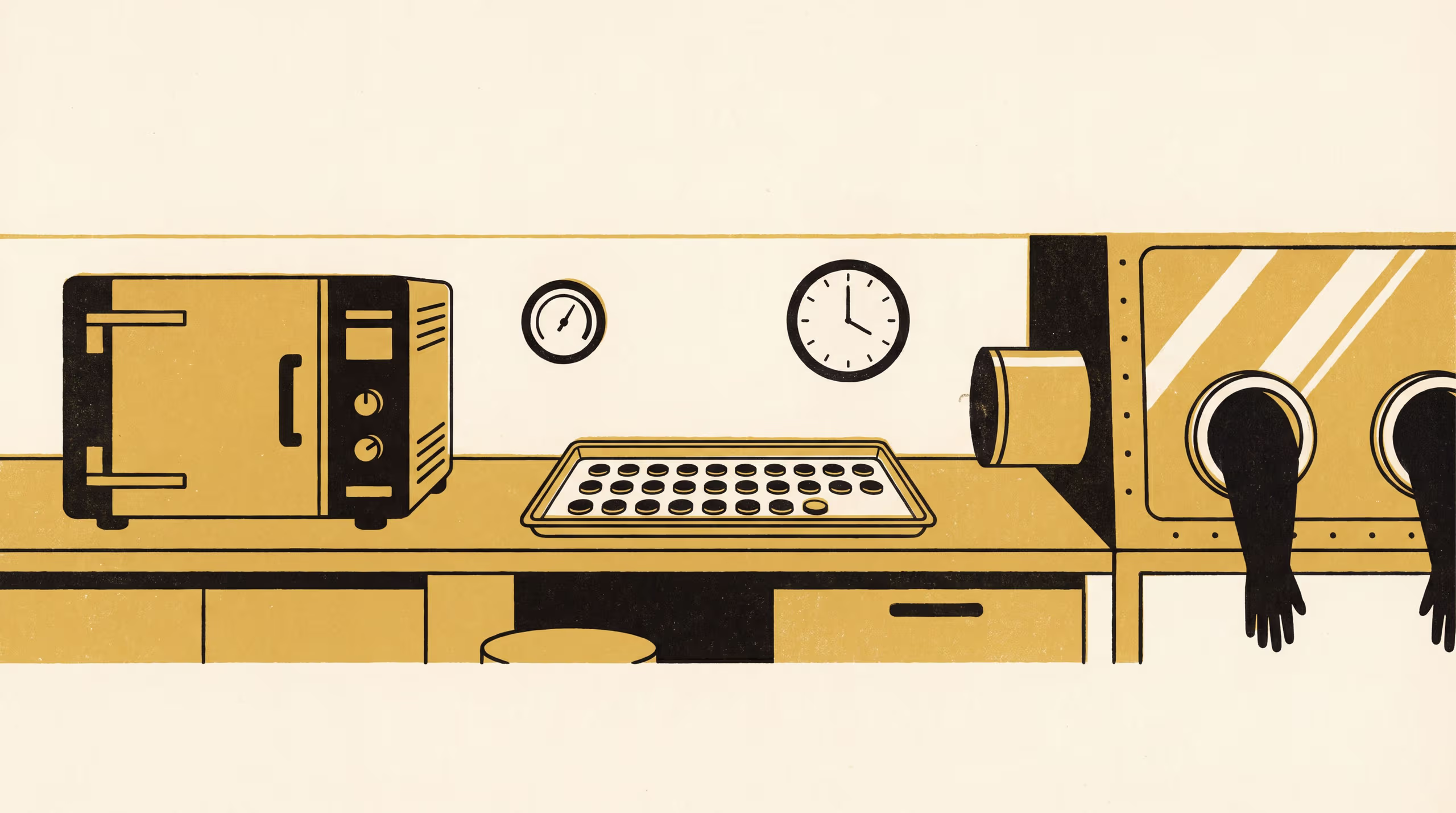
A new research poster from the School of Continuous Improvement follows activated-carbon electrodes across the short walk from vacuum oven to glovebox, and finds that the time they spend waiting stays with them.
A research poster links the hours a dried supercapacitor electrode spends in laboratory air to its capacitance ten thousand cycles later
Two hundred and twenty-four electrode discs, seven waiting times and a semester of humidity readings sit behind The Bench Interval, a new research poster from the School of Continuous Improvement. It turns the School’s attention to the fabrication of supercapacitors, and to a stretch of laboratory time that has rarely been written down.
The poster is led by Ms Signy Okpara, Doctoral Candidate, with Dr Marit Osayande, Lecturer and Convenor, Living Dashboard, and Dr Bram Ntuli, Lecturer and Convenor, Improvement Grand Rounds. The team reports that a dried activated-carbon electrode takes back most of its moisture within six hours of leaving the oven, and that cells built from the longest-waiting discs kept 69 per cent of their capacitance after 10,000 cycles, against 94 per cent for discs carried straight into the glovebox.
We hope the next person to carry a tray across the corridor will do it a little more quickly, and perhaps a little more thoughtfully.
— Ms Signy Okpara, Doctoral Candidate, School of Continuous Improvement
The work aligns materials fabrication with process stewardship, positioning the interval between preparation and assembly as a site of shared responsibility across the research-infrastructure ecosystem. Its recommendations are modest: the interval is now written on the tray label, and reported beside the drying conditions.
“Our thanks go to everyone who shares the laboratory, and who let a semester of trays sit exactly where we left them,” said Dr Osayande.
The poster adds to the School’s growing presence at the laboratory bench, a setting the University increasingly regards as continuous with its broader stewardship of process.
The full poster is available from the University’s research repository under an open licence, doi:10.5555/slop.we210l.