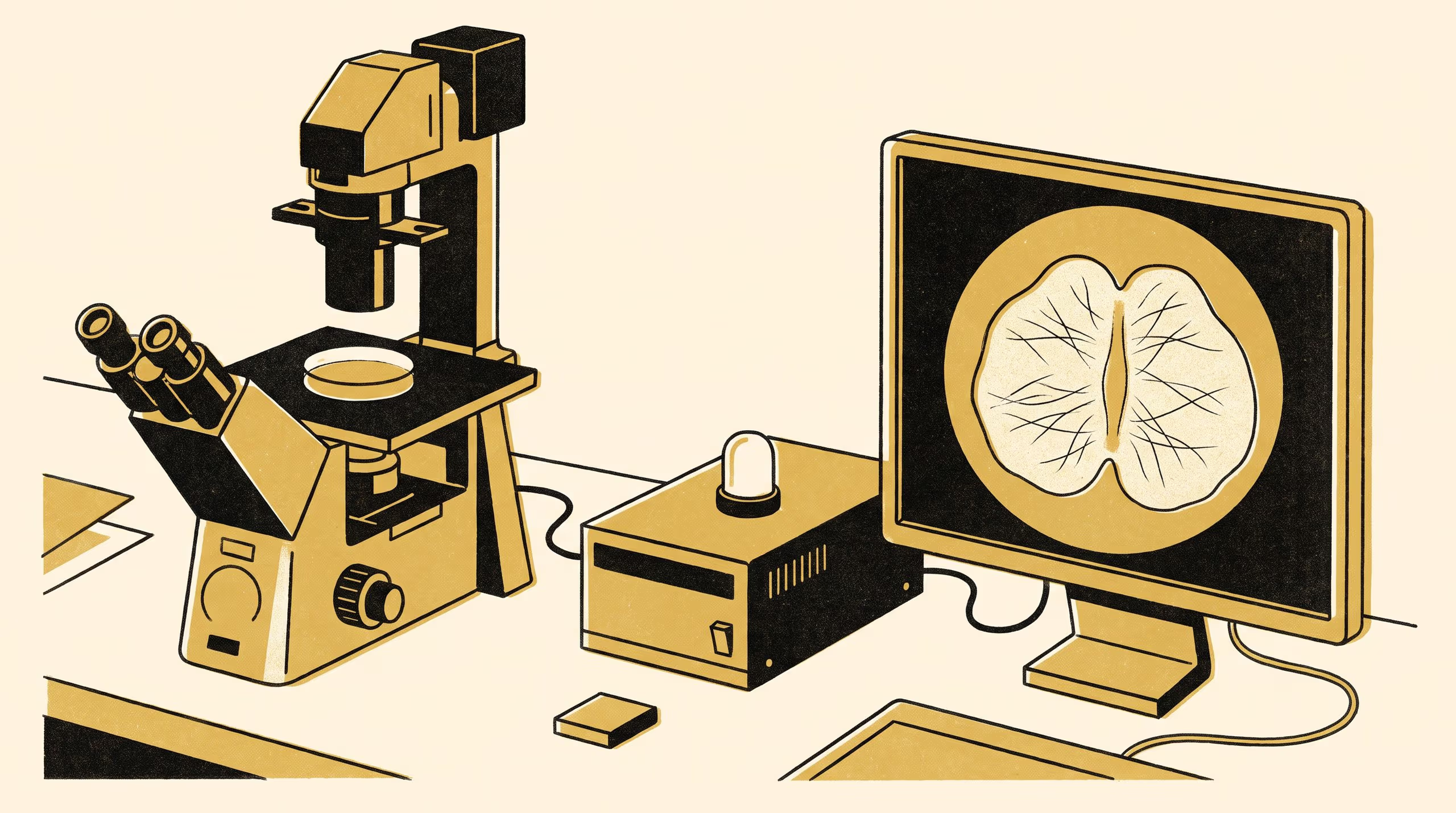
A new research poster from the School of Emergent Priorities asks what later nerve fibres do when the fibres that crossed the midline before them are removed.
Removing the first axons to cross a developing spinal cord slows the ones that follow, but does not stop them
In a dish of embryonic spinal cord, the first nerve fibres to cross the midline can be taken away, and the fibres that come after them will still find their way over. They simply take longer to leave.
That is the central observation of Followers Without Leaders, a new research poster by Ms Hedvig Anyanwu, Doctoral Candidate, with Ms Sunniva Balogun, Doctoral Candidate, and Dr Petra Umbile, Postdoctoral Fellow, all of the School of Emergent Priorities. Across 38 explants and 792 traced followers, the team reports that the earliest arrivals lingered at the midline nearly twice as long as usual, and that the delay eased with each later group, as though the first followers had quietly taken up the lead.
The School spends much of its time on what an organisation does once the people who set its direction have moved on. It has been instructive to spend a year at the microscope watching that question answered patiently, a few hours at a time.
— Ms Hedvig Anyanwu, Doctoral Candidate, School of Emergent Priorities
The project combines precision laser instrumentation, long-run time-lapse imaging and a mixed-effects analytical framework, situating developmental neuroscience within the School’s broader agenda of succession, sequence and continuity.
The University sees in the poster a welcome widening of the School’s reach, from the priorities of institutions to the earliest priorities of a growing nervous system. “What stays with me is how unhurried the recovery was,” said Dr Umbile. “Nothing in the dish appeared to be in any rush to replace anyone.”
The full poster is available from the University’s research repository under an open licence, doi:10.5555/slop.o32uyr.