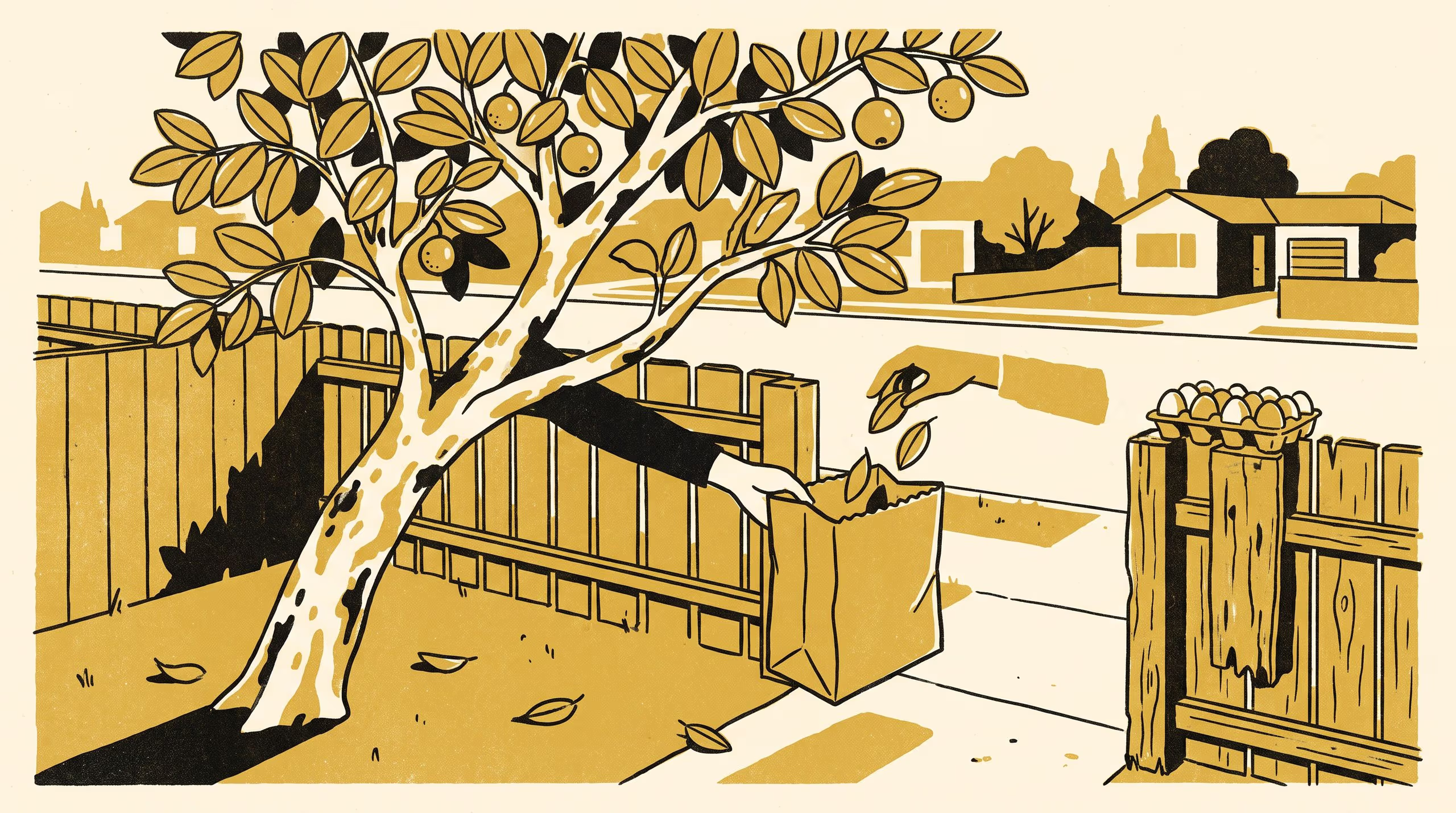
A research poster from the School of Underlying Conditions follows 212 requests for guava leaves across five backyard trees, finding that leaves are asked for, fruit is offered, and the right to pick for oneself is extended slowly.
Fourteen months on one peri-urban street find the ask, not the remedy, doing the neighbourly work
The School of Underlying Conditions has long concerned itself with what sits beneath an ordinary surface. Its newest poster, A Few Leaves, If You Don’t Mind: Asking, Picking and Owing Around Backyard Guava Trees on One Peri-Urban Street, carries that interest out of the ground and up to the front fence.
Dr Vigdis Emenike, Senior Lecturer, leads the work with Dr Anneke Tolan, Senior Research Fellow and Deputy Convenor of Futures in Committee, and Mr Eivind Onwuka, Doctoral Candidate. Together they describe a street on which a few leaves from a neighbour’s tree circulate as a household remedy, and on which the asking matters at least as much as the leaves. Fruit, the team reports, is offered; leaves must be asked for, and the right to reach over and pick them is granted only gradually.
Combining sustained participant observation, walking interviews along the fencelines and picking diaries kept in partnership with tree-holders, the project builds a fine-grained account of reciprocity, permission and regard as they unfold at the scale of a single street.
Five households let us stand at their fences for the better part of fourteen months, and more than once handed us a bag of leaves we had not asked for. The poster is our attempt to return the favour, slowly and in the proper currency.
— Dr Vigdis Emenike, Senior Lecturer, School of Underlying Conditions
“Every request is a small act of governance,” said Dr Tolan. “It has been a privilege to watch one conducted over a fence instead of across a table.”
The University counts the poster among the School’s most neighbourly contributions to date.
The full poster is available from the University’s research repository under an open licence, doi:10.5555/slop.x9vs19.