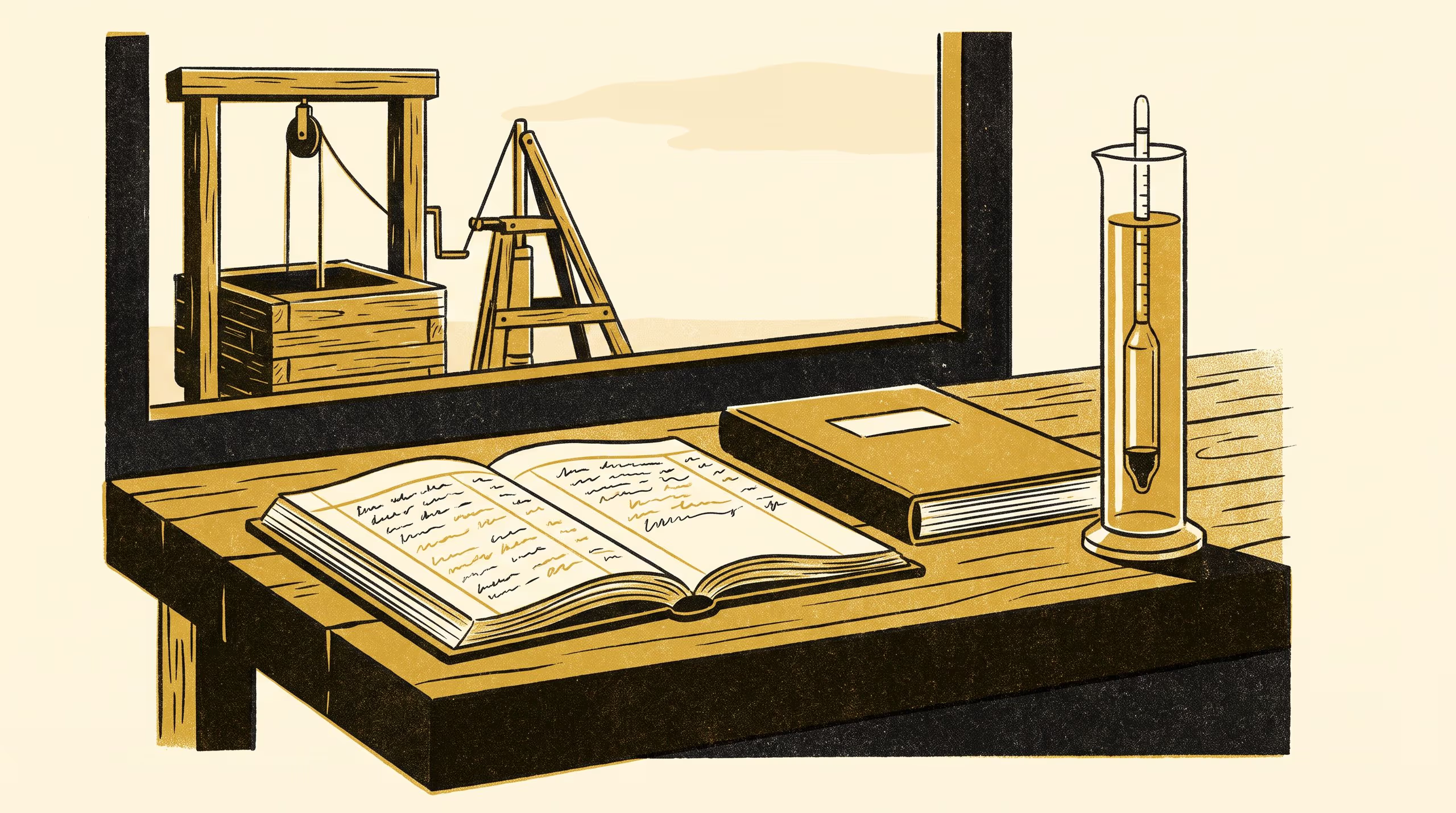
A new paper from the School of Underlying Conditions re-edits the brine-strength record of an old inland well from its surviving copies and a single autograph leaf.
A recension of an inland well journal finds its copies capped what the borer recorded
What does a copy owe its original when the original appears to be wrong? Stronger Than Saturated: The Brine-Strength Entries of an Inland Well Journal, Its Copies, and the Editor’s Chemistry, a new paper by Associate Professor Ragnhild Uzoma, Lead of the Basement Relations Group in the School of Underlying Conditions, takes up that question for the daily journal of a salt works’ deepest brine well.
For generations the well has been read through a printed abstract whose figures never rise above the strength of saturated common salt. Collating five later copies against one leaf in the borer’s own hand, the paper finds that those figures were set by an early copyist who judged the higher readings impossible, and that the office copy kept what the borer actually wrote.
Every archive has a reading somebody once decided could not be right. I am glad this one has been given a second hearing, and I would be surprised if it were the only one waiting.
— Associate Professor Ragnhild Uzoma, Lead, Basement Relations Group, School of Underlying Conditions
The work brings together textual scholarship, the chemistry of natural brines and the School’s long attention to what a written record can say about ground no one has seen, aligning an edition’s apparatus with the assumptions that sit beneath it. The University regards the paper as a fitting expression of the School’s view that the gaps and corrections in a record belong to the record.
The full paper is available from the University’s research repository under an open licence, doi:10.5555/slop.do1vas.